
ERP for Small Manufacturing Businesses: What to Fix Before You Implement New Software
About the Author: Ashley Thomson

Owners often come to me when they’re frustrated with their systems. They’ve outgrown spreadsheets, job folders, and the patchwork of apps that used to be fine when the team was smaller. As a business coach working with manufacturing, fabrication, and trades-based businesses every day, I see the same pattern. The owner decides it’s time for an ERP, but the business isn’t ready for the upgrade. The software gets blamed, but the real issue is that the foundations weren’t strong enough before implementation.
If you’re considering business coaching or business coaching services to prepare your manufacturing operation for an ERP, this guide will help you understand what needs fixing first. ERP for small manufacturing businesses is a powerful step, but only when the groundwork is done properly.
I’m Ashley Thomson, business coach and managing director at Tenfold Business Coaching. My goal is to help you get the return on investment you expect from new systems, without the blowouts, delays, and internal resistance that derail so many ERP projects.
Why ERP for Small Manufacturing Businesses Fails Without Preparation
When I coach owners through ERP readiness, I see the same root causes behind failed or stalled implementations. The business wants the ERP to solve operational issues that should have been fixed long before software entered the picture. The ERP becomes a very expensive band-aid.
Manufacturing and fabrication businesses often struggle with inconsistent processes, tribal knowledge, and job management gaps. In construction trades and custom home building, the challenge is usually workflow discipline and cost control. In commercial maintenance, it’s scheduling accuracy and labour allocation. These issues don’t disappear with software. They get amplified.
Business coaching for manufacturing helps owners fix these operational weaknesses before they become embedded in the ERP. Once they’re embedded, they’re harder and more expensive to unwind.
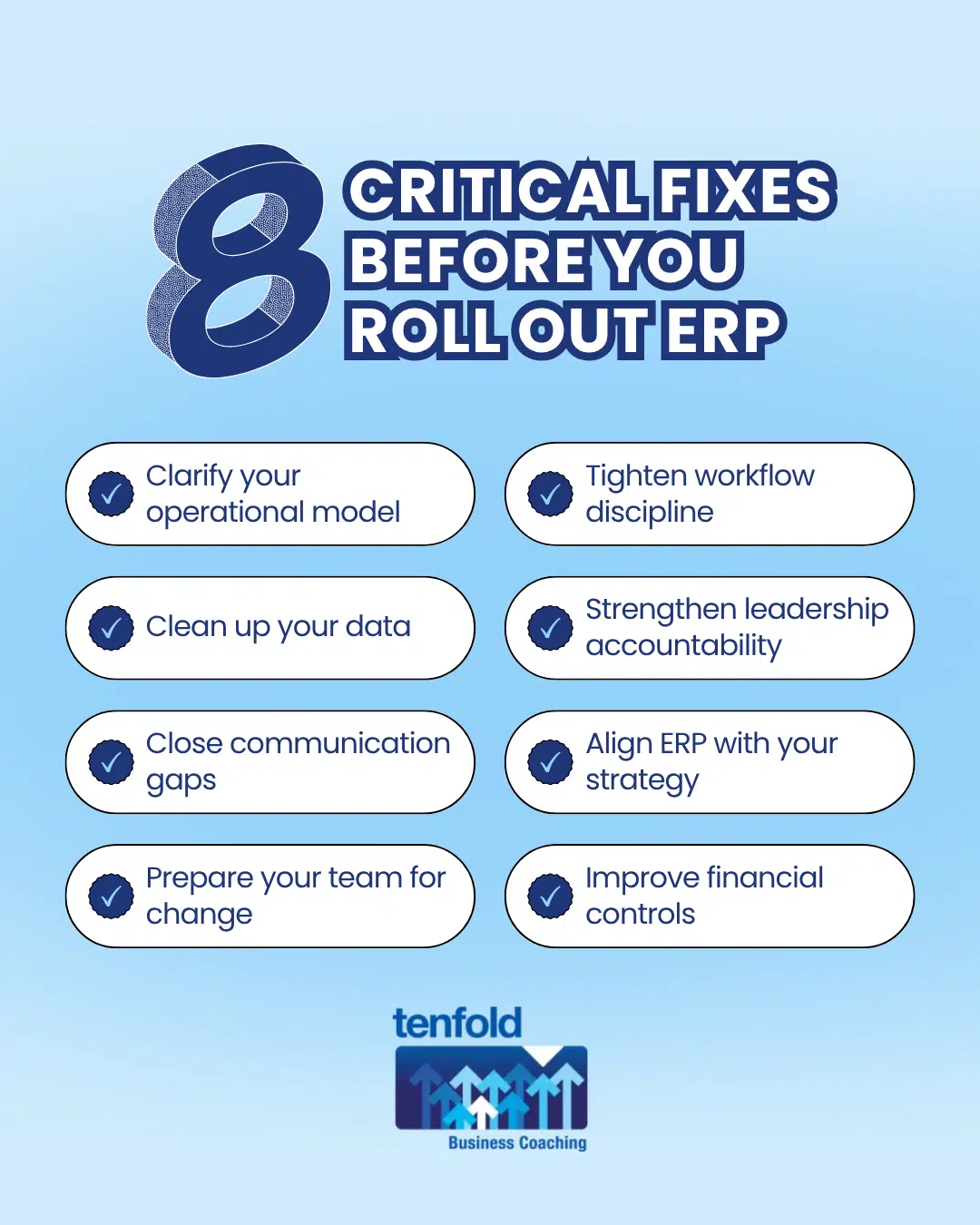
Clarifying Your Operational Model Before ERP Implementation
Before you invest in new software, you need a clear operational model. This is the backbone of your business. It defines how work moves from quote to delivery, how materials are managed, how labour is allocated, and how quality is controlled.
When I coach owners, I often find that their operational model exists only in their head. The team follows habits, not systems. That’s fine when you’re small, but it breaks down once you have multiple crews, multiple machines, or multiple supervisors.
ERP for small manufacturing businesses works best when the operational model is already documented, stable, and followed. If your team doesn’t follow your current processes, they won’t follow the ERP processes either.
Fixing Workflow Discipline Before You Add Technology
Workflow discipline is the biggest predictor of ERP success. If your team doesn’t complete job sheets, update production notes, or follow scheduling rules now, they won’t magically start doing it because the software tells them to.
In fabrication shops, I often see jobs move through the workshop without proper tracking. In trades businesses, I see technicians skipping steps because they’re trying to get to the next job. In manufacturing, I see supervisors adjusting schedules on the fly without communicating changes.
Business coaching services help owners tighten workflow discipline before ERP implementation. You need your team to follow a consistent rhythm. Once that rhythm is in place, the ERP can automate and optimise it.
Cleaning Up Your Data Before You Migrate Anything
ERP systems rely on clean data. If your current data is messy, inconsistent, or incomplete, your ERP will be messy, inconsistent, and incomplete too.
When I coach manufacturing businesses, I usually find issues like outdated BOMs, inconsistent part naming, inaccurate stock counts, and job costing that doesn’t reflect real labour or materials. In trades businesses, I see pricing inconsistencies, variations not captured properly, and job notes that are too vague to be useful.
Data cleanup isn’t glamorous, but it’s essential. You need accurate stock levels, consistent naming conventions, reliable job costing, and up-to-date customer information. Without this, your ERP becomes a liability instead of an asset.
Strengthening Leadership Accountability Before ERP Rollout
ERP implementation isn’t a software project. It’s a leadership project. Your supervisors, foremen, and team leaders need to be aligned, accountable, and able to drive change.
When I coach owners, I often find that their leadership team is reactive rather than proactive. They’re good at solving problems but not good at preventing them. ERP requires prevention. It requires leaders who follow systems, enforce standards, and communicate clearly.
If your leadership team isn’t ready, your ERP won’t be ready either. You need leaders who can champion the new system, not resist it.
Fixing Communication Gaps Before You Introduce New Tools
ERP systems depend on clear communication. If your team currently relies on verbal updates, last-minute changes, or assumptions, the ERP will expose those gaps.
In manufacturing, communication gaps show up as rework, delays, and material shortages. In trades, they show up as missed appointments, incorrect job notes, and variations that aren’t captured. In fabrication, they show up as jobs that move through the workshop without proper documentation.
Business coaching helps owners build communication habits that support ERP success. You need structured meetings, clear handovers, and consistent reporting. Once those habits are in place, the ERP can enhance them.
Aligning Your Business Strategy With Your ERP Goals
ERP for small manufacturing businesses isn’t just about operations. It’s about strategy. You need to know what you want the ERP to achieve.
When I coach owners, I ask questions like:
What do you want to scale?
What do you want to control?
What do you want to automate?
What do you want to measure?
If you don’t have clear strategic goals, your ERP becomes a generic system instead of a strategic tool. You need clarity on production capacity, margin targets, labour efficiency, and customer experience. Once your strategy is clear, the ERP can support it.
Preparing Your Team for Change Before You Start Implementation
ERP implementation is a cultural shift. Your team needs to understand why the change is happening and how it benefits them.
When I coach manufacturing teams, I focus on building buy-in. People need to see that the ERP will make their work easier, not harder. They need to trust that the business is investing in systems because it’s investing in them.
If your team isn’t ready for change, they’ll resist the ERP. Resistance slows implementation, increases costs, and reduces adoption.
Building Strong Financial Controls Before ERP Integration
ERP systems improve financial visibility, but only if your financial controls are already strong. If your costing is inconsistent, your margins unclear, or your reporting delayed, the ERP won’t fix those issues. It will highlight them.
Business coaching for manufacturing often starts with financial discipline. You need accurate job costing, reliable forecasting, and clear margin reporting. Once those controls are in place, the ERP can automate and enhance them.
Why Business Coaching Matters Before ERP Implementation
Owners often underestimate the preparation required for ERP success. They assume the software will fix operational issues, but the software only magnifies what already exists.
Business coaching services help owners build the foundations that ERP systems rely on. Coaching ensures your processes are stable, your data is clean, your leadership team is aligned, and your strategy is clear. With those foundations in place, ERP becomes a growth tool instead of a frustration.
The Real ROI of ERP Comes From What You Fix First
ERP for small manufacturing businesses delivers real value when the business is ready. The ROI doesn’t come from the software. It comes from the preparation.
When I coach owners through ERP readiness, I focus on building a business that can scale, automate, and improve margins. The ERP then becomes the engine that drives that growth.
If you invest in the foundations first, your ERP will deliver the efficiency, visibility, and control you’re expecting. If you skip the foundations, the ERP becomes another operational headache.
Your Next Step
If you’re considering ERP and want to make sure your business is ready, the next step is a conversation. As a business coach working with manufacturing, trades, and fabrication businesses across Australia, I can help you assess your readiness and build the foundations that ensure a successful implementation. Reach out to Tenfold Business Coaching and let’s talk about preparing your business for the upgrade.
Frequently Asked Questions (FAQs)
What risks do small manufacturing businesses face if they implement ERP before fixing operational issues?
The main risk is that the ERP locks in flawed processes. Once those processes are embedded in the system, they become harder and more expensive to correct, and the business loses efficiency instead of gaining it.
When is the right time for a small manufacturing business to start an ERP project?
The right time is when your processes are documented, your team follows them consistently, your data is accurate, and your leadership group is capable of driving change without relying on software to fix behavioural gaps.
How does early preparation affect the total cost of ERP implementation?
Preparation reduces cost by preventing rework, avoiding unnecessary customisation, shortening implementation timelines, and reducing the amount of external support required during rollout.
What internal systems should be fixed before selecting or implementing ERP software?
You should stabilise workflow discipline, clean up operational and financial data, strengthen communication habits, align leadership accountability, and ensure your operational model is clearly defined and consistently followed.
How does Tenfold Business Coaching support owners preparing for ERP?
I work with owners to build operational discipline, clean up data, align leadership, strengthen financial controls, and ensure the business is structurally ready for ERP so the software delivers the efficiency and margin improvements you’re investing in.
If this is the problem you’re wrestling with, that’s literally what we coach on. Speak with Tania on 03 9813 8777 or book a strategy call.


