
Builder Risk Checklist for Trade Subcontractors: How to Spot Slow Payers, Bad Debts and High-Risk Building Jobs Before You Start Work
About the Author: Ashley Thomson

As a business coach working with established trade and construction businesses across Australia, I spend a lot of time helping owners strengthen their commercial systems. One of the most valuable capabilities a subcontractor can build is the ability to assess builder risk before committing to a project. When your team knows how to identify slow payers, high‑risk builders, and unstable projects early, you protect your cash flow, reduce stress, and avoid preventable disputes.
This guide is designed to help you and your team recognise the warning signs before you start work. When your project managers, estimators, and leading hands understand how to assess builder risk, they make better decisions and protect the business commercially. A strong risk‑assessment process gives you confidence, improves margins, and supports steady operations.
Why Builder Risk Assessment Matters for Subcontractors
Subcontractors in electrical, plumbing, HVAC, concrete, landscaping, solar, fabrication, and commercial maintenance often carry significant financial exposure. You supply labour, materials, and time long before you receive payment. You rely on builders to honour agreements, approve variations, and pay on time. If a builder is slow to pay or financially unstable, your business feels the impact immediately.
Builder risk assessment helps you identify issues early. It gives you a structured way to evaluate whether a project is commercially safe, whether the builder is reliable, and whether the job is worth taking on. In my business coaching work with tradies, I see the difference clearly. Businesses that assess builder risk consistently have fewer disputes, stronger cash flow, and more predictable workloads. Businesses that skip this step often find themselves chasing payments, absorbing cost increases, or dealing with preventable problems.
The Warning Signs of a High‑Risk Builder
There are several indicators that a builder may pose a payment risk. When your team knows how to recognise these signs, they can raise concerns early and help you make informed decisions.
One of the most common warning signs is inconsistent communication. If a builder is slow to respond during the quoting stage, provides vague instructions, or avoids discussing contract terms, it often reflects how they’ll behave during the project.
Another warning sign is unusual pressure around pricing. If a builder pushes aggressively for discounts, shortens deadlines, or avoids discussing variations, it may indicate cash flow issues or a pattern of squeezing subcontractors.
A third warning sign is a history of disputes with other subcontractors. If you hear consistent feedback about delayed payments, withheld retention, or difficult contract terms, it’s worth taking seriously.
How to Assess Builder Payment Behaviour
Payment behaviour is one of the strongest indicators of builder reliability. Your team should know how to assess this before committing to a project.
Start by reviewing the builder’s payment history with your business. If they’ve been slow to pay in the past, it’s unlikely to improve without stronger contract terms or clearer expectations.
Speak with other subcontractors who’ve recently worked with the builder. Ask about payment timelines, variation approvals, and communication. Subcontractors are usually honest about their experiences because they understand the impact of slow payment.
Finally, look at the builder’s administrative systems. Builders with organised processes, clear claim dates, and consistent communication are usually more reliable. Builders who rely on ad‑hoc processes or last‑minute approvals often create delays.
How to Identify Financial Instability in Builders
Financial instability is one of the biggest risks for subcontractors. When a builder is under pressure, payment delays become more frequent, variations become harder to approve, and disputes become more common.
There are several signs that a builder may be experiencing financial strain. Frequent staff turnover, delayed project starts, and sudden changes in scope can all indicate internal pressure. If a builder is taking on too many projects at once or undercutting market rates, it may signal cash flow issues.
Your team should also pay attention to how the builder manages deposits, progress claims, and retention. If they’re slow to release retention or consistently delay claim approvals, it may reflect deeper financial problems.
How to Assess Project‑Level Risk
Not all risk comes from the builder. Some projects carry higher commercial risk due to design complexity, unclear scope, or unrealistic timelines. Your team needs to understand how to assess project‑level risk before committing to the job so they can protect margins and avoid preventable issues.
Reviewing the Project Documentation
The first stage is reviewing the project documentation. If drawings are incomplete, specifications are unclear, or the scope is still evolving, the project may require additional variations and entail greater commercial risk. Early gaps in documentation often lead to rework, delays, and disagreements about what was included in the original price. When your team knows how to identify these gaps, they can raise questions early and ensure the quote reflects the true scope of work.
Assessing the Project Timeline
The second stage is assessing the project timeline. If the schedule is compressed or doesn’t allow for delays, your team may face pressure that impacts quality, safety, or profitability. Tight timelines often lead to rushed decisions, out‑of‑sequence work, and increased labour costs. When your team understands how to evaluate the schedule, they can identify whether the timeline is achievable and what adjustments may be needed to protect the business.
Understanding the Project’s Funding Structure
The third stage is understanding the project’s funding structure. Projects with private funding, staged financing, or multiple stakeholders may carry more risk than government‑funded or institutional projects. Funding uncertainty can lead to delayed payments, slowed progress, or sudden changes in scope. When your team knows how to assess the financial structure behind the project, they can identify potential risks early and help you decide whether the job is commercially safe.
How to Use Contract Terms to Reduce Builder Risk
Strong contract terms help balance builder risk. When your contract terms are clear and aligned with your internal systems, your team can protect the business commercially.
Payment terms should outline claim dates, approval timelines, and consequences for late payment. Variation clauses should clarify how changes are instructed, documented, and approved. Price adjustment clauses should protect you from material cost increases. Time extension clauses should protect you from delays outside your control.
When your team understands these clauses, they can apply them consistently and reduce the impact of builder risk.
How to Strengthen Your Internal Risk‑Assessment Systems
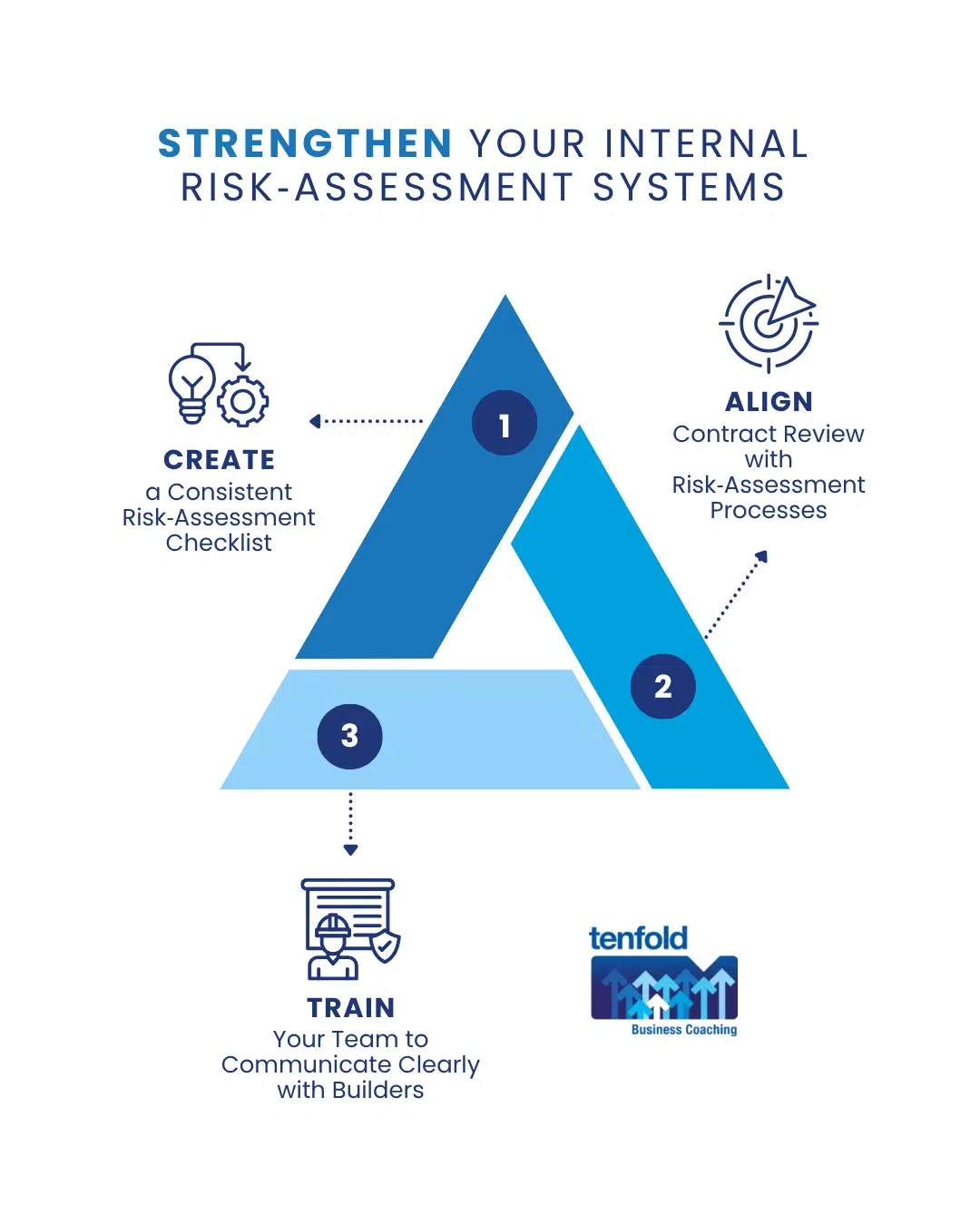
Builder risk assessment becomes far more effective when your internal systems support it. Your team needs a clear, repeatable process for evaluating builders, reviewing contract terms, and identifying red flags before you commit to a project. When these systems are consistent, your business becomes more resilient, and your team can make informed decisions without relying on you for every commercial call.
Creating a Consistent Risk‑Assessment Checklist
The first stage is creating a consistent risk‑assessment checklist that your team can follow every time they price or review a job. This checklist should guide them through the key areas of builder behaviour, project documentation, payment history, and contract terms. Your team needs to know what to look for, what questions to ask, and when to raise concerns. A structured checklist helps them identify patterns early, such as slow payment behaviour, unclear scope, or unrealistic timelines. When your team uses the same checklist across all projects, you get a clearer picture of which builders are reliable and which projects carry higher commercial exposure.
Aligning Contract Review with Risk‑Assessment Processes
The second stage is aligning your contract review process with your risk‑assessment process. If a builder presents several red flags, your contract terms need to be stronger to protect your position. This alignment ensures your team doesn’t treat risk assessment and contract review as separate tasks. Instead, they become part of the same commercial process. For example, if a builder has a history of slow payments, your payment terms need to be tighter. If the project scope is unclear, your variation clause needs to be reinforced. When your internal systems reflect the level of risk, your team can manage projects more confidently and avoid preventable disputes.
Training Your Team to Communicate Clearly with Builders
The third stage is training your team to communicate clearly and professionally with builders. When your people understand the commercial risks, they can have confident conversations about payment terms, variations, timelines, and documentation. Clear communication helps prevent misunderstandings and sets expectations early. It also reduces the pressure on you as the owner because your team can handle commercial discussions without escalating everything back to you. When your project managers and estimators can speak to the contract and the risks with confidence, they protect your position and strengthen your relationships with builders.
Building Capability in Your Team Through Business Coaching
Owners often come to me because they want their team to take on more commercial responsibility. They don’t want to be the only person who understands builder risk, contract terms, or payment processes. They want their project managers, estimators, and leading hands to operate with commercial awareness.
Business coaching services help your team build that capability. When your people understand how to assess builder risk, they make better decisions, protect your margins, and reduce exposure. They also communicate more effectively with builders because they understand the commercial framework behind the work.
The Commercial Benefits of Assessing Builder Risk Properly
When subcontractors assess builder risk consistently, the commercial benefits are clear. Payment becomes more predictable. Disputes are reduced. Margins improve. Your team operates with confidence and clarity.
When builder risk is ignored or assessed inconsistently, the opposite happens. Payment delays increase. Variations become harder to manage. Projects become more stressful. Your business carries unnecessary risk.
Treating builder risk assessment as part of your commercial toolkit helps you build a stronger, more resilient business.
Preparing Your Business for Better Risk Management
If you want to improve how your business manages builder risk, start by reviewing your current processes. Identify which risks you’ve faced in the past and what caused them. Train your team to recognise the warning signs. Align your contract terms with your risk‑assessment process.
Once these foundations are in place, risk management becomes far easier. You’ll have the systems, capabilities, and confidence to protect your business effectively.
Next Steps for Owners Considering Coaching
If you’re investing in coaching for your team, this is an area that delivers strong commercial returns. When your people understand how to assess builder risk and protect the business, your operations become more stable and more profitable.
At Tenfold, we coach your team to operate with the discipline and structure that established businesses need. If you want your project managers, estimators, or leading hands to step up commercially, this is the right time to start.
Frequently Asked Questions (FAQs)
What’s the risk of working with a high‑risk builder?
You may face delayed payments, unclear variations, or increased financial exposure that impacts your cash flow.
When should subcontractors assess builder risk?
Risk assessment should happen before quoting, signing the contract, and starting work.
What investment is involved in improving risk‑assessment processes?
The main investment is in training and systems. Strong risk‑assessment processes usually deliver significant financial returns.
What internal systems support better builder‑risk management?
Clear documentation, consistent contract reviews, structured communication, and a reliable risk‑assessment checklist all support strong risk management.
How does Tenfold Business Coaching help subcontractors assess builder risk?
We train your team to identify red flags, understand commercial risk, and apply structured processes that protect your business.
If this is the problem you’re wrestling with, that’s literally what we coach on. Speak with Tania on 03 9813 8777 or book a strategy call.


