
How Manufacturing and Fabrication Businesses Can Identify Their Most Profitable Work
About the Author: Ashley Thomson

As a business coach working with owners in manufacturing and fabrication, I see a consistent pattern across the sector. The businesses that grow reliably and stay profitable are the ones that know exactly which work makes them money and which work quietly erodes margin. When owners invest in business coaching for manufacturing, their managers learn how to analyse jobs properly, understand cost drivers and make decisions that lift gross profit. That capability becomes a competitive advantage, especially in environments where labour, materials and lead times are constantly shifting.
Manufacturing and fabrication businesses don’t succeed by being busy. They succeed by being busy with the right work. The challenge is that most owners don’t have clear visibility of which jobs, product lines or client types deliver the strongest return. They rely on gut feel or anecdotal feedback from the workshop floor. In a business with multiple processes, variable labour inputs and complex material costs, gut feel isn’t enough. You need data, discipline and managers who understand how to interpret the numbers. That’s where business coaching services make a measurable difference.
Why profitable work is not always obvious
In manufacturing and fabrication, the most profitable work is rarely the biggest job or the most impressive project. It’s usually the work that runs smoothly, uses predictable labour, has minimal rework and fits your team’s strengths. As part of business coaching services, I help owners break down their workflow so they can see where profit is created and where it disappears.
A fabrication shop might assume large structural jobs are their most profitable because the invoices are big. But once you factor in overtime, delays, rework, material handling and project management time, those jobs often deliver lower margins than smaller, repeatable work. A manufacturer might assume custom orders are high-value, but customisation often introduces complexity that slows production and increases labour costs. Without proper analysis, it’s easy to misjudge which work is actually driving profit.
Managers often tell me they were surprised when they saw the real numbers. Jobs they thought were strong performers turned out to be barely breaking even. Jobs they considered low priority were actually delivering the highest margin per labour hour. Once you see the truth, you can make better decisions about where to focus your resources.
Understanding the true cost of production
The first step in identifying profitable work is understanding the true cost of production. Most manufacturing and fabrication businesses underestimate labour time, overestimate efficiency and fail to capture indirect costs. When I coach managers, I teach them how to track labour accurately, measure productivity and identify bottlenecks.
If your team spends too much time setting up machines, adjusting jigs or waiting for materials, your labour cost increases even if the job looks profitable on paper. If your supervisors don’t record rework time, you lose visibility of where quality issues are costing you money. Business coaching for manufacturing helps managers develop the discipline to consistently track these details. Once you have accurate data, profitable work becomes much easier to identify.
Owners often assume their labour productivity is stable, but once they start measuring it properly, they see significant variation between job types. Some jobs flow smoothly through the workshop. Others create friction at every stage. That friction costs money, even if the invoice value looks attractive.
Analysing job profitability with real numbers
Job profitability analysis is one of the most valuable capabilities a manufacturing or fabrication manager can develop. It’s also one of the most underutilised. Many owners review profitability only at a high level, focusing on monthly financials rather than job-level performance. That approach hides the variation between different types of work.
When I work with owners, we build a simple but powerful job review process. Managers learn how to compare estimated labour to actual labour, assess material usage, review rework and evaluate scheduling efficiency. They also learn how to identify patterns. For example, a fabrication business might discover that stainless work consistently delivers higher margins than mild steel because the team is more efficient with stainless processes. A manufacturer might find that batch runs of fifty units are more profitable than runs of ten because setup time is amortised more effectively.
These insights allow owners to make strategic decisions about which work to prioritise and which work to reduce. When your managers understand how to analyse job profitability, they start making better decisions every day. They quote more accurately, schedule more effectively and manage labour with more discipline.
The role of workflow efficiency in profitability
Workflow efficiency is one of the biggest drivers of profit in manufacturing and fabrication. When your workflow is predictable, your margins stabilise. When your workflow is inconsistent, your margins fluctuate. Business coaching helps managers understand how workflow impacts profitability and how to improve it.
If your team is constantly switching between different product types, materials or machine setups, efficiency drops. If your supervisors don’t plan ahead for material availability, downtime increases. If your workshop layout forces technicians to walk long distances between stations, labour time increases without adding value. These inefficiencies often go unnoticed because they’re part of the daily routine. Coaching helps managers see them clearly and fix them systematically.
Workflow efficiency also impacts morale. When jobs run smoothly, your team feels in control. When jobs constantly stall, your team becomes reactive and stressed. That stress leads to mistakes, rework and lower productivity. Improving workflow efficiency enhances profitability and culture simultaneously.
Identifying profitable clients and industries
Profitability isn’t just about the work itself. It’s also about the clients you serve. Some clients value quality, reliability and turnaround time. Others focus heavily on price. When I coach owners, we analyse client behaviour, payment terms, communication patterns and project complexity.
A fabrication business might find that commercial builders deliver consistent work but push hard on price, reducing margin. Meanwhile, smaller industrial clients might pay higher rates and value reliability, making them more profitable even if the job size is smaller. A manufacturer might discover that one industry segment consistently produces fewer quality issues because the specifications are clearer and the tolerances are more predictable.
Understanding which clients and industries align with your strengths allows you to focus your pipeline on profitable work rather than chasing volume. When your managers understand client profitability, they negotiate better, quote more confidently and manage expectations more effectively.
How quoting accuracy shapes profitability
Quoting is one of the most important levers in manufacturing profitability. If your quoting process is inconsistent or based on outdated assumptions, your margins will fluctuate. Business coaching helps owners tighten their quoting process so that every quote reflects the true cost, true risk, and the standard of work the business delivers.
Many fabrication and manufacturing businesses quote based on historical jobs without reviewing whether those jobs were actually profitable. Others quote based on optimistic labour estimates that don’t reflect real conditions. When your managers learn how to quote accurately, your margins improve immediately.
Accurate quoting also strengthens client relationships. When your pricing is consistent and transparent, clients trust you. They know what to expect, and they understand the value you deliver. That trust becomes a competitive advantage in industries where reliability matters.
The impact of rework on profitability
Rework is one of the highest hidden costs in manufacturing and fabrication. It’s also one of the least measured. When I coach managers, I teach them how to track rework time, identify root causes and implement corrective actions.
Rework often comes from unclear specifications, rushed production, poor communication or inconsistent quality control. When rework isn’t measured, it becomes part of the culture. Technicians fix mistakes quietly, supervisors absorb the cost, and owners never see the impact. Once you start measuring rework, you can reduce it. Reducing rework increases profitability immediately.
Managers who understand the cost of rework make better decisions. They slow down when accuracy matters. They communicate more clearly. They check quality earlier in the process. These behaviours protect margin and improve client satisfaction.
Developing managers who can make commercial decisions
Identifying profitable work isn’t a one-off exercise. It’s an ongoing capability that your managers need to develop. When owners invest in business coaching services for their managers, they build commercial awareness across the business. Managers learn how to interpret job data, understand cost drivers and make decisions that protect margin.
A production manager who understands profitability will schedule work differently. A workshop supervisor who understands labour cost will manage technicians more effectively. A project manager who understands margin will negotiate variations confidently. These commercial skills compound over time, creating a business that consistently delivers profitable work.
Using business coaching to shift your business toward profitable work
Once you know which work is profitable, the next step is shifting your business toward it. This often requires changes in quoting, scheduling, client selection and workflow. Business coaching helps owners implement these changes without disrupting operations.
You might adjust your quoting structure to reflect true labour cost. You might prioritise certain job types in your schedule. You might reduce or eliminate work that consistently produces low margins. You might train your managers to negotiate better terms with clients. These changes create a more stable, profitable business that grows with intention rather than reacting to whatever work comes in.
What to do next
If you want your manufacturing or fabrication business to grow profitably, start by building your managers’ capabilities. They’re the ones who track labour, manage workflow, oversee production and protect margin. When they’re supported through business coaching, your business becomes more predictable, more profitable and easier to scale.
At Tenfold Business Coaching, we specialise in coaching managers in manufacturing and fabrication. If you want clarity on your most profitable work and a team capable of delivering it consistently, now is the right time to invest.
Frequently Asked Questions (FAQs)
What’s the risk of not knowing which work is most profitable?
The risk is running a busy workshop that loses money without realising it. Without job-level visibility, margin erosion goes unnoticed and becomes a long-term problem.
When should I start analysing job profitability?
You should start as soon as your team has consistent workflow and repeatable processes. Early analysis helps you make better decisions about quoting, scheduling and client selection.
How much should I invest in improving profitability analysis?
Investment depends on your size and complexity. Most owners start by coaching their managers to understand job costing, labour tracking and workflow efficiency because those areas deliver immediate returns.
What systems do I need before analysing profitable work?
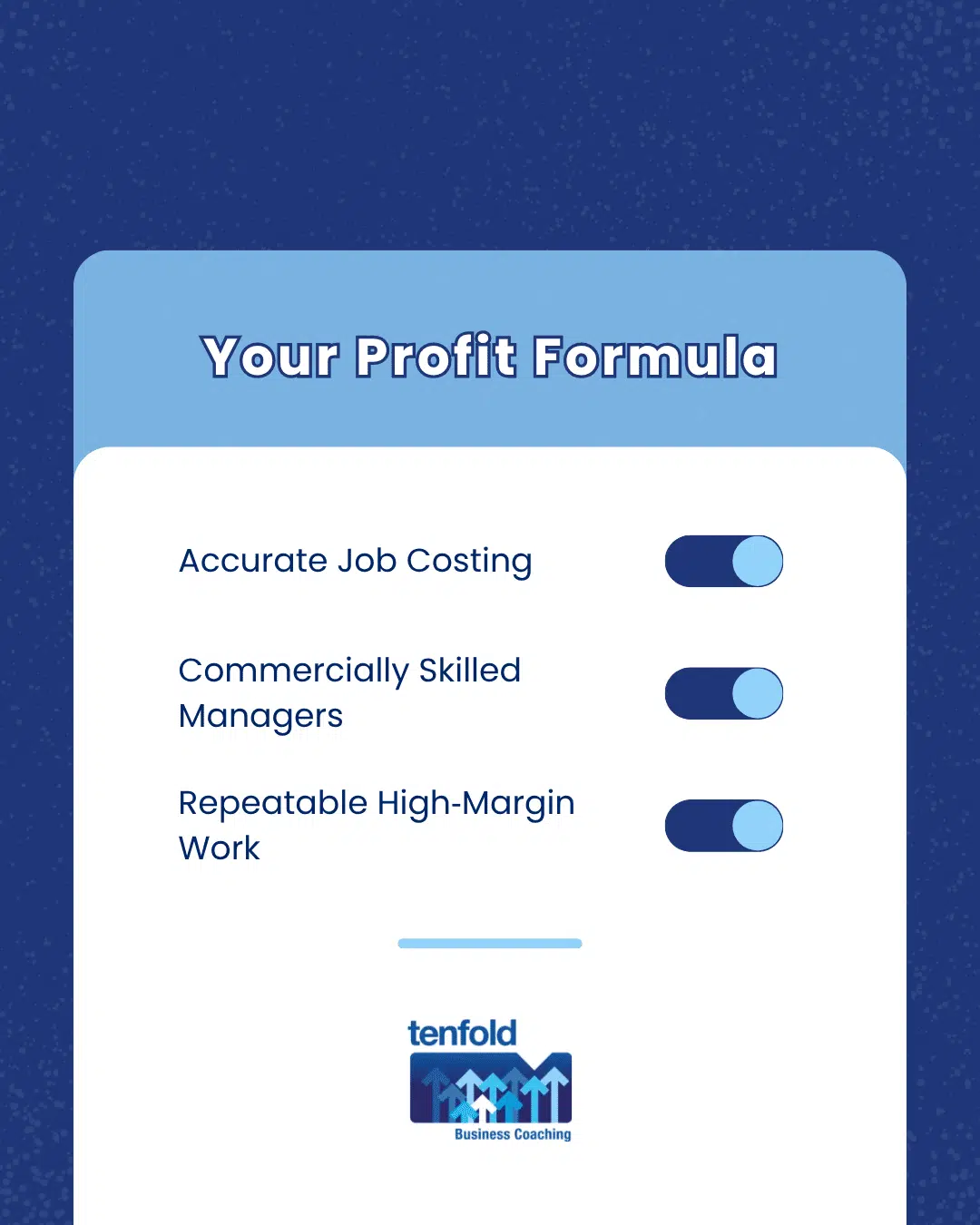
You need reliable job costing, accurate labour tracking, consistent quoting and managers who understand how to review job performance. These systems create the foundation for clear profitability insights.
How does Tenfold Business Coaching help manufacturing businesses?
We coach owners and managers to analyse job profitability, strengthen workflow, improve commercial capability and shift the business toward high-margin work. The result is a more profitable and more scalable manufacturing operation.
If this is the problem you’re wrestling with, that’s literally what we coach on. Speak with Tania on 03 9813 8777 or book a strategy call.


