
How do I protect my cash flow in a slowing construction market?
About the Author: Ashley Thomson

When owners ask how to protect cash flow in a slowing construction market, the first step is understanding how quickly conditions can shift on site and in the pipeline. Cash flow pressure shows up early in trades and construction because projects stretch out, clients take longer to approve variations, and decision timelines drift. Across electrical, plumbing, HVAC, fabrication, landscaping, and custom home building, the pattern is consistent. The businesses that stay steady are the ones that tighten their controls early, build their managers’ capabilities, and treat cash flow as a discipline that needs constant attention, not something to revisit only when the bank balance dips.
Why cash flow discipline matters in a slowing market
A slowing market exposes weaknesses that stay hidden when work is abundant. When demand softens, margins compress, quoting becomes more competitive, and clients expect sharper pricing. That pressure flows straight through to cash flow. Owners often tell me they feel like they’re working harder for less return, even when the pipeline still looks healthy. The issue isn’t always revenue. It’s the timing of money in and money out.
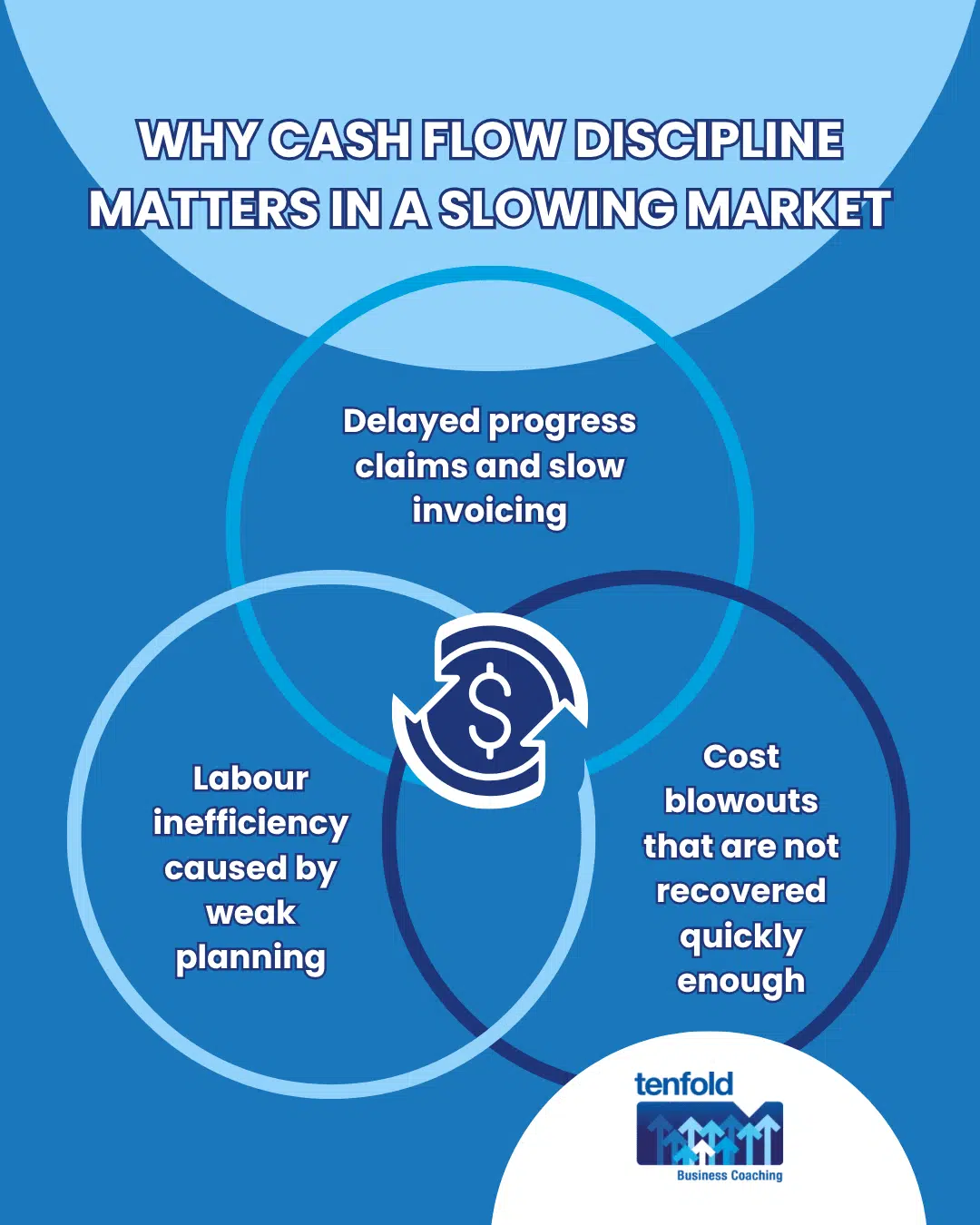
In construction and trades, cash flow pressure usually comes from three predictable areas. These issues exist in every market cycle, but they become sharper and more disruptive when conditions soften. Understanding these risks clearly gives owners a stronger foundation for stabilising their financial position and improving their managers’ performance.
Delayed progress claims and slow invoicing
Delayed progress claims and slow invoicing are the most common sources of cash flow strain. When work is busy, teams often push claims back a few days because they are focused on delivery. In a slowing market, those delays compound. Claims sit in inboxes longer, clients take extra time to review them, and any missing detail becomes a reason for further hold‑ups. The result is a widening gap between work completed and money received. That gap becomes more noticeable when margins tighten, and overheads remain constant. Owners who want predictable cash flow need managers who understand the importance of timely claims, accurate documentation, and consistent follow‑up. These habits protect the business from unnecessary delays and keep money moving even when clients are cautious.
Labour inefficiency caused by weak planning or supervision
Labour inefficiency is the second major risk. It is also the most expensive. When planning is rushed or supervision is inconsistent, crews lose time waiting for materials, clarifying instructions, or reworking tasks that were not set up correctly. In a strong market, these inefficiencies are often absorbed by high work volume. In a slowing market, they erode cash flow quickly because every hour of unproductive labour reduces the job’s margin. Managers who understand how labour efficiency affects cash flow make different decisions. They plan ahead, coordinate with suppliers earlier, and communicate expectations clearly. This level of discipline becomes essential when the market softens and every hour counts.
Cost blowouts that are not recovered quickly enough
The third risk is cost blowouts that are not recovered quickly enough. Variations, material increases, and unexpected site conditions are part of construction and trades. The issue is not the variation itself. The issue is the delay between identifying the cost and recovering it. When managers are stretched or inexperienced, variations are often recorded late, priced late, or communicated poorly. This creates disputes, slows approvals, and pushes recovery further down the timeline. In a slowing market, that delay becomes a direct hit to cash flow. Strong commercial habits protect the business by ensuring that costs are captured early, documented clearly, and communicated in a way that keeps the client aligned.
Strengthening your financial rhythm with business coaching
A consistent financial rhythm is one of the most powerful tools for protecting cash flow. When I work with owners through business coaching, we build a weekly cadence that keeps the business ahead of issues instead of reacting to them. This rhythm includes reviewing job profitability, checking labour utilisation, confirming the timing of progress claims, and validating upcoming commitments. It’s not complicated, but it requires discipline.
Managers in trades and construction often come up through the tools. They’re technically strong but haven’t been trained to think in terms of cash flow. Coaching helps them understand how their decisions affect the business’s financial health. When they learn how to forecast labour, control variations, and communicate proactively with clients, cash flow stabilises. Owners tell me they notice a noticeable shift when their managers start thinking commercially rather than just operationally.
Improving job control to protect cash flow
Job control is the backbone of cash flow protection. In a slowing market, the businesses that stay profitable are the ones that run tight jobs. That means accurate scopes, clear schedules, disciplined purchasing, and consistent communication. When job control slips, cash flow suffers. Variations get missed, labour overruns accumulate, and materials arrive too early or too late.
As an electrical business coach or plumber business coach, I often see managers who are capable but stretched. They’re juggling too many jobs, dealing with client changes, and trying to keep crews productive. Coaching gives them structure. They learn how to plan ahead, delegate effectively, and keep jobs moving without constant firefighting. When job control improves, cash flow improves. It’s a direct link.
Managing labour efficiency in a softer market
Labour is the biggest lever in trades and construction. When the market slows, inefficiency becomes expensive. Crews waiting on materials, unclear instructions, or rework can erode cash flow quickly. Business coaching helps managers build stronger planning habits so they can anticipate issues before they hit the site.
I work with managers to break down jobs into clear stages, allocate labour accurately, and communicate expectations to their teams. When managers understand how labour efficiency affects cash flow, they make better decisions. They schedule smarter, coordinate with suppliers earlier, and keep the team focused on productive work. This shift alone can protect tens of thousands of dollars in a quarter.
Strengthening your pipeline quality, not just quantity
In a slowing market, owners often focus on filling the pipeline. The real advantage comes from improving the quality of the pipeline. That means quoting the right work, pricing accurately, and avoiding jobs that drain cash flow. Business coaching helps owners and estimators refine their qualification process to identify profitable opportunities and walk away from risky ones.
I encourage owners to review their quoting assumptions, update their labour rates, and tighten their margin expectations. When the market softens, some competitors drop their prices. That doesn’t mean you should. A well-run trades or construction business can maintain strong margins if it controls its delivery and communicates value clearly. Coaching helps owners stay confident in their pricing and avoid the temptation to chase unprofitable work.
Building stronger client communication to accelerate payments
Cash flow improves when clients understand what’s happening and when. Delays in approvals, variations, or progress claims often come from unclear communication. Managers who learn how to set expectations early, follow up consistently, and document changes properly keep money moving.
Through business coaching, I help managers develop communication routines that reduce friction. They learn how to confirm decisions in writing, provide clear updates, and escalate issues before they become disputes. This reduces payment delays and strengthens client relationships. In a slowing market, strong communication becomes a competitive advantage.
Preparing your business for longer payment cycles
A softer market often leads to longer payment cycles. Clients hold onto cash, builders slow down claims, and commercial clients stretch terms. Owners who prepare early avoid the stress that comes when cash tightens unexpectedly. This preparation includes reviewing credit policies, tightening terms, and ensuring progress claims are accurate and timely.
Coaching helps owners and managers build systems that support faster billing and more consistent follow-up. When the team understands the importance of cash flow, they treat invoicing and claims as critical tasks rather than administrative chores. This mindset shift protects the business during uncertain periods.
Lifting manager capability to protect cash flow
The most effective way to protect cash flow is to lift the capability of the people who influence it every day. Operations managers, project managers, and service managers make decisions that affect labour, materials, scheduling, and client communication. When they’re trained and supported, the business becomes more resilient.
Owners invest in business coaching because they want their managers to think commercially, communicate clearly, and run jobs with confidence. Coaching gives managers the tools to make better decisions and the structure to stay consistent. In a slowing market, that capability becomes a strategic advantage.
Strengthening your internal systems for stability
Systems create stability. When the market slows, strong systems keep the business predictable. This includes job costing, scheduling, purchasing, invoicing, and reporting. Many owners know their systems need improvement, but don’t have the time to overhaul them. Coaching provides the accountability and guidance to make those improvements without overwhelming the team.
I work with owners to build systems that fit their business’s scale. The goal is to create clarity, reduce errors, and support better decision-making. When systems improve, cash flow becomes more reliable.
Building resilience through business coaching
A slowing construction market doesn’t have to be a threat. It can be an opportunity to strengthen the business, lift capability, and build resilience. Owners who invest in business coaching during these periods often come out stronger. They have better managers, tighter systems, and more predictable cash flow.
Cash flow protection isn’t a single action. It’s a combination of discipline, capability, and structure. When those elements come together, the business can navigate uncertainty with confidence.
Next steps for owners considering coaching
If you’re seeing early signs of a slowdown or feeling pressure on cash flow, this is the right time to invest in your managers. Coaching gives them the tools to run tighter jobs, communicate more effectively, and protect your business’s financial health. The owners I work with tell me that the improvements in cash flow, job control, and team capability make a measurable difference.
If you want to strengthen your business for the next phase of the market, let’s talk about how coaching can support your managers and give you more control over your cash flow.
Frequently Asked Questions
What’s the real risk of ignoring cash flow in a slowing market?
The risk is that small delays and inefficiencies compound quickly. A few late claims, a couple of labour overruns, or a handful of missed variations can create a cash squeeze that’s hard to recover from.
When should I start preparing my business for a slowdown?
Preparation should begin as soon as you notice longer decision times, tighter pricing pressure, or slower approvals. Early action gives you more options and reduces stress.
How much should I expect to invest in improving cash flow capability?
The investment depends on the size of your team and the level of support your managers need. Most owners see a strong return because improvements in job control and labour efficiency flow directly into cash flow.
What systems make the biggest difference to cash flow stability?
Clear job costing, accurate scheduling, disciplined purchasing, and timely invoicing create the strongest foundation. When these systems are consistent, cash flow becomes more predictable.
How does Tenfold Business Coaching help protect cash flow?
We work directly with your managers to build capability, improve job control, strengthen communication, and create financial discipline. This lifts the performance of the whole business and stabilises cash flow.
If this is the problem you’re wrestling with, that’s literally what we coach on. Speak with Tania on 03 9813 8777 or book a strategy call.


