
How do I protect my margins when material and labour costs keep rising?
About the Author: Ashley Thomson

When owners come to me for business coaching, this is the question they ask most. Material prices move without warning. Labour is harder to secure and more expensive to retain. Subcontractors lift their rates. Clients push back on quotes. Profit that once felt predictable now feels fragile. As a business coach working with established Australian trades, construction and manufacturing businesses, I see the same pattern across electrical contractors, custom home builders, HVAC teams, fabricators, landscapers, solar installers and commercial maintenance providers. Rising costs are not the real problem. The real problem is when rising costs meet outdated pricing habits, loose job control and inconsistent commercial discipline.
Protecting your margins is not about reacting to cost increases. It is about building an operating model that keeps the margin intact regardless of what the market does. That is the focus of this article: practical, commercially grounded steps that owners can implement immediately to protect profitability in a rising-cost environment.
Why margin protection starts long before the job begins
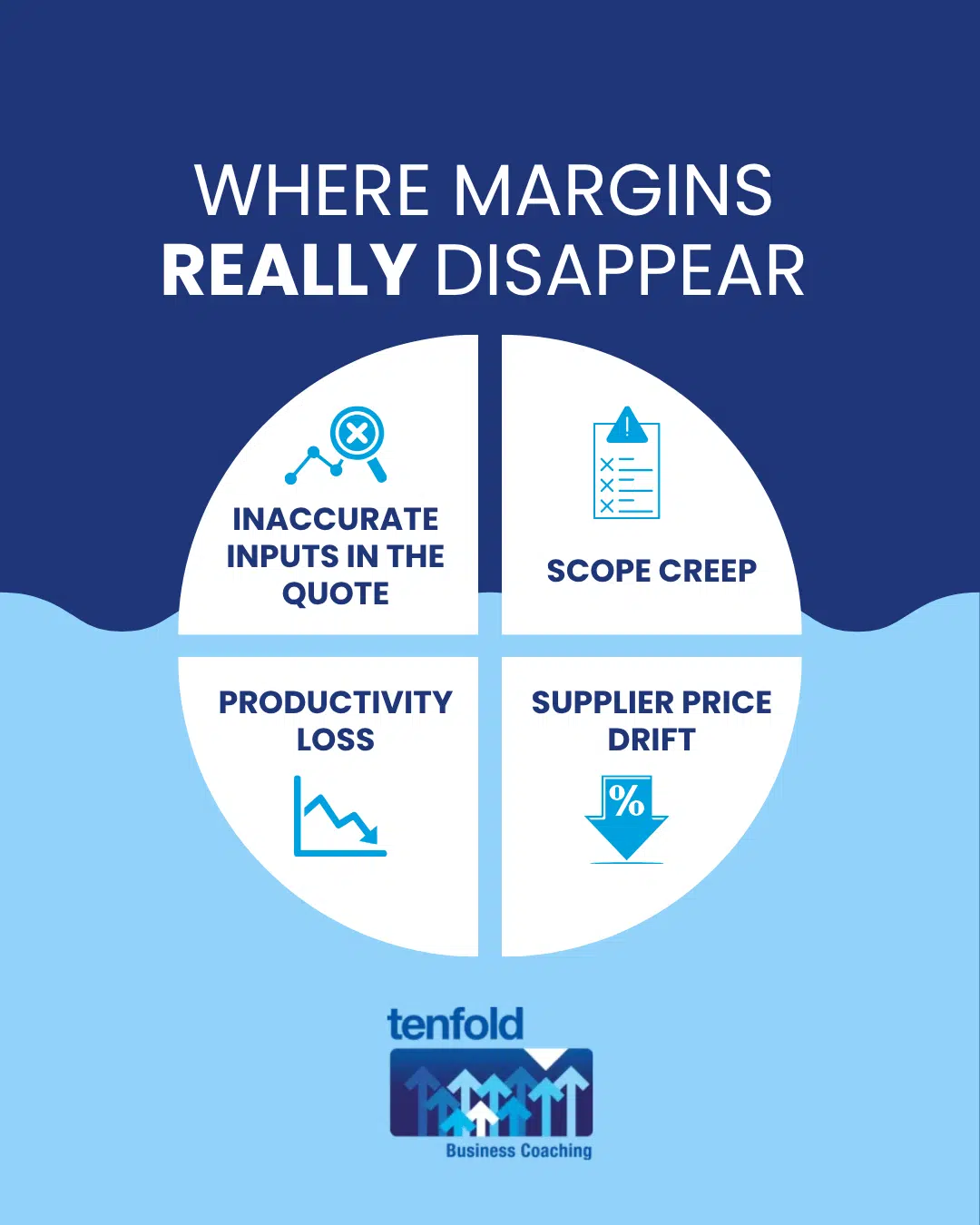
The first place margins disappear is in the assumptions that go into a quote. Many owners still rely on historical supplier pricing or labour productivity that no longer reflects reality. In a stable market, those shortcuts might have been harmless. In today’s environment, they are expensive. When I work with owners through business coaching, the first thing I look at is how they build a quote. A quote is not a guess. It is a commercial commitment. If the inputs are wrong, the margin is gone before the job even starts.
Accurate inputs mean current supplier pricing, realistic labour allowances, updated overhead recovery and a clear understanding of risk. In trades and manufacturing, risk is not theoretical. It shows up in access issues, weather delays, client changes, coordination with other trades, material shortages and subcontractor availability. If your pricing does not reflect these realities, you are absorbing the cost instead of recovering it.
Margin protection starts with disciplined pricing. It does not rely on aggressive pricing or discounting to remain competitive. Instead, it involves setting prices that accurately reflect the true cost of delivering the work.
The quiet ways margin erodes inside established businesses
Margin erosion rarely occurs as a single, dramatic event. Instead, it gradually develops through numerous small decisions that seem harmless at the moment. For example, a slight variation may go uncharged, an extra few hours might be absorbed to satisfy a client, a supplier increase could be accepted without negotiation, a job might be started without all materials on site, or a scope could expand without proper documentation. These decisions compound over time. In construction trades and fabrication, the difference between a profitable year and a stressful one is often determined by these small leaks.
The challenge is that these leaks are invisible until it is too late. The P and L show the damage at the end of the month, but the decisions that caused it happened weeks earlier. That is why margin protection requires real-time visibility. Job costing must be current. Labour hours must be tracked daily. Material usage must be compared to the estimate. Variations must be logged immediately. When owners have accurate information, they can correct issues early. When they do not, they discover the problem after the job is complete and the margin is unrecoverable.
Scope control is the real battleground for margin
In every trade and manufacturing business I coach, scope creep is one of the biggest threats to margin because it rarely manifests as a major change. Instead, it often comes as small requests that seem too minor to charge for, such as a slight adjustment to a layout, an extra fitting, a small repair while already on site, or a client request that feels easier to absorb than to document.
In a rising-cost environment, absorbing these changes becomes costly. Scope control is not about being difficult. It is about being clear. Every change must be documented. Every variation must be priced. Every request outside the original scope must be treated as a commercial decision. Clients respect clarity. They do not respect businesses that absorb costs silently and then complain later. Protecting margin requires the discipline to treat scope as a boundary, not a suggestion.
Productivity is the hidden lever that protects margin faster than pricing
When material and labour costs rise, many owners focus only on pricing. Pricing matters, but productivity is often the bigger lever. If your team loses an hour a day to poor scheduling, unclear instructions, missing materials or rework, that is the equivalent of a price discount on every job. In fabrication shops, I see productivity losses due to changeovers, machine downtime, and inefficient workflows. In trade businesses, I see it in travel time, callbacks, poor sequencing, and unclear job preparation.
Protecting margin means tightening the operational basics. Jobs must start on time. Materials must be ready. Instructions must be clear. Rework must be eliminated. Productivity improvements compound quickly, especially when labour is your highest cost. When I work with owners as a business coach, productivity is often the fastest path to margin recovery because it delivers immediate, measurable results.
Supplier strategy is a commercial decision, not a loyalty decision
Many owners stay loyal to suppliers long after the pricing stops being competitive. Loyalty has value, but only when it is mutual. When costs rise, you need a supplier strategy, not a supplier habit. That means negotiating terms, reviewing pricing regularly, exploring alternatives, consolidating volume and understanding where you have leverage. It also means being proactive. If you wait for suppliers to notify you of increases, you are already behind.
The strongest businesses treat suppliers as part of their commercial engine. They communicate forecasts, negotiate early and build relationships that support margin protection. They do not accept increases without question. They do not rely on one supplier for critical materials. They understand that supplier management is a commercial skill, not an administrative task.
Cash flow discipline is part of margin protection
Rising costs do not just affect profitability. They affect cash flow. If you are funding material increases, labour blowouts or slow client payments, your margin is under pressure even before the job is complete. Margin protection requires strong cash flow discipline. Deposits must be collected. Progress claims must be timely. Payment terms must be enforced. Supplier terms must be negotiated.
A profitable job that pays slowly is not a good job. In a rising cost environment, cash flow discipline is part of margin protection. When owners tighten their cash flow processes, they reduce the financial strain that rising costs place on their businesses.
Margin protection becomes reliable when it becomes a system
Owners often try to protect margin by reacting to problems. They increase prices after a bad month. They tighten the scope after a job blows out. They negotiate with suppliers after a large increase. They focus on productivity after a period of rework. These reactions help, but they do not create stability.
Margin protection becomes reliable when it is integrated into a comprehensive system. Pricing is updated regularly, and job costing is reviewed daily. Scope is consistently controlled, productivity is closely monitored, and supplier pricing is frequently checked. Cash flow is maintained with discipline. When these elements work together, margin protection becomes predictable. This is the outcome I strive for in business coaching – establishing robust, pressure-resistant commercial systems rather than seeking quick fixes.
The next step for owners who want stronger margins
If rising material and labour costs are squeezing your profitability, the solution is not to work harder or hope the market settles. The solution is to tighten your commercial systems, strengthen your pricing logic and improve your operational discipline. This is the work I do with established Australian businesses every day. If you want support to protect your margins and build a more commercially resilient business, reach out and let’s talk about how business coaching can help you get ahead of the cost pressures rather than reacting to them.
Frequently Asked Questions
What is the risk if I do nothing about rising costs?
The primary risk is silent margin erosion, where costs steadily rise faster than pricing adjustments. Over time, these incremental cost increases, coupled with small operational inefficiencies, accumulate and amplify, ultimately leading to a substantial reduction in profits. If left unaddressed, this gradual decline can significantly impact the overall financial health and sustainability of the business.
How do I know when it is the right time to adjust pricing?
You should regularly review your pricing strategies whenever there are changes in supplier costs, labour rates, or productivity levels. Delaying these reviews can lead to a situation where you are forced to absorb increased expenses that you cannot pass on to your customers, potentially impacting your profit margins and overall financial health.
What investment is required to effectively protect margins?
The investment is primarily focused on strengthening commercial discipline within the organisation. By ensuring accurate quoting, precise job costing, clear scope control, and continuous productivity improvements, we can deliver a measurable and sustainable return on investment over time.
Do I need new systems before I can improve margin protection?
Most businesses already have the systems they need in place to operate efficiently. However, the key to unlocking their full potential lies in consistently utilising these systems and making informed decisions based on real-time data. By doing so, companies can improve their performance, respond more effectively to changing circumstances, and stay ahead of the competition.
How does Tenfold Business Coaching help with margin protection?
We work closely with property owners and stakeholders to carefully analyse and fine-tune pricing strategies, implement robust job control measures, and develop targeted initiatives to enhance overall productivity. Additionally, we focus on building and reinforcing a strong sense of commercial discipline within teams to ensure consistently strong profit margins, even amid rising costs and economic fluctuations.
If this is the problem you’re wrestling with, that’s literally what we coach on. Speak with Tania on 03 9813 8777 or book a strategy call.


