
Should I be worried about a recession? And how do I prepare my trade business?
About the Author: Ashley Thomson

A recession tends to hit hardest when a business is already running close to the edge. Thin margins, dependence on one or two major clients, or managers who struggle under pressure all increase the impact. In my work as a business coach supporting owners in electrical, plumbing, HVAC, fabrication, landscaping, concrete and custom home building, I see the same pattern every cycle. The owners who prepare early protect their margins, hold onto their best people and come through in a stronger position. The owners who wait for certainty usually move too late. That’s why business coaching becomes a strategic advantage. You’re not preparing in isolation, and your managers aren’t left trying to work it out on their own.
Understanding recession risk in a trade business
When owners ask me whether they should be worried about a recession, I tell them to look at their exposure, not the headlines. Trade businesses don’t move in perfect sync with the broader economy. Electrical contractors might stay busy with compliance and maintenance work even when construction slows. Plumbers often see steady demand because breakdowns don’t follow economic cycles. Fabricators and HVAC businesses feel the slowdown earlier because they’re tied to commercial projects and capital works. Tradie business coaching helps owners understand these patterns and build a plan that suits their specific workflow, client mix and cost structure.
The risk isn’t the recession itself. The risk is entering a downturn with weak systems, inconsistent quoting, underdeveloped managers and no clear plan for cash flow. When those gaps exist, a recession exposes them quickly. When those gaps are closed, a recession becomes manageable.
Why trade businesses feel recession pressure differently
Every trade business has a different lag time between economic signals and operational impact. As a business coach, I help owners map that lag so they know when to act. Electrical contractors often have a pipeline of scheduled work that cushions the first six to twelve months of a downturn. Plumbers and maintenance-focused trades usually hold steady because essential services don’t pause. Fabrication shops, HVAC installers and custom builders feel the slowdown earlier because clients delay upgrades, expansions and new builds.
This is why a one-size-fits-all approach doesn’t work. An electrical business coach will focus on labour efficiency, quoting accuracy and backlog management. A plumber business coach will focus on call flow, technician productivity and service-level consistency. Tradie business coaching for fabrication or HVAC will focus on margin control, project management capability and reducing rework. The preparation is different, but the goal is the same. You want your business to stay profitable even if revenue softens.
Strengthening your margins before the economy shifts
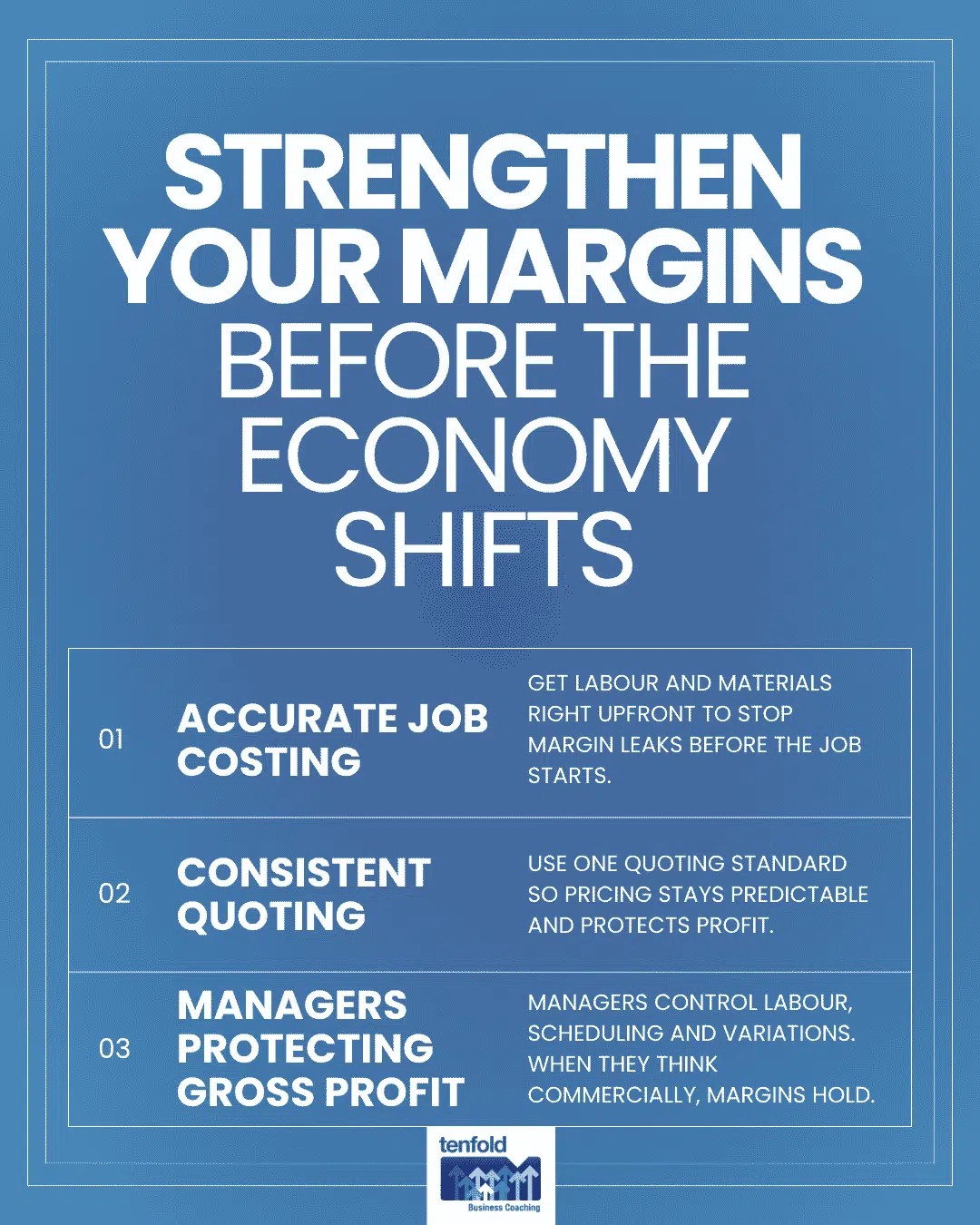
Margins are the first line of defence when conditions tighten. In every trade business I coach, the owners who stay profitable in a recession are the ones who get the fundamentals right long before the slowdown arrives. Margin protection always starts with three core areas that determine how much money you keep on every job.
Accurate job costing
Accurate job costing is the foundation of margin control. If your labour allowances, material estimates or productivity assumptions are off, the job is already losing money before your team arrives on site. In electrical, plumbing, HVAC and fabrication businesses, I often see costing based on outdated rates or optimistic labour estimates that don’t reflect real site conditions. When the economy is strong, those inaccuracies get absorbed. When the economy tightens, they turn into margin leaks that compound quickly. Getting job costing right gives you clarity and gives your managers a realistic plan to work to.
Consistent quoting
Consistent quoting is the next layer of protection. A recession exposes inconsistencies in how quotes are prepared, reviewed, and approved. If one project manager includes travel time and another forgets it, or if variations are priced differently depending on who prepares them, your margins become unpredictable. Consistency creates discipline. It also builds trust with clients because your pricing is stable and transparent. In business coaching, I help owners tighten their quoting process so every quote reflects true cost, true risk and the standard of work the business delivers.
Managers who understand how to protect gross profit
Your managers are the ones who protect gross profit on every job. They control labour, schedule the work, manage variations, communicate with clients and keep technicians accountable. When managers understand the commercial impact of their decisions, margins hold. When they don’t, labour blowouts, scope creep, poor scheduling and weak supervision start to erode profit. In a strong economy, those issues get hidden by high demand. In a recession, they become expensive very quickly. Coaching your managers to think commercially is one of the most effective ways to strengthen your margins before the economy shifts.
Building a resilient pipeline in uncertain conditions
A recession doesn’t remove demand. It shifts it. Clients become more selective, more price-conscious and more risk-averse. That means your business needs a pipeline that isn’t dependent on one or two major clients. You need a mix of recurring work, maintenance contracts, small projects and larger jobs. You also need managers who can build relationships, follow up on quotes and keep communication tight.
In business coaching, I work with owners to build a pipeline strategy that suits their trade. Electrical contractors might focus on compliance testing, switchboard upgrades and commercial maintenance. Plumbers might focus on preventative maintenance, strata relationships and emergency response. Fabricators might focus on repeat clients, small-batch production and value-added services. The goal is to create stability so you’re not exposed to sudden drops in project volume.
Developing managers who can carry more responsibility
A recession is the wrong time to realise your managers aren’t ready. If your operations manager can’t run the schedule without you, or your project manager can’t manage variations confidently, you’ll feel every bump in the economy. This is where business coaching becomes a multiplier. When I coach managers, I focus on capability, accountability and commercial awareness. They learn how to run jobs profitably, manage technicians, communicate with clients and make decisions that protect the business.
Owners often tell me that coaching their managers was the turning point. It freed them from day-to-day firefighting and gave them confidence that the business could operate at a higher standard. In a recession, that capability becomes a competitive advantage.
Strengthening your financial position before conditions tighten
Cash flow is the oxygen of a trade business. When the economy slows, payment terms stretch, clients delay decisions, and projects take longer to start. You need a financial buffer, but you also need systems that keep cash moving. That means accurate invoicing, tight follow-up, clear terms and managers who understand the importance of job profitability.
Business coaching helps owners build financial discipline into their operations. You learn how to forecast, how to manage working capital and how to make decisions based on data rather than gut feel. When your financial systems are strong, you can navigate uncertainty without panic.
Preparing your workforce for a changing environment
Your technicians, apprentices and supervisors need clarity during uncertain times. They need to know what’s expected, how performance is measured and how the business is positioning itself for the future. When communication is strong, your team stays focused. When communication is weak, rumours fill the gaps.
As a business coach, I help owners build communication rhythms that keep the team aligned. Toolbox talks, weekly manager meetings, job reviews and performance check-ins all contribute to stability. When your team understands the plan, they perform better and stay engaged.
Using business coaching to stay ahead of the cycle
Recession preparation isn’t about fear. It’s about readiness. When you work with a business coach, you’re not reacting to the economy. You’re building a business that performs in any cycle. Electrical business coach programs, plumber business coach programs and broader tradie business coaching all share the same objective. They help owners build capability, strengthen systems and develop managers who can run the business at a higher level.
The owners who invest early are the ones who stay profitable, keep their best people and take market share when competitors pull back. Preparation isn’t optional. It’s strategic.
What to do next
If you’re thinking about how to prepare your trade business for a recession, start by strengthening your managers. They’re the ones who protect your margins, run your jobs and keep your team performing. When they’re supported through business coaching, your business becomes more resilient and more profitable.
At Tenfold Business Coaching, we specialise in coaching managers in trades, construction and manufacturing. If you want to build a business that can handle any economic cycle, now is the time to invest.
Frequently Asked Questions
What’s the real risk of a recession for a trade business?
The primary risk is entering an economic downturn with weak systems in place, inconsistent profit margins, and managers who are not adequately prepared to take on increased responsibilities. When these gaps and vulnerabilities are present, a recession can quickly reveal and exacerbate them, leading to significant challenges for the organisation.
When should I start preparing my business for a recession?
Preparation should start well before the slowdown begins to affect your sector. Since trade businesses often experience the impact at different times depending on various factors, starting your planning early allows you to build a stronger buffer, giving your business a better chance to withstand the challenges that may come.
How much should I invest in preparing my business?
Investment strategy varies depending on your company’s size, organisational structure, and level of risk exposure. Typically, most owners prioritise efforts to improve profit margins, develop their management teams, and strengthen their financial systems, as these areas tend to provide the highest return on investment and significantly contribute to long-term growth and stability.
What systems should I have in place before conditions tighten?
You need accurate job costing methods to ensure that costs are precisely tracked for each project, consistent and transparent quoting procedures to maintain client trust, strong scheduling practices to optimise resource utilisation and meet deadlines, reliable invoicing systems that facilitate prompt payments, and managers who understand how to protect gross profit margins by controlling costs and pricing strategies. Implementing these integrated systems helps to stabilise the business during periods of uncertainty and provides a solid foundation for growth and resilience.
How does Tenfold Business Coaching help trade businesses prepare?
We provide comprehensive coaching to owners and managers across the trades, construction, and manufacturing industries, helping them develop their leadership capabilities, optimise operational systems, and enhance their commercial performance. By implementing these strategies, businesses can build a strong foundation, ensuring they remain profitable and resilient through any economic cycle, regardless of market fluctuations or industry challenges.
If this is the problem you’re wrestling with, that’s literally what we coach on. Speak with Tania on 03 9813 8777 or book a strategy call.


