
Building Up – How to Break Into and Win Mid-Size Commercial Work
About the Author: Ashley Thomson

In part one of this series, we explored the shifting landscape of Australian construction and why mid-size commercial projects are emerging as a powerful growth opportunity. In part two, we identified the sectors where demand is strongest, from healthcare and childcare to education and aged care. Now, in part three, we turn insight into action.
This final instalment is designed for builders who are ready to take the next step – to prepare their business, build credibility, and tender competitively without overextending their resources. With the right strategy and support, including next level business coaching, residential builders can successfully transition into mid-size commercial work and unlock long-term stability.
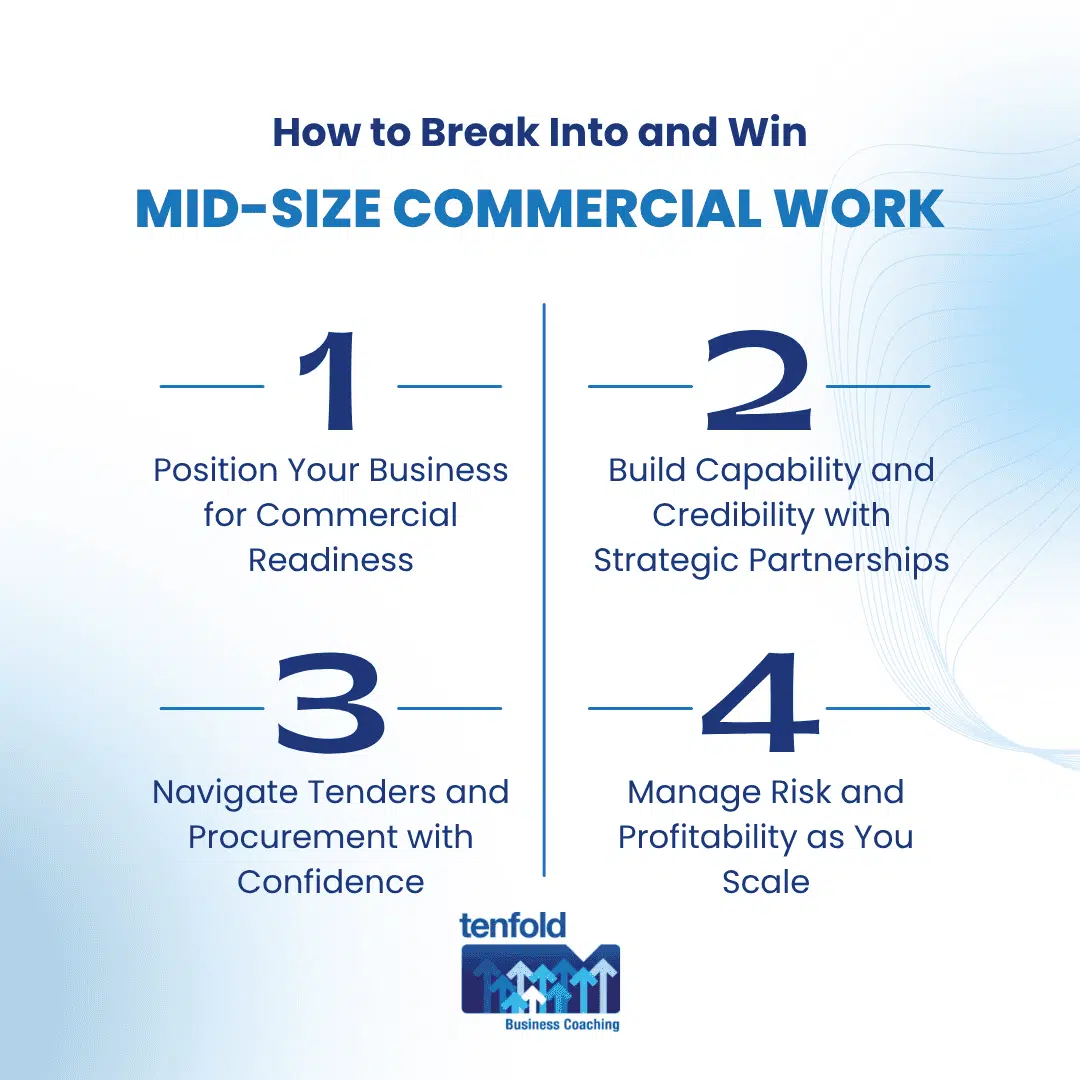
Position Your Business for Commercial Readiness
Breaking into the commercial construction industry begins with thorough preparation and strategic planning. Builders must ensure that their business is properly structured and equipped to meet the high expectations of a diverse range of clients, including institutional organisations, government departments, and property developers. This entails having all the necessary documentation, such as licenses, permits, and certifications, in addition to appropriate insurances that cover liability, workers’ compensation, and professional indemnity.
Compliance systems must be rigorously maintained to adhere to Australian standards and regulations. Safety manuals, quality assurance procedures, occupational health and safety (OH&S) policies, and detailed financial statements are often prerequisites for the prequalification process.
Moreover, builders need to demonstrate their financial capacity to undertake projects, which includes effective cash flow management, access to sufficient working capital, and a strong credit history.
Engaging with business coaching or advisory services can be immensely beneficial in this stage, helping builders assess their overall readiness, identify any internal gaps or weaknesses, and develop robust internal systems and processes. These steps are essential to foster confidence when entering the competitive Australian commercial construction market and to position the business for sustainable growth and success.
Build Capability and Credibility with Strategic Partnerships
Credibility is earned through capability, and capability is built through experience. Builders who are looking to expand their presence in the commercial construction industry should consider starting with smaller, manageable projects such as refurbishments, fitouts, or taking on subcontractor roles within larger construction jobs. These entry points provide valuable opportunities for teams to gain firsthand experience with commercial workflows, understand compliance standards, and learn how to effectively coordinate with multiple stakeholders involved in a project.
Building strong relationships by partnering with architects, engineers, and consultants can also significantly help builders expand their professional network and establish trust with key decision-makers in the industry. Additionally, engaging a business coach can be highly beneficial; they can guide builders through the process of positioning their brand more effectively, developing comprehensive capability statements, and identifying strategic partnerships that can open new doors and create more opportunities for growth and success in the competitive Australian market.
Navigate Tenders and Procurement with Confidence
Tendering is one of the most misunderstood aspects of commercial construction projects in Australia. Many builders and contractors often believe that to win projects, they must continuously undercut their competitors on price. However, relying solely on price rarely guarantees that a contract will be awarded.
It is crucial to develop a thorough understanding of various procurement models used within the Australian construction industry, such as design and construct, lump sum, and negotiated tenders. Each of these models comes with its own unique risks, responsibilities, and relationship dynamics between the parties involved. Builders and contractors need to learn how to effectively prequalify for tenders, respond appropriately to tender invitations, and build strong, professional relationships with project managers, developers, and other key stakeholders.
Engaging in business coaching or professional development can equip industry participants with the necessary tools and insights to approach tendering more strategically. This includes avoiding common pitfalls, understanding the details of project requirements, and presenting a comprehensive and compelling case for selection that reflects their capabilities and value proposition.
Manage Risk and Profitability as You Scale
Mid-size commercial projects generally offer stronger profit margins compared to residential buildings, but they also tend to be more complex to manage. Builders need to be well prepared to handle various aspects, such as controlling costs, managing scope creep, scheduling efficiently, and coordinating trades across a larger scale. One common challenge for those new to commercial construction is underpricing their projects, which can lead to financial difficulties down the line.
To succeed, builders must learn to price their projects accurately, considering all costs and contingencies, in order to protect their profit margins. Managing risks effectively and implementing proper operational strategies are crucial for maintaining project profitability and ensuring sustainability over time. Business coaching services can be highly beneficial during this transitional phase by offering critical support such as financial modelling tailored to commercial projects, risk assessment tools, and strategic guidance on operations.
Lessons learned from experienced builders who have successfully made this transition reveal that with the right systems in place, growth in the commercial sector is achievable without sacrificing quality of work or cash flow. Developing a clear understanding of the unique challenges associated with larger, more complex projects (and building systems to manage them) can significantly enhance a builder’s chances of long-term success in the Australian market.
Partner with Expertise – The Role of a Business Coach
Diversifying into mid-size commercial construction is not just a tactical move; it’s a strategic evolution. Builders who partner with a business coach gain access to industry insights, proven frameworks, and tailored support that accelerates success. Tenfold Business Coaching works with builders across Australia to assess readiness, identify ideal sectors, and build commercial systems that scale. From financial planning to tender preparation, Tenfold helps businesses make the leap confidently and profitably. Case studies from Tenfold clients show that with expert guidance, builders can transition smoothly, win work consistently, and build a reputation that attracts repeat business.
The Opportunity Is Now – Take the Next Step
Australia’s mid-size commercial construction market is full of momentum. Government pipelines are strong, private capital is flowing, and community infrastructure is in high demand. For builders who act strategically, the opportunity is real and within reach. The key is preparation, positioning, and partnership. If you’re ready to explore commercial work, now is the time to move. Contact Tenfold Business Coaching to book a strategy session or readiness review. With the right support, your business can grow, diversify, and thrive in this evolving market.
FAQs – Business Coaching Insights for Builders
What documentation do I need to prequalify for commercial tenders?
Builders typically need insurance, QA manuals, OH&S policies, and financial statements to meet prequalification requirements.
How can smaller builders win tenders against larger firms?
By specialising in projects under $10M and leveraging agility, relationships, and quality delivery, smaller builders can compete effectively.
What are the first steps to take before bidding on a commercial project?
Builders should build capability through smaller commercial fitouts or subcontractor partnerships to gain experience and credibility.
How long does it take to build a commercial reputation?
With strategic marketing, strong partnerships, and consistent delivery, builders can establish a reputation within 1 to 2 years.
Can business coaching really help with diversification?
Yes. Business coaching provides financial modelling, tender support, and strategic guidance that reduces risk and accelerates success in new markets.
If this is the problem you’re wrestling with, that’s literally what we coach on. Speak with Tania on 03 9813 8777 or book a strategy call.


