
About the Author: Ashley Thomson

Professional Journey
Ashley started in business improvement in 1998, working for an Australian consulting company. He honed his skills by optimising corporate giants like Coles Group, Myer, ANZ Bank, Telstra, and Zurich Insurance. This hands-on experience gave him practical insights into the workings of great businesses and the pitfalls of poor performers.
Accolades and Awards
Ashley’s exceptional coaching prowess has earned him a place in the prestigious Coaching Hall of Fame (2019). Additionally, his achievements have been acknowledged through multiple awards, solidifying his reputation as a world-class business coach. He leads a team of award-winning business coaches at Tenfold, setting the gold standard in the industry.
Expertise Across Industries
With diverse experience spanning FMCG, manufacturing, wholesale, distribution, construction, trades, retail, and professional services, Ashley has successfully coached businesses across various sectors. His expertise lies in coaching mature businesses with revenues ranging from $5M to $50M, guiding them through complex financial structures, marketing strategies, operational improvements, and leadership development.
Innovative Problem Solver
Ashley’s background as a convergence task force manager and project manager at leading organisations like Show Ads and NewsCorp – PMP Print equipped him with the skills to streamline complex business functions. His ability to sift through data, identify key business drivers, and provide agile financial models enables businesses to thrive in competitive markets.
Published Author and Global Authority
Ashley’s influence extends far beyond his coaching practice. He co-authored “The Quiet Sales Genius,” a definitive guide to effective sales strategies. He has been featured in prominent publications, podcasts, and conferences, cementing his status as a thought leader in the coaching community.
Ashley’s influence reaches across the globe, with features and accolades from esteemed platforms such as:
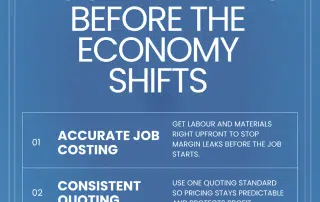
Should I be worried about a recession? And how do I prepare my trade business?
A recession tends to hit hardest when a business is already running close to the edge. Thin margins, dependence on one or two major clients, or managers who struggle under pressure all increase the impact. In my work as a business coach supporting owners in electrical, plumbing, HVAC, fabrication, landscaping, concrete and custom home building, I see the same pattern every cycle. The owners who prepare early protect their margins, hold onto their best people and come through in a stronger position. The owners who wait for certainty usually move too late. That’s why business coaching becomes a strategic advantage. ...
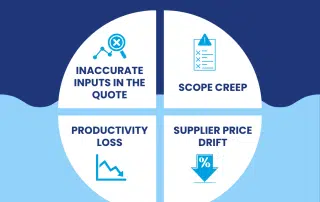
How do I protect my margins when material and labour costs keep rising?
When owners come to me for business coaching, this is the question they ask most. Material prices move without warning. Labour is harder to secure and more expensive to retain. Subcontractors lift their rates. Clients push back on quotes. Profit that once felt predictable now feels fragile. As a business coach working with established Australian trades, construction and manufacturing businesses, I see the same pattern across electrical contractors, custom home builders, HVAC teams, fabricators, landscapers, solar installers and commercial maintenance providers. Rising costs are not the real problem. The real problem is when rising costs meet outdated pricing habits, loose ...
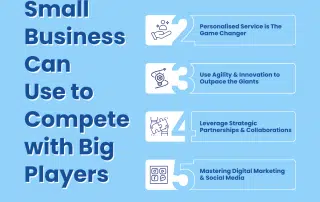
Small Business vs Big Business: 5 Strategies to Compete and Win
Small businesses can compete with big players by winning on focus, speed, and commercial clarity, not by trying to outspend them. The practical path is to pick the parts of the market where you can be decisively better, build proof fast, and remove friction from buying and delivery. As a business coach, I see small Australian service SMEs beat larger competitors when they tighten positioning, operational execution, and decision-making discipline, then communicate it with simple evidence. What is the real advantage a small business has over a large competitor? The real advantage is the ability to make decisions and ...

Business Objectives and KPIs for Australian SMEs: 12 Measurable Targets to Track Success in 2026 [+3 Bonus Metrics]
Australian SMEs measure success with clear business objectives, KPIs, cash flow control, customer retention, operational delivery, and team performance. Executive summary Business objectives are the measurable targets and actions that turn a broad goal like “build a profitable business” into something you can manage week to week. Your job is to choose a small set of objectives across money, customers, operations, people, and market position, then build a cadence to review them before problems become expensive. Below are 12 practical business objectives I use with established Australian SMEs to measure success, keep decisions grounded, and stop leadership from operating on ...
Cash Flow Under Pressure: Why Australian SME Owners Need to Get Ahead of Late Payments
As of April 2026, Australian business conditions are still tight, and the Reserve Bank of Australia cash rate target is 4.10%. Higher rates and cautious spending amplify one simple truth I see every week: late payments turn into an expensive form of financing that your business did not agree to provide. The fact is cash flow timing, not just profitability, determines whether you can meet payroll, pay suppliers, and keep service quality high. The implication for service-based SMEs employing staff is brutal: one slow-paying client can force you to choose between paying wages on time and investing in delivery ...
Late Payments Are Strangling Australian SMEs: How Business Owners Can Take Back Control of Cash Flow
Late payments strangle otherwise profitable Australian SMEs because they force you to fund your customers’ business with your working capital. If your debtor control is weak, you end up making reactive decisions: delaying ATO payments, cutting wages/contractors late, skipping maintenance, and saying “yes” to the wrong work just to keep cash moving. The fix is tighter payment design, faster invoicing, and a disciplined collections system you run every week. Why do late payments hit profitable SMEs so hard? Late payments hurt profitable SMEs because profit is an accounting outcome, while cash is a timing outcome and payroll, suppliers, rent, ...
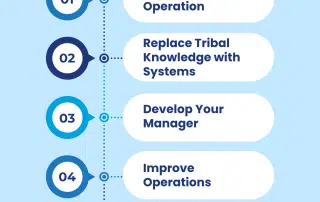
Bought a Business, Bought the Problems: How to Renovate the Fixer-upper You Took Over
When you buy an established business, you rarely inherit a clean slate. More often, you inherit a fixer-upper. You get the staff, the clients, the equipment and the revenue. You also get the outdated systems, the patchy reporting, the tribal knowledge and the habits that made the previous owner want to sell in the first place. I see this every week with new owners in manufacturing, fabrication, trades, distribution and plant hire. They buy a business that looks solid from the outside, only to discover that the inside needs serious renovation. This article is written for owners who have found ...
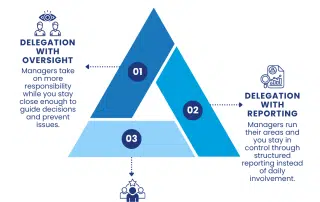
Bought a Business for Freedom, But You’re Working Harder: How to Get Control and Step Out of Day-to-day
When owners come to me after buying a business, the story is usually the same. They expected more freedom, more structure and a team that could run the day-to-day. Instead, they find themselves working harder than ever. The business they bought looked established, but once they stepped in, they discovered weak systems, patchy reporting and a lot of tribal knowledge. If that is your situation, you are not alone. Many owners who have bought a business with staff and systems already in place quickly realise that the operation relies heavily on habit rather than structure. I coach owners through this ...
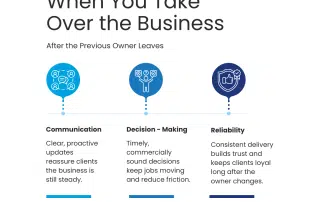
After the Previous Owner Leaves: How to Keep Clients When You Take Over the Business
Taking over an established business is a major investment, especially when you inherit a team, long-standing clients, and systems held together by habit rather than structure. This is common in the types of acquisitions I see owners make. Architectural aluminium manufacturers, sheet metal fabricators, powder coating workshops, mechanical repair businesses, height safety fabricators, wholesalers, distributors, and plant and equipment hire firms often have strong technical capability but inconsistent processes and extensive tribal knowledge. When the previous owner steps away, the business enters a vulnerable period. Clients start watching closely. Staff feel unsettled. Competitors look for openings. This is where strong ...
Protected: Tenfold Client Briefing: Petrol Prices, Recession Prediction and Actions to Take Now
This content is password-protected. To view it, please enter the password below. Password:
