

Managing an Estimator for the First Time: How to Improve Margins, Speed, and Accuracy
About the Author: Ashley Thomson

In a previous guide, we examined the process of hiring an estimator tailored for a trade or construction business. Many business owners successfully take this initial step; however, the real challenge begins once the estimator is officially part of the team. Without clear structures, robust management practices, and effective communication channels, the role of the estimator can quickly become inefficient, prone to inaccuracies, or disconnected from the business’s overall operations.
This article offers a practical and straightforward framework specifically designed for established trade business owners across Australia. Whether you own a construction company or you’re a builder, electrician, plumber, concreter, HVAC contractor, solar installer, or civil and structural contractor, the principles outlined here will assist you in effectively managing your in-house estimator.
Implementing these strategies can help you protect your profit margins, accelerate project completion, and reduce costly errors. By fostering a supportive environment with clear expectations and regular feedback, you can maximise the value that your estimator brings to your business and enhance overall operational efficiency.
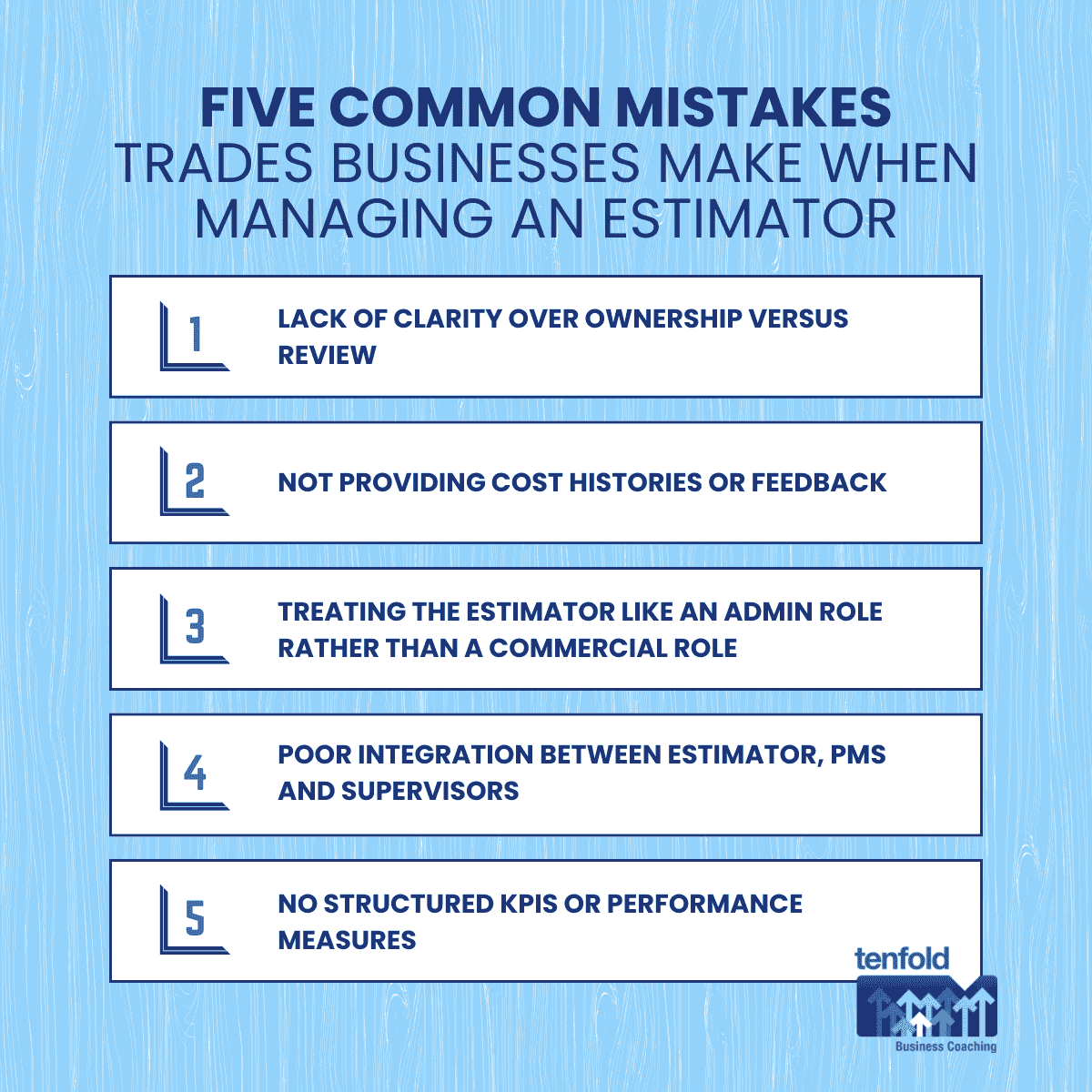
Five Common Mistakes Trades Businesses Make When Managing an Estimator – and How to Avoid Them
Lack of Clarity Over Ownership Versus Review
One of the most common pitfalls is failing to clearly define which parts of the estimating process the estimator owns outright and which require approval from the owner or project manager. Without clear boundaries, estimators may either overstep their authority or underperform. For instance, if decisions regarding profit margins are left ambiguous, the estimator might apply inconsistent mark-ups, ultimately eroding profitability. The solution is to establish explicit workflows. Clearly identify which decisions the estimator can make independently, such as take-offs and labour assumptions, and which decisions require review, such as final margin adjustments or scope inclusions. It is important to document these boundaries thoroughly and reinforce them during weekly check-in meetings, ensuring that ownership of tasks is transparent and accountability is maintained.
Not Providing Cost Histories or Feedback
Estimators cannot effectively improve their accuracy if they are pricing blindly. When they do not have access to actual data from past projects, they tend to rely on guesswork or outdated assumptions. This often results in quotes that appear reasonable on paper but fail to hold up in real-world scenarios. A practical solution is to implement regular reviews comparing actual costs with initial estimates. After each project, the estimator’s figures should be compared with the final, actual costs incurred. This data should be shared openly within the team and used as a basis for discussion, focusing on where assumptions were correct and where they missed the mark. Over time, this consistent feedback process sharpens the accuracy of future estimates and helps to build a reliable and comprehensive cost library. Businesses that commit to this disciplined approach will typically see a significant improvement in their estimators’ precision, which in turn provides greater protection against budget overruns and unexpected costs.
Treating the Estimator Like an Admin Role Rather Than a Commercial Role
Another common mistake is assigning the estimator with low-value administrative tasks. If they spend hours formatting documents, chasing subcontractor compliance paperwork, or entering data manually, they are not dedicating time to quoting. The primary role of an estimator is commercial, not clerical. It is important to protect their time by providing administrative support where necessary. For example, a junior administrator can handle document formatting and compliance checks, which allows the estimator to focus on pricing strategies and margin analysis. When the estimator’s role is recognised as a commercial one, their output directly contributes to the overall profitability of the project, rather than being diminished by inefficient admin tasks.
Poor Integration Between Estimator, PMs and Supervisors
Estimators who work in isolation often overlook constructability issues or scope gaps that can arise during a project. Without regular input and collaboration from project managers and supervisors, the quotes produced may appear accurate and thorough on paper but can fall short when applied in the field. The consequences of such oversights are costly rework, disputes, and erosion of profit margins. To avoid these problems, it is essential to incorporate cross-functional communication into your workflow. This can be achieved by encouraging estimators to participate in project kick-off meetings, walk sites with supervisors, and review scopes of work directly with project managers. Such integration ensures that the quotes accurately reflect real-world conditions and that operational teams have confidence in the numbers provided. A seasoned business coach would emphasise that this level of integration is not optional; it is crucial in bridging the gap between theoretical pricing and practical application, ultimately leading to more successful project outcomes.
No Structured KPIs or Performance Measures
Many owners rely on their intuition to judge whether their estimator is performing well, which can be quite risky. This approach leaves the role without clear standards, making it difficult to evaluate success consistently. A better solution is to implement a simple yet reliable performance framework. Establish key performance indicators (KPIs) that cover accuracy, speed, commercial awareness, collaboration, process discipline, and continuous improvement. Review these KPIs on a monthly basis and provide constructive feedback to the estimator. When expectations are clearly defined and measurable, the estimator understands exactly what success looks like. This also allows the owner to manage the estimator’s performance objectively, rather than relying solely on intuition or gut feelings.
Management Framework: Practical Systems for Owners
Managing an estimator doesn’t require complicated systems, but it does need discipline. Hold weekly check-ins of 15 to 30 minutes to review current quotes, clarify assumptions, and tackle any bottlenecks. Monthly pipeline and pricing meetings offer a wider perspective. In these, discuss upcoming tenders, workload distribution, and margin strategies. Update templates, margins, or assumptions quickly and in writing to prevent the estimator from working with outdated info. Keep the estimator involved in project delivery by including them in post-project reviews and site visits. This prevents them from becoming isolated and ensures their pricing aligns with operational realities. The aim is to establish a communication rhythm that keeps the estimator in sync with the business’s commercial objectives.
Performance Rubric for the Estimator Role
To manage performance effectively, owners need a clear rubric. Below is a framework with three levels: Developing, Competent, and High Performer. It assesses performance across six key categories.
Accuracy
A Developing estimator produces take-offs with frequent errors, inconsistent labour assumptions, and margins that vary without justification. Rework is common. A Competent estimator delivers reliable take-offs, applies consistent labour assumptions, and maintains margin discipline with minimal rework. A High Performer consistently produces accurate take-offs, applies labour assumptions that reflect real-world productivity, maintains margin consistency across all quotes, and requires little to no rework.
Speed and Throughput
A Developing estimator struggles with turnaround times, often missing deadlines and finding it difficult to manage multiple quotes. Workflow discipline is weak. A Competent estimator meets deadlines, manages several quotes simultaneously, and follows established workflows. A High Performer delivers quotes quickly without sacrificing accuracy, handles multiple complex tenders with ease, and demonstrates strong workflow discipline that keeps the pipeline moving smoothly.
Commercial Awareness
A Developing estimator has a limited understanding of margin and risk, misses scope gaps, and rarely clarifies RFIs proactively. A Competent estimator understands margin and risk, identifies scope gaps, and seeks clarification when needed. A High Performer demonstrates strong commercial awareness, proactively identifies and addresses scope gaps, manages risk effectively, and initiates RFIs to protect the business’s position before issues arise.
Communication and Collaboration
A Developing estimator communicates inconsistently, interacts poorly with PMs, supervisors, clients, and subcontractors, and lacks professionalism. A Competent estimator communicates clearly, interacts professionally with all stakeholders, and responds promptly. A High Performer demonstrates exceptional professionalism, builds strong relationships with PMs, supervisors, clients, and subcontractors, and communicates with clarity and responsiveness, thereby enhancing trust and collaboration.
Process Discipline
A Developing estimator struggles to use company templates and systems, lacks documentation control, and is inconsistent with workflows. A Competent estimator uses templates and systems correctly, maintains documentation and version control, and follows workflows reliably. A High Performer demonstrates rigorous process discipline, ensures documentation is always accurate and controlled, and consistently applies workflows that improve efficiency and reduce risk.
Continuous Improvement
A Developing estimator rarely updates rate libraries or templates, does not participate in cost reviews, and offers few process improvements. A Competent estimator updates rate libraries and templates when required, participates in cost reviews, and occasionally suggests improvements. A High Performer actively updates rate libraries and templates, participates enthusiastically in cost reviews, and regularly suggests process improvements that enhance accuracy and efficiency.
Why Business Coaching for Tradies Helps Owners Manage Estimators
Many trade business owners are technically skilled but face commercial challenges. Managing an estimator requires systems, clarity, and discipline that don’t come naturally to everyone. Business coaching services, such as those offered by Tenfold Business Coaching, help owners put these frameworks into place. A business coach provides accountability, ensures KPIs are applied consistently, and helps owners protect margins by managing the estimator’s role effectively. Business coaching for tradies is especially valuable because it translates commercial principles into practical steps suited to the realities of construction and trade businesses.
Turning Estimating into a Profit Centre
Hiring an estimator is only the first step. Managing them effectively turns estimating into a profit centre rather than a cost. By avoiding common mistakes, applying a practical management framework, and using a clear performance rubric, trade business owners can ensure their estimator provides maximum value. The outcome is better margins, faster quoting, lower risk, and smoother operations. For businesses with turnover between $1M and $10M, these improvements are not small; they are game-changing. With the right management, your estimator becomes a key driver of commercial success instead of just a back-office task. That is the power of disciplined management and the clarity that business coaching services give to tradies who want to grow confidence. Get started, today.