


How to Hand Over Estimating: A Practical Guide for Trades & Construction Business Owners
About the Author: Ashley Thomson

For many well-established builders and contractors, estimating has been a fundamental aspect of their business journey. It is the core skill that secured their first jobs, helped build credibility with clients, and laid the financial groundwork for their companies. Owners often find it difficult to let go of estimating because it feels inherently linked to their identity as business leaders. They worry that no one else will fully understand the subtleties of their trade, the risks hidden within drawings, or the client expectations that can determine the success or failure of a project.
Business coaching services emphasise that this reluctance is a natural human instinct; however, it can also serve as a significant bottleneck to growth. When owners continue to handle all the estimating themselves, they inadvertently limit their business’s potential, reduce their responsiveness to market demands, and hinder scalability beyond their personal capacity. Delegating this crucial task can be challenging, but it is essential for enabling the company to expand and thrive.
What Work Should Be Handed Over First
The transition does not need to be abrupt. Owners should begin by handing over the simpler, lower-risk estimates to their new estimator. These might include repeat jobs, standardised scopes, or projects with minimal complexity. By starting with work that has fewer variables, the estimator can gradually build confidence and improve accuracy in their assessments. Meanwhile, the owner can maintain oversight of more complex or high-value quotes.
Business coaching for tradies often emphasises that this staged approach helps reduce stress for both parties involved. It creates a safer, more manageable environment for everyone, allowing each step to be completed with greater confidence and clarity.
How to Implement a Staged Transition Plan
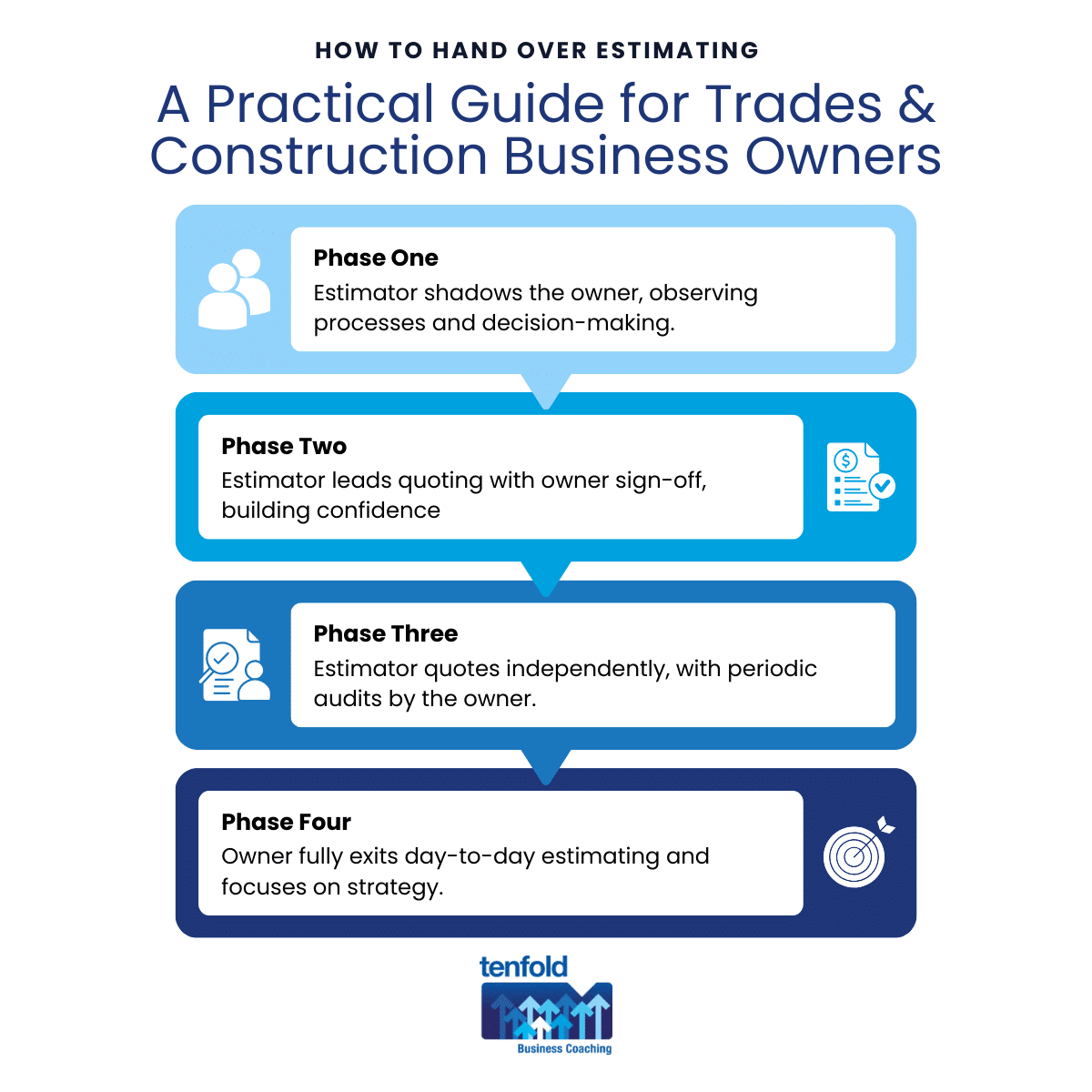
A staged transition plan is regarded as the most effective method for transferring estimating responsibilities from the owner to the estimator. This plan should be carefully organised into distinct phases that progressively increase the estimator’s level of independence. In the initial phase, the estimator shadows the owner, closely observing how quotes are prepared and reviewed to gain a thorough understanding of the process.
During the second phase, the estimator takes the lead in the quoting process but still submits each estimate for the owner’s review and approval. This allows the owner to monitor progress and provide guidance as needed. In the third phase, the estimator is responsible for quoting independently, with the owner periodically conducting audits to ensure accuracy and consistency.
Finally, in the fourth phase, the owner completely steps back from day-to-day estimating activities. Instead, they focus on leadership, sales, and strategic planning to support the business’s ongoing growth.
Business coaching services emphasise that implementing this structured roadmap offers clarity throughout the transition process. It also helps to reduce potential risks and ensures that the changeover is carried out smoothly and effectively.
What Quality Checks and Approval Gates Are Needed Early On
Quality checks are crucial during the early stages of any transition process. Owners should put in place approval gates that require estimates to be carefully reviewed before submission. These gates might include verifying the clarity of the scope, checking the assumptions related to productivity, and confirming the risk allowances included in the estimates.
By incorporating these checks into the workflow from the outset, owners can ensure they maintain a high level of confidence in the work produced by the estimator. This approach also allows them to gradually reduce their direct involvement over time, trusting that the quality controls are effectively in place.
It is common to introduce structured review templates. These templates help ensure consistency in the checking process across projects and team members, ultimately leading to more reliable and accurate estimates.
How to Set Up Workflows That Ensure Independence
Workflows are the foundation of estimator independence. Without well-defined processes, estimators may become overly reliant on the owner, resulting in delays and workflow inefficiencies. It is essential that workflows clearly outline how information flows from the initial client enquiry through to the final quotation, including who is responsible for each step.
Estimators should have access to standardised templates, comprehensive databases of historical productivity rates, and well-established protocols for defining the scope of work. Business coaching services emphasise that when workflows are carefully designed and implemented, estimators can operate more autonomously. This increased independence allows the owner to concentrate on higher-value activities that contribute more significantly to the business.
Having structured workflows in place not only improves efficiency but also enhances consistency and accuracy across estimates, which benefits both the estimator and the client. By ensuring that each stage of the process has clear guidance and accountability, businesses can achieve smoother operations and better overall outcomes.
How to Avoid Boomerang Work
Boomerang work occurs when estimators send everything back to the owner for review or correction. This process can undermine the smooth transition of responsibilities and often keeps the owner trapped in the day-to-day details of estimating. Such situations can slow down the overall workflow and create unnecessary frustration.
To avoid boomerang work, owners must establish clear expectations for decision-making authority from the outset. Estimators should be empowered to resolve routine issues on their own, with only the more complex or high-risk matters requiring escalation to the owner for input. This approach helps streamline the estimating process and reduces bottlenecks.
In addition, business coaching for tradies often recommends implementing regular check-ins. These meetings allow team members to address questions proactively, which in turn minimises the likelihood of work bouncing back to the owner for minor clarifications. By fostering open communication and setting firm boundaries on decision-making, businesses can ensure a more efficient and effective estimating process.
How to Build Confidence Through Accuracy Checks and A vs E Reviews
Confidence in the estimator improves as accuracy is consistently measured and demonstrated. Conducting accuracy checks involves comparing actual project costs with initial estimates, a process commonly referred to as A versus E reviews. These reviews serve to highlight instances where estimates were precise and identify areas where adjustments are necessary, thereby providing valuable insights.
Over time, the regular application of A versus E reviews establishes a feedback loop that continually enhances estimating accuracy. This process also helps to build and reinforce trust between the project owner and the estimator, fostering a more collaborative relationship. Business coaching services emphasise that such reviews should be conducted regularly and viewed as an important learning tool rather than a means for assigning blame. When approached in this manner, A versus E reviews can significantly improve project outcomes and strengthen professional relationships.
How Owners Should Reallocate Their Time
As responsibilities shift, owners must reallocate their time toward activities that actively promote business growth. This includes engaging in sales, managing client relationships, and conducting strategic planning. By stepping back from the task of quoting, owners can devote more attention to building stronger relationships with clients, exploring new markets, and enhancing the business’s competitive position in the industry.
Business coaching aimed explicitly at tradies often emphasises that this reallocation of time and focus is one of the key benefits of hiring an estimator. It frees up owners to work on the business rather than just within it, which ultimately helps in creating scalability and sustainable growth.
Step-by-Step Transition Roadmap
A clear transition roadmap is essential for trade and construction business owners who want to move estimating responsibilities from themselves to a dedicated estimator. Without structure, the process can feel uncertain and lead to frustration for both the owner and the estimator. With a staged plan, however, the handover becomes predictable, controlled, and confidence-building.
Phase 1: Shadowing and Observation
The journey begins with the estimator shadowing the owner. At this stage, the estimator is not expected to produce quotes independently; instead, they learn by watching how the owner approaches scope reviews, risk allowances, and client communication. This phase is about absorbing processes and understanding the decision-making logic that underpins accurate estimating.
Phase 2: Estimator-Led Quoting with Owner Sign-Off
Once the estimator has observed enough to grasp the fundamentals, they begin leading the quoting process. Every estimate is still reviewed and signed off by the owner, which provides a safety net while allowing the estimator to build confidence. This stage is critical for reinforcing accuracy and ensuring that the estimator’s approach aligns with the business’s standards.
Phase 3: Independent Quoting with Periodic Audits
As confidence grows, the estimator begins quoting independently. The owner steps back from daily involvement but continues to conduct periodic audits. These audits are not about micromanagement but about quality assurance. They provide opportunities to identify strengths, highlight areas for improvement, and ensure that the estimator’s work consistently protects the margin.
Phase 4: Owner Fully Exits Day-to-Day Estimating
The final phase is where the owner fully steps away from estimating. At this point, the estimator can manage the quoting process independently, supported by established workflows and accuracy checks. The owner reallocates their time into leadership, sales, client relationships, and strategic growth. Business coaching services often guide owners through this roadmap, ensuring that each phase is completed thoroughly before progressing to the next.
This structured approach prevents rushed handovers, reduces the risk of errors, and builds trust between the owner and the estimator. By following the roadmap, owners can confidently step back from estimating while knowing their business is protected and positioned for growth.
Building a Scalable Business Through Estimator Independence
Transitioning out of estimating is one of the most significant steps a trade or construction business owner can take to scale their business. While it can be challenging to let go, a structured plan, clear workflows, and regular accuracy checks make the process manageable and effective. By empowering estimators to operate independently, owners free themselves to focus on growth, client relationships, and strategy. Business coaching services provide the frameworks and support needed to make this transition successful. For builders, electricians, plumbers, concreters, HVAC specialists, solar installers, and civil contractors, handing over estimating is not just about saving time. It is about building a scalable, resilient business that can thrive beyond the owner’s personal involvement.
If you’re ready to step back from quoting and build a business that runs without you at the centre of every estimate, reach out to Tenfold Business Coaching. Our team specialises in business coaching for tradies and construction professionals, helping owners implement proven systems, train estimators, and protect margin through every phase of growth. Contact Tenfold Business Coaching to start your transition with confidence.
Frequently Asked Questions
How can I maintain quality control when handing over estimating?
Quality control is maintained through structured review gates and accuracy checks. Early on, every estimate should be reviewed before submission, and periodic audits should continue as the estimator gains independence.
How do I build trust in a new estimator?
Trust is built through accuracy checks and A vs E reviews. By comparing actual costs against estimates, owners can see where the estimator is accurate and where adjustments are needed.
What if workflow issues slow down the transition?
Workflow issues should be addressed by creating clear processes and responsibilities. Standardised templates and protocols reduce confusion and ensure that estimators can operate independently.
How long does the transition usually take?
The timeline varies depending on the complexity of the business and the estimator’s experience. A staged plan typically takes several months, with each phase completed before moving to the next.
How do I know when the transition is complete?
The transition is complete when the estimator can quote independently, accuracy is consistent, and the owner no longer needs to be involved in day-to-day estimating. At this point, the owner can focus fully on leadership, sales, and strategy.


