


Hiring an Estimator for the First Time: A Practical Guide for Trades & Construction Businesses
About the Author: Ashley Thomson

For most growing trade and construction businesses, the owner begins as the estimator. It’s a natural progression: you know the work, the clients, the suppliers, and the numbers better than anyone else. But as your business grows, estimating quietly becomes a bottleneck. It starts competing with supervising teams, overseeing projects, and driving new opportunities. Eventually, quoting slows down, margins fluctuate, and growth stalls.
With over 20 years of coaching established trades and construction businesses, Tenfold Business Coaching has seen this turning point hundreds of times. The pattern is consistent: when the owner is still doing the estimating, the business eventually hits an invisible ceiling.
Hiring an estimator stops being a “maybe later” idea and becomes a strategic necessity.
Yet for many owners, handing over estimating feels risky. It’s a high-stakes role — the kind where a great hire can accelerate growth, but a poor hire can erode margins, lose jobs, and damage client relationships. Combine that with a competitive job market (in cities like Melbourne, Sydney, and Brisbane, SEEK regularly lists 1,000+ estimator roles), and caution is understandable.
However, when approached with structure and preparation, bringing on your first estimator is one of the highest-leverage decisions you can make.
Why Estimating Becomes a Bottleneck as Your Business Grows
Based on two decades of coaching trades and construction companies, three friction points consistently emerge when the owner remains the estimator.
- Quote turnaround slows down
Operational demands intensify. You’re juggling teams, jobs, clients, and admin — and quotes inevitably slide down the list. A slow quoting cycle means opportunities go cold and competitors get in first.
- Margin consistency declines
Rushed estimates lead to missing scope items, under-costed labour, and inconsistent profit outcomes. Even small variances compound across multiple projects.
- Leadership attention becomes scattered
Time spent quoting is time not spent developing the team, refining systems, or strategically strengthening the business.
Tenfold clients who transition to a dedicated estimator often reduce their quoting backlog by 30–60% within 90 days.
A real-world example: a concreting business coached by Tenfold dramatically increased quoting capacity and regained control of bid cycles after hiring its first estimator. They had outgrown owner-led estimating, and the shift unlocked their next stage of growth.
What Estimators Earn: Salary Benchmarks You Need to Know
Before you post a job ad or start interviewing, it’s important to understand what estimators earn. According to the Hays Salary Guide FY25- 26:
Commercial Construction (Melbourne)
- Senior Estimator: approx. $155,000 (range: $120,000–$200,000)
- Intermediate/Junior: approx. $100,000 (range: $90,000–$155,000)
Residential Construction
- Senior Estimator: approx. $110,000
- Junior/Intermediate: approx. $80,000
These figures help you budget and avoid hiring someone whose salary expectations don’t match your business size or quoting complexity.
Tenfold’s coaching experience shows that businesses seeking strong communication skills, autonomy, and margin discipline often benefit from offering toward the upper-middle of the range. Hiring too cheaply is a false economy — delayed accuracy can cost more than the salary difference.
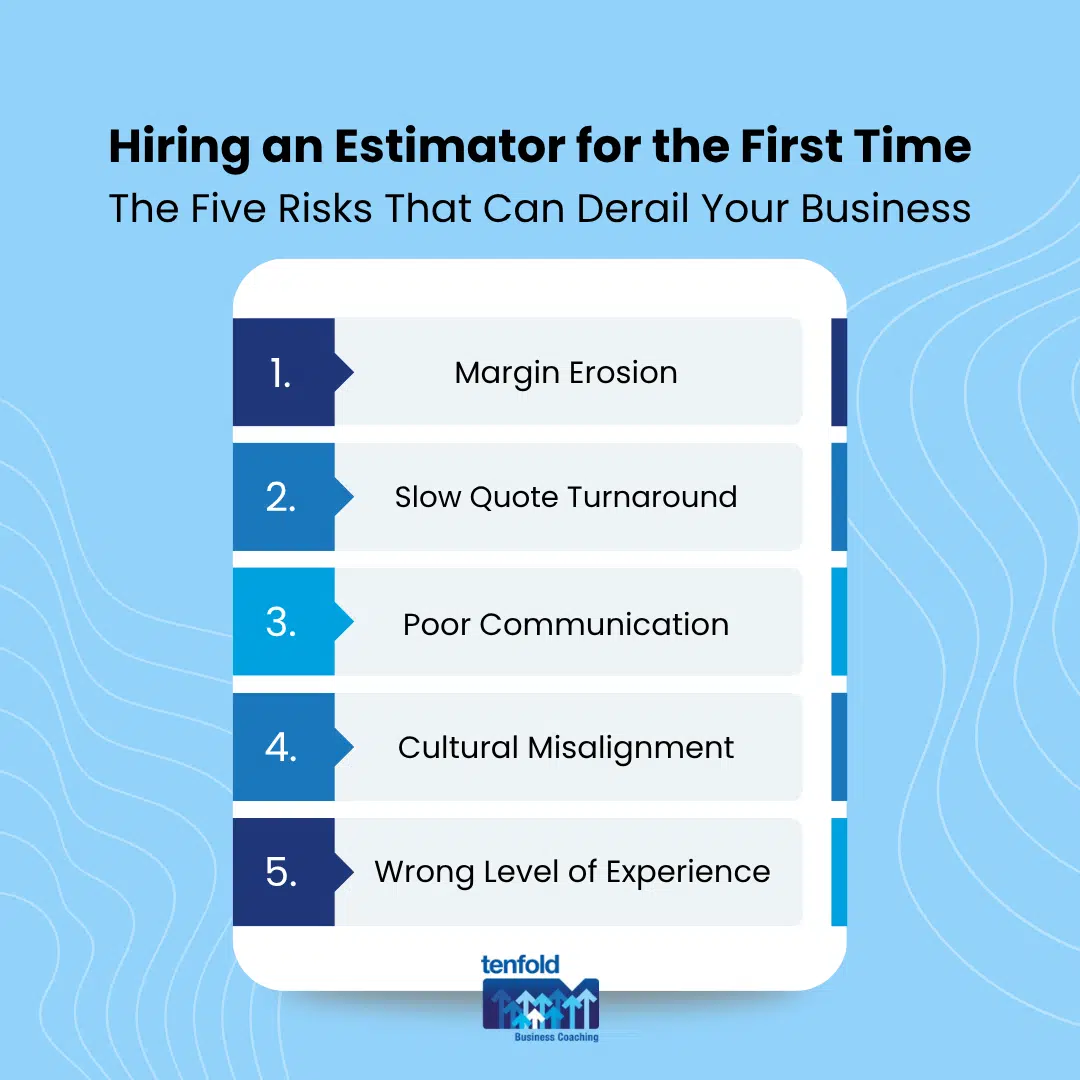
The Five Major Risks When You Hire the Wrong Estimator
Hiring an estimator is high-impact. Here are the core risks to manage.
1. Margin Erosion
This is the most financially damaging risk. If your estimator underprices jobs, overlooks scope items, or misjudges labour and materials, your margins vanish.
Even small errors can compound across multiple projects, leading to significant profit loss.
For trade businesses operating on tight margins, this kind of erosion can quickly undermine growth and stability.
2. Slow Quote Turnaround
Speed matters in quoting. If your estimator takes too long to produce quotes, you risk losing jobs to faster competitors. Slow quotes can frustrate loyal clients. Delays can also bottleneck your scheduling and cash flow. A slow quoting process can affect your entire operational rhythm.
3. Poor Communication
Estimators sit at the centre of your quoting ecosystem. They need to communicate clearly with clients, subcontractors, and project managers. If they’re vague, inconsistent, or unreliable, it creates confusion and mistrust.
Poor communication can lead to scope disputes, rework, and reputational damage, especially in high-stakes or time-sensitive projects.
4. Cultural Misalignment
Technical skill alone isn’t enough. If your estimator doesn’t align with your team’s values, pace, or accountability standards, tension will follow.
In trade businesses where collaboration is key, attitude and alignment matter just as much as ability.
5. Wrong Level of Experience
Hiring someone too senior or too junior for your business can backfire. A senior estimator may expect autonomy, complex scopes, or strategic input that your business isn’t ready to offer. A junior may lack the experience and may require supervision you don’t have capacity for.
Getting the level right ensures your estimator can thrive and your business can grow without disruption.
Prolux Electrical – a long-term Tenfold client – doubled their business within 12 months of deeply restructuring their estimating and reporting systems. A key part of their success was hiring at the right level and embedding clear accountability.
Signs You’re Ready to Hire an Estimator
Not every business is immediately ready to hire an estimator, and recognising the right time can sometimes be challenging. However the right signs are clear.
You’re ready if:
- You’re quoting 15–20+ jobs per month
This is the critical volume where quoting delays begin affecting sales and delivery schedules.
- Project complexity is increasing
Detailed scopes, multi-trade quotes, and higher-value contracts require more structured estimating.
- Job types are stable
Repeating consistent project types means your data and templates are mature enough for someone else to use effectively.
- You have historical cost data
Actual vs. estimated comparisons help a new estimator build accuracy quickly.
- You know your target margins and want to scale
If you have clear margin expectations but can’t consistently hit them, it’s likely time.
Tenfold’s experience in coaching hundreds of trades and construction businesses shows that owners who hire once two or more of these signals appear typically achieve ROI on their estimator hire within 6–9 months.
What Needs to Be in Place Before You Hire an Estimator
Hiring an estimator isn’t just about about finding the right person – it’s about setting them up for success from the very beginning.
- Standardised quoting templates
These create consistency, reduce oversight burden, and speed up quote development. Tools like standardised quoting templates give your estimator a consistent framework and help reduce the risk of errors .
- A comprehensive cost library
Labour rates, materials, subcontractor pricing, equipment allowances — all documented and regularly updated.
- Job cost history
Tracking actual costs against estimates helps refine accuracy and identify patterns. Our coaches recommend using a documented job cost history .
- Clear delegation and approval workflows
Your estimator should understand what they’re accountable for, what requires approval, and when to escalate.
- Structured communication pathways
Direct, defined communication with project managers, subcontractors, and clients prevents errors and accelerates decision-making.
- The right technology
Take-off software, estimating systems, shared drives, and version-controlled templates ensure accuracy and collaboration.
Tenfold has found that clients with strong pre-hire systems experience 40% fewer estimating revisions within the first year of bringing an estimator onboard.
Onboarding Your Estimator: A 90-Day Plan
Onboarding determines whether your estimator becomes a high performer or a high-cost uncertainty.
Month 1 — Foundations
Week 1: Orientation
Introduce processes, review past jobs, define expectations, and align on margin targets.
Week 2: Systems Training
Walk through software, templates, workflows, and take-off methods.
Weeks 3–4: Supervised Estimating
Quote real jobs under guidance, with daily feedback loops.
Month 2 — Building Competence
Increase independence, update templates based on learning, and review accuracy weekly.
Month 3 — Ownership
By the end of month 3, your estimator should own the full estimating cycle. Continue fortnightly reviews to maintain consistency.
One Tenfold-coached client in managed services saw quoting capacity increase 35% by week 11 after implementing this structured onboarding approach.
What to Expect After You Hire
A strong estimator delivers measurable improvements within the first 3–6 months:
- Faster quote turnaround
- Higher conversion rate
- More consistent margins
- Fewer surprises during delivery
- Less pressure on the owner
- Greater ability to plan work and cash flow
As the business owner, you’ll have more time to focus on leadership and strategic planning. But you’ll also need to stay involved. You’re not stepping away from estimating entirely; you’re stepping into a new role as the overseer of a critical business function.
Reliable Plumbing (a 40-year-old Melbourne business coached by Tenfold) improved net profit five-fold by implementing a structured estimating function combined with strong operational systems.
When to Reassess and Scale Further
Hiring your first estimator is a significant milestone but often, it’s only the beginning.
As your business grows, you may need to add:
- a second estimator
- a senior estimator
- an estimating manager
- upgraded systems
- expanded cost libraries
Tenfold clients typically reach this point around $10–15 million revenue or 30+ quotes per month. At this stage, estimating becomes a specialist department rather than a single role.
Business Coaching for Tradies: Making the Transition Smooth
Delegating estimating can feel like a major step. Business coaching helps owners clarify readiness, build the right systems, avoid hiring mistakes, and support their estimator through onboarding and performance monitoring.
Since 2002, Tenfold has coached trades and construction businesses across Australia, including builders, electricians, plumbers, landscapers, and civil contractors. These are established businesses — typically $3M–$10M revenue — looking for structure, predictable profit, and scalable systems.
The businesses that succeed aren’t necessarily the ones with the most technical knowledge. They’re the ones with clarity, direction, accountability, and the right people doing the right jobs.
Final Thoughts: Confidence Through Clarity
Hiring an estimator for the first time is a high-stakes decision. But it doesn’t have to be a gamble. With the right preparation, clear systems, and expert support, you can make a confident hire that strengthens your business. Whether you’re ready now or still assessing, the key is clarity. Know your numbers. Know your goals. Know what success looks like. And if you’re unsure, speak with a business coach who understands the trade sector. At Tenfold Business Coaching, we specialise in helping trade businesses make smart, strategic decisions, including when and how to hire an estimator.
FAQs
Why is hiring an estimator considered high-risk for trade businesses?
A poor hire can lead to inaccurate quotes, lost jobs, margin erosion, and internal disruption. Estimators directly influence revenue and profitability, so the stakes are high.
How do I know if my business is ready to hire an estimator?
If you’re quoting 15-20 jobs a month, have stable job types, historical cost data, and clear margin targets, you’re likely ready. If estimating is slowing you down, it’s time to delegate.
What salary should I expect to pay?
In Melbourne, senior construction estimators typically earn $155,000. Junior or intermediate roles sit around $100,000. Residential estimators are slightly lower. These figures vary by location and experience.
What systems should I have in place before hiring?
You’ll need quoting templates, cost libraries, job cost history, delegation workflows, communication pathways, and estimating software. These ensure your estimator can hit the ground running.
How can business coaching help with hiring an estimator?
Business coaching services help you assess readiness, prepare your systems, structure onboarding, and monitor performance. Coaches also help you avoid common hiring mistakes and align the role with your growth goals.


