
How AI Is Changing Employment and People Management for Small Business Owners
About the Author: Ashley Thomson

This article provides general information only and is not legal advice. You should seek advice specific to your circumstances before acting.
Across Australia, small and medium-sized businesses are navigating a wave of change in how they manage people. At the centre of this shift is artificial intelligence. From recruitment to rostering, AI is becoming part of the everyday toolkit for employers. But as these tools become more common, so too do the risks. One of the clearest warning signs? A sharp rise in unfair dismissal and employment-related claims.
According to the Fair Work Commission’s 2024-25 annual report, unfair dismissal applications made up more than one-third of all workplace claims, with a 10% increase in total lodgements compared to the previous year. That’s not just a legal statistic; it’s a signal that many businesses are struggling to manage staff transitions fairly and in compliance with the law in a rapidly changing environment.
As business coaches working with trade, construction, manufacturing, and service-based SMEs, we’re seeing this play out in real time. Employers are adopting AI to improve efficiency, but without the right systems and safeguards, they’re also exposing themselves to unnecessary risk. Let’s unpack what’s happening, where the pitfalls lie, and how to use AI responsibly in your business.
AI is already part of your HR toolkit
You might not think of your rostering software or recruitment platform as “AI”, but chances are, it includes some form of machine learning or automation. AI is now embedded in many of the tools used to screen candidates, schedule shifts, track productivity, and even draft HR documents.
In recruitment, AI can scan resumes, shortlist applicants, and even conduct initial video interviews using facial recognition and sentiment analysis to evaluate candidates. In performance management, AI tools can analyse output, attendance, and customer feedback to flag underperformance. Some platforms generate automated warnings or performance summaries based on this data.
In workforce management, AI-driven software can optimise rosters based on availability, skillsets, and business demand. In HR documentation, AI is being used to draft contracts, warning letters, and termination notices using templates and predictive text.
These tools can save time and reduce human error. But they also change the way decisions are made, and that’s where business owners need to tread carefully.
Changing roles, rising expectations
As AI assumes more administrative and analytical tasks, the role of managers is evolving. Instead of manually reviewing every CV or writing every performance note, managers are now interpreting AI-generated insights and making decisions based on them.
This can be a positive shift. It frees up time for coaching, mentoring, and strategic planning – the kind of work that drives long-term business growth. But it also requires new skills. Managers need to understand how AI tools work, what their limitations are, and how to apply human judgment to the data they produce.
At the same time, employees are becoming more aware of how they’re being monitored and assessed. If they feel that decisions are being made by a machine, without context or compassion, trust can erode quickly. That’s especially true in high-stakes situations like performance management or termination.
Where the risks arise
The rise in unfair dismissal claims is not just about AI. It reflects broader pressures, such as economic uncertainty, cost-of-living stress, and changing workplace laws. AI can amplify those risks if it’s used without proper oversight.
One of the biggest dangers is over-reliance. If a manager acts on an AI-generated performance report without checking the context (for example, that an employee’s output dropped due to a family emergency), they may make a decision that appears unfair or discriminatory.
Another risk is a lack of transparency. If staff don’t know they’re being monitored, or don’t understand how decisions are made, they may feel blindsided. That can lead to grievances, disputes, and ultimately claims.
There’s also the issue of bias. AI systems are only as good as the data they’re trained on. If that data reflects past biases (for example, favouring certain qualifications or communication styles), the AI may replicate those patterns, even if unintentionally.
Finally, there’s the risk of poor documentation. If a dismissal is challenged, the Fair Work Commission will look at the process followed, not just the outcome. If the employer can’t show that they considered the full context, gave the employee a chance to respond, and followed a fair process, they may be found to have acted unfairly, even if the decision itself was reasonable.
Using AI responsibly in your business
So how can small business owners use AI tools without falling into these traps? The key is to treat AI as a support tool, not a decision-maker. It can help you gather information, spot patterns, and streamline admin. But it should never replace human judgement, especially when it comes to people.
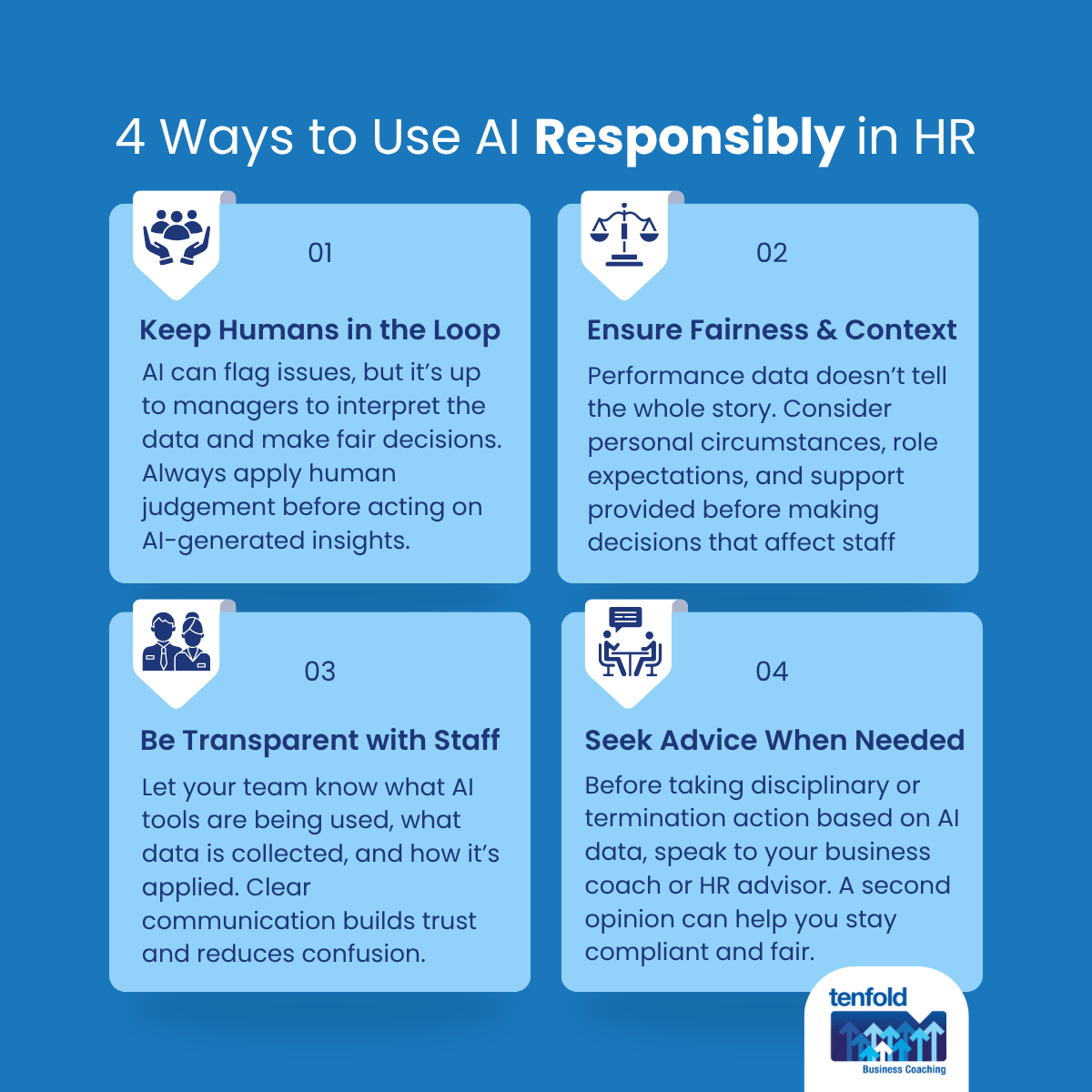
Keep humans in the loop. Make sure managers are reviewing AI-generated insights and applying context before making decisions. Train them to ask questions, seek clarification, and consider the human side of the story.
Ensure fairness and context. If an AI tool flags underperformance, look at the broader picture. Has the employee been given clear expectations? Have they had the support they need? Are there external factors at play?
Be transparent with staff. Let your team know what tools you’re using, what data is being collected, and how it’s being used. This builds trust and reduces the risk of misunderstandings.
Know when to seek advice. If you’re considering disciplinary action or termination based on AI-generated data, it’s wise to get a second opinion. That’s where HR experts come in.
At Tenfold Business Coaching, we work closely with Strawberry Seed Consulting, our HR advisory alliance partner. They provide practical, plain-English advice on HR and recruitment for small businesses. Whether you’re reviewing your performance processes or navigating a tricky staff issue, they can help you stay compliant and fair. You can learn more about them at Strawberry Seed Consulting.
AI is here to stay – but so is good management
The rise of AI doesn’t mean the end of people management. In fact, it makes strong leadership more important than ever. Your team still needs clear communication, fair treatment, and a sense of purpose. Your managers still need to coach, support, and make tough calls with empathy and professionalism.
As business coaches, we see AI as a powerful tool, but only when used wisely. It can help you run a more efficient, data-informed business. But it can’t replace your values, your culture, or your responsibility as an employer.
If you’re not sure how AI is being used in your business, or you want to make sure your systems are supporting good decisions, now is the time to take stock. At Tenfold Business Coaching, we help business owners like you leverage technology to grow sustainably, with the right advice, partners, and processes in place.
Reach out to us for a strategic review of your people systems. Together with our HR partners at Strawberry Seed Consulting, we’ll help you harness AI in a way that supports your team, protects your business, and sets you up for long-term success.
Frequently Asked Questions
Is AI increasing unfair dismissal claims?
AI itself isn’t the cause of rising claims, but poor use of AI can contribute. If decisions are made without proper process or human oversight, employees may feel they’ve been treated unfairly. That’s why it’s critical to use AI as a support tool, not a substitute for sound judgement.
Can AI write warning letters?
Yes, many HR platforms now offer AI-generated templates for warning letters. These can save time, but they still need to be reviewed and tailored by a manager. Always ensure the content is accurate, fair, and aligned with your business’s policies.
How open should I be with staff about AI monitoring?
Transparency is key. Let staff know what data is being collected, how it’s used, and what it means for them. This helps build trust and reduces the risk of disputes down the track.
What records should I keep when using AI data?
Keep clear records of how AI data is used in decision-making, especially for performance management or termination. Document the human review process and any conversations with the employee. This can be vital if a claim is made.
Does AI make redundancy easier?
AI can help identify patterns or inefficiencies, but redundancy decisions must still follow a fair and lawful process. That includes consultation, exploring redeployment options, and ensuring decisions are not discriminatory. Always seek HR advice before proceeding.
How do I reduce staff anxiety about AI?
Start with clear communication. Explain what AI is, how it’s used, and what it means for their roles. Emphasise that AI is there to support, not replace, people and that human judgement still matters.
Can AI tell me if a dismissal is lawful?
No. AI can flag issues or suggest actions, but it can’t assess legal risk or apply the Fair Work Act. Before making any termination decision, especially one based on AI data, seek advice from an HR or legal professional.
Who should I talk to before making HR decisions involving AI?
Speak to your business coach and your HR advisor. At Tenfold, we work alongside Strawberry Seed Consulting to help you make informed, compliant decisions. Together, we can guide you through the process and reduce your risk.