


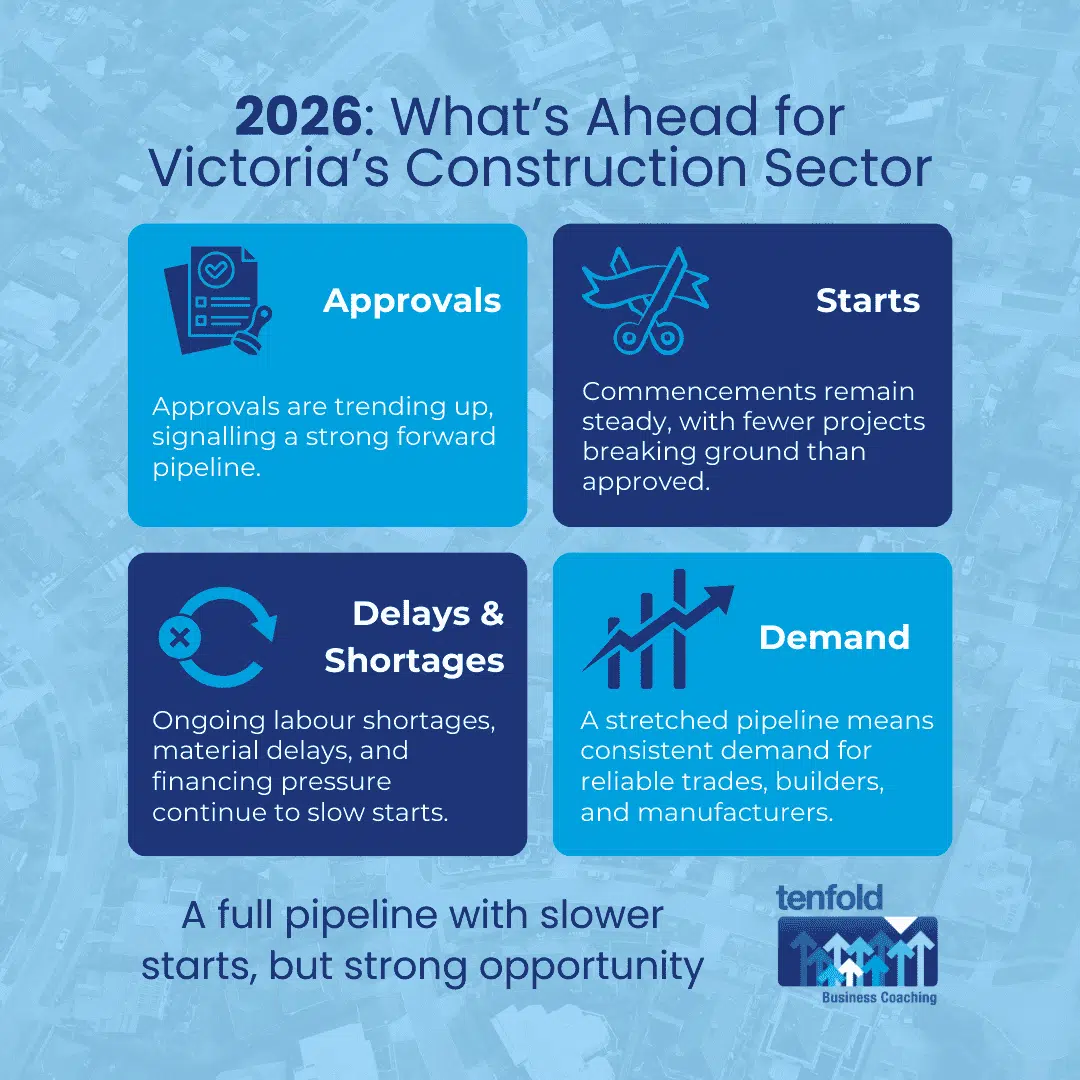
Victoria’s Construction Pipeline 2026: Approvals, Commencements and What It Means for Trades, Builders and Manufacturers
About the Author: Ashley Thomson

This article is part 2 of Tenfold’s “Victoria’s Economy 2026” series for business owners in construction, trades and manufacturing.
In the opening article, Victoria’s Economy 2026: Growth and Demand Snapshot for Trades, Builders and Manufacturers, I outlined the big-picture growth and demand backdrop in Victoria and why owners need tighter decision frameworks in a more uneven market. This instalment focuses on the construction pipeline (public and private), what approvals and commencements are really telling us, and what that means for pricing, cash, capacity and risk decisions as you plan into 2026.
How to read the pipeline without fooling yourself
Most owners hear “approvals are up/down” and assume that’s the job queue. It isn’t. For operational decisions, I want you to separate three layers: approvals, commencements, and work done. They each matter, but for different reasons.
Approvals are intent, not workload
Building approvals are a leading indicator. They show what’s been approved, not what has started and certainly not what will flow smoothly through to your schedule. They’re also lumpy. A handful of larger multi-unit projects can swing a month’s result without creating stable, predictable work for the average trade contractor or supplier.
Use approvals as an early warning for the next 3–9 months. If approvals are choppy or trending down in your segment, assume competition increases and quote quality declines unless you tighten your qualification rules. The ABS is the cleanest source for approvals data: ABS Building Approvals, Australia (latest release).
Commencements are closer to “boots on the ground”
Commencements are a better proxy for actual site activity. They’re still not perfect (a “start” doesn’t guarantee a clean programme), but they’re far closer to what drives labour planning, supplier ordering, and your cash timing.
The ABS publishes building activity data (including commencements and work done): ABS Building Activity, Australia (latest release). If commencements soften, you’ll usually see a lagged effect: more re-quotes, more scope changes, and more pressure on payment behaviour as businesses chase fewer starts.
“Work done” explains why you can feel busy during a slowdown
Even when approvals fall, many businesses stay busy because of backlog and longer build times. That’s why I encourage owners to run a simple internal dashboard:
- Secured backlog (signed work, scheduled)
- Quoted pipeline (weighted by probability and realistic start timing)
- Conversion rate (by segment and by lead source)
- Average gross margin (by job type)
If you don’t quantify conversion and start timing, you’ll over-hire at the top and panic-cut at the bottom. In my business coaching work with Victorian trades and builders, this is one of the fastest fixes that improves decisions without adding admin for the sake of it.
What the latest approvals signal in Victoria (and why it matters)
The most useful question isn’t “are approvals up or down?” It’s: what’s happening in the segments that feed your revenue, and what does that do to margin and risk?
In the ABS October 2025 release, Victoria’s seasonally adjusted total dwellings approved fell sharply month-on-month (down 24.7%). That headline is a reminder that demand is still sensitive to finance conditions and confidence, especially in discretionary new-build segments. You can see the state breakdown in the ABS release here: ABS Building Approvals, Australia (October 2025 release page).
Here’s how I translate this into decisions for owners:
- Pricing power is not uniform. If you’re heavily exposed to new detached housing, you’re more exposed to the “rate-and-confidence” cycle than businesses with a mix of maintenance, insurance, compliance, and light commercial work.
- Multi-unit approvals don’t automatically equal stable work. Apartments and medium density can swing the data, but the work often arrives in uneven packages, and build programmes can stretch or pause when finance and pre-sales are under pressure.
- Quote discipline becomes a margin lever. In a softer approvals environment, average job quality declines unless you qualify harder, price risk properly, and walk away from messy scope.
If you’re feeling pipeline pressure right now, start by getting clear on which approvals category you’re actually dependent on (detached, medium density, high rise, non-residential). Most owners misclassify their exposure.
Commencements: the reality check against housing targets
Victoria has set an explicit target to build 800,000 homes over the next decade. That target matters because it drives reforms and incentives, and it shapes how industry bodies and government talk about “pipeline.” The Victorian Government’s summary is here: Announcing Victoria’s Housing Statement.
But targets don’t pay your wages. Starts do. HIA’s commentary on ABS building activity data for the June quarter 2025 noted that Victoria started construction on 13,970 new homes in the quarter. The HIA piece (which references the ABS release) is here: HIA: Victorian house building hits new low (Oct 2025).
What this means operationally
- The “feast then famine” risk rises. When commencements are running below what’s needed, you often get policy responses, incentive bursts, and occasional surges. The danger is building a permanent cost base (overheads and labour) around short-lived spikes.
- Builders and clients prioritise certainty. In a patchier starts environment, the businesses that win aren’t always the cheapest. They’re the ones who can demonstrate schedule reliability, clean documentation, variation control, and predictable delivery.
- Renovations, rectification and “keep-it-running” work becomes more valuable. When new starts are constrained, a bigger slice shifts to maintenance, compliance upgrades, and retrofit. If you’re a trade business, this is the time to formalise a maintenance offer with response times, scope templates, and pricing rules that protect margin.
As a business coach Melbourne owners work with when they want decisions grounded in reality, my advice is to treat commencements as your external “truth check,” and then build your plan off your own conversion, backlog and cash position.
Public pipeline in Victoria: still meaningful, but more selective
Public infrastructure continues to stabilise parts of the market for commercial trades, maintenance contractors, and many manufacturers and fabricators. The shift I’m seeing is less about “no work” and more about selectivity: tighter procurement, stronger scrutiny on delivery, and a higher bar for compliance and reporting.
Infrastructure Partnerships Australia summarised the 2025–26 Victorian Budget as showing the state’s four-year infrastructure spend dropping 7% to $71.6 billion, with limited new commitments and most funding directed toward continuing projects. You can read the (non-paywalled) PDF here: Infrastructure Partnerships Australia: 2025–26 Victorian Budget media release (PDF).
Three practical actions for owners
- Get visibility on what’s actually coming to market. Use the Victorian Government’s project pipeline tool to map likely opportunities by sector and region: Victorian Major Projects Pipeline.
- Treat tendering as an investment, not a habit. If you’re bidding because “it’s quiet,” you’ll burn time and erode margin. Set bid/no-bid rules, target win rate by estimator and segment, and standardise your submissions so you’re not re-inventing the wheel every time.
- Build delivery systems that sell certainty. Public and tier-one buyers want evidence: safety, QA, programme, subcontractor management, and reporting. This is where structured business coaching services can be practical—tightening the operating system so you can win and deliver without relying on heroics.
Master Builders Victoria has also been vocal about procurement and tender process reform, which aligns with what owners are experiencing on the ground. You can see their 2025–26 pre-budget submission here: Master Builders Victoria: Pre-Budget Submission 2025–2026.
Private non-residential and industrial: what commercial trades and manufacturers should watch
For commercial trades (especially maintenance and facilities) and for manufacturing/fabrication businesses linked to construction, the pipeline is often a mix: new builds, upgrades, and ongoing capex/opex spend. The risks differ from residential because project decision-making and funding sources differ.
What I recommend tracking monthly
- Non-residential approvals value as a directional guide, alongside your own enquiry and conversion data. The ABS approvals release includes non-residential movements: ABS Building Approvals, Australia.
- Major project stage shifts (early works, procurement, construction). Your sales approach should change by stage: specification and relationships early; compliance and capability during procurement; delivery proof during construction.
- Funding source and customer type. Privately financed projects can pause quickly when credit conditions tighten. Public projects can be slower to award but more predictable once under contract.
Interest rates and credit conditions still matter here because they shape feasibility, borrowing appetite, and customer confidence. The RBA’s December 2025 decision to hold the cash rate at 3.60% (and the accompanying commentary) is here: RBA: Monetary Policy Decision (December 2025).
Two specific plays that work in this market
- Manufacturing/fabrication: push upstream earlier. Don’t wait for “commencement” to try to win supply. Aim to influence specification and lock in preferred supplier status during design and procurement, when choices are still flexible.
- Commercial maintenance: sell risk reduction, not hours. Clients want controlled downtime, compliance coverage, and reporting. Tighten scope templates, response times, and service-level options so margin is defended by structure, not argument.
The 2026 operating playbook: pricing, capacity, cash and risk
A mixed pipeline needs rules. If you rely on vibes, you’ll over-commit at the wrong time and under-invest when the right opportunities appear. Here’s the playbook I use with owners.
Pricing: stop quoting like it’s 2021
Decide your pricing rules before you’re under pressure. I suggest you set:
- Minimum gross margin by job type and customer type
- Walk-away points (scope uncertainty, programme risk, poor payment reputation)
- Variation rules (what triggers a variation, how fast you issue it, and who approves it)
This is where a good business coach can change outcomes quickly—because it’s not theory, it’s tightening the rules you actually operate by.
Capacity: run two numbers, not one
Track (1) productive capacity and (2) supervisory/management capacity. Many businesses can sell work, but can’t supervise it properly, which creates defects, rework, disputes and delayed claims. In a tighter market, delivery problems are more damaging because there’s less margin buffer to absorb mistakes.
Cashflow: assume payment behaviour gets tougher when competition rises
When commencements are softer and more firms chase fewer jobs, someone will underprice and then try to recover cash by stretching suppliers or disputing claims. Protect yourself with:
- Progress claim discipline (weekly rhythm, not “end of month when I get to it”)
- Clear documentation and sign-offs (scope, variations, completion evidence)
- Credit checks on new builders/clients and tighter terms where needed
- A rolling 13-week cash forecast you update every week
Pipeline: diversify intentionally, not reactively
If you’re heavily new-residential, add a second leg: maintenance, insurance, compliance upgrades, light commercial, or developer services that smooth revenue. The Victorian government focus on housing supply is real (see the 800,000 homes target), but your business needs stability while the market works through approvals, commencements and credit cycles.
Next steps: a practical way to stay in control in 2026
The Victorian construction pipeline isn’t one story. Approvals can swing month to month, commencements tell you what’s actually starting, and public infrastructure remains meaningful but more selective. The owners who win in 2026 will be disciplined: clear exposure by segment, tighter bid/no-bid rules, scope control that protects margin, and cash systems that prevent nasty surprises.
If you want a practical plan rather than more commentary, this is where Tenfold Business Coaching helps. As the best business coach firm for commercial outcomes, a Tenfold business coach works on pipeline, pricing, capacity and cash that fits how your business runs. That means better decisions earlier, fewer surprises, and a business that stays in control even when the market is uneven.
FAQs
Are building approvals a reliable predictor of work for trade businesses?
They’re useful, but they’re not your workload. Approvals show intent and can be volatile, especially for multi-unit projects. As an experienced business coach my advice is to use approvals as an early warning, then validate with your own enquiry volume, conversion rate and secured backlog.
If commencements are low, why do I still feel busy?
Because construction has lag. Backlog and longer build times can keep sites active even when fewer projects are starting. The risk is the next layer: when today’s backlog finishes, replacement work may be lower margin unless you plan early. The best business coaches look ahead, not in the rear-view mirror.
How should custom home builders adjust their pipeline strategy in 2026?
Tighten qualification and quoting discipline. Prioritise clients with finance readiness, clear scope decisions and realistic timelines. Build a pipeline that includes some lower-variance work so you’re not hostage to a single segment.
What’s the practical way to pursue government or major-project work?
Start with visibility using the Victorian Major Projects Pipeline, then align your pre-qualifications, compliance and documentation. Treat tenders as investments with targets for win rate and margin, not as “busy work” when things slow down.
What should I do if I suspect payment times will blow out?
Act before it happens. Tighten contracts, enforce progress claim processes, verify client credit and keep a live 13-week cash forecast. If cash surprises are recurring, it’s usually a system problem that can be fixed with the right weekly rhythm and controls.

