


How Trades Businesses can Take Advantage of Regional Victoria’s Tree-Change Boom
About the Author: Ashley Thomson

Regional Victoria is no longer a sleepy overflow valve for Melbourne. Over the last five years, several tree-change regions have posted extraordinary house price growth, driven by a mix of lifestyle migration, remote work, tight rental markets, and affordability pressures in the capitals.
For established trades and construction businesses, this isn’t just property news. It’s a clear demand signal. Rising house prices usually follow (and then reinforce) population inflows, renovation activity, new builds, commercial expansion, and infrastructure pressure. When the makeup of who lives in a region changes, so does what they buy, what they expect, and what they’re willing to pay for quality work.
At Tenfold, we tell clients to read market shifts like this the way a smart developer reads a rezoning map: early, calmly, and with a plan. This article unpacks what the price growth means, which regions matter, and how businesses in our niche can turn these insights into hiring, pricing, service, and growth advantages.
The price growth pattern across regional Victoria
A report from The Age on property prices in regional Victoria highlights a strong upward pattern in several regional areas:
- Indigo region (including Beechworth): up 76.8% in five years, from about $390,000 (Sep 2020) to about $689,500 (2025).
- Alpine and Mansfield regions (including Bright and Mount Buller corridor): up 69%+ in five years.
- Other sizeable risers include Mildura, Greater Shepparton and Horsham.
The driver mix is important:
- Lifestyle migration into high-amenity towns (food, tourism, nature, culture).
- Remote and hybrid work normalisation, allowing metro earners to relocate.
- Affordability spillover from Melbourne’s high price base.
- Rental tightness and investor demand, pushing transactions and yields.
- A national setup for more growth through 2026 as interest settings and policy changes stimulate demand, keeping pressure on regional markets.
Even without needing to pick the next Bright, the pattern is clear: many regional Victorian towns are now growth markets, not decline markets. That changes the commercial game for trades businesses operating there.
Why house prices matter to your pipeline
House prices aren’t just a wealth statistic. They’re a proxy for several things trades businesses care about:
- Population inflow: people follow affordability and lifestyle, then prices follow people.
- Customer confidence: rising values create a wealth effect. Homeowners invest in upgrades because they feel their asset can support it.
- Credit availability: banks lend more readily into strong markets, and consumers borrow more willingly.
- Job mix shift: towns transitioning from retirees to young families and professionals reshape demand toward extensions, energy upgrades, remodels, sheds, pools, landscaping, and higher-spec finishes.
At Tenfold, we see a predictable cycle in growth towns:
- Inflow starts; rentals tighten; small projects spike (repairs, quick upgrades).
- Confidence rises; mid-tier renovations and outdoor projects follow.
- Developers and owner-builders move; new builds rise.
- Commercial and civic upgrades lag but then hit hard (schools, health, retail, hospitality).
If you can align your service mix, capacity, and pricing to that curve, you’re in front of the market rather than being dragged by it.
The new regional client and what they want from you
A lot of business owners assume regional demand means more of the same. That’s half-right. The newer cohort moving into places like Beechworth, Bright, Mansfield, Warragul, Drouin, Mildura, Shepparton, and Horsham brings different expectations.
Here’s what’s changing in many tree-change towns:
- Higher design literacy: metro buyers arrive with clear quality benchmarks.
- Lower tolerance for disorganisation: they’re used to firms with systems and polished quoting.
- Willingness to pay for certainty: not necessarily cheap, but clear.
- Preference for energy, sustainability, and comfort upgrades: glazing, insulation, electrification, solar, efficient heating/cooling, outdoor living.
- Time sensitivity: remote workers want projects wrapped around their schedule.
This is why price growth matters for margins, not just volume. A changing client base supports a more premium positioning if your business looks and behaves like a premium operator.
Service opportunities created by the growth towns
Let’s translate the housing shift into concrete revenue streams. For most established trades businesses, the opportunity sits in four buckets.
Renovation and retrofit wave
Migration towns attract buyers of older stock. They often buy cheaper homes, then upgrade them. In Beechworth and similar towns, the demographic shift away from retiree buyers toward young families and professionals is already being observed.
What to do with that:
- Package renovation-ready offers: bathrooms, kitchens, whole-of-home updates, structural upgrades, outdoor living builds.
- Build relationships with local real estate agents and buyer advocates who see incoming purchasers first.
- Offer staged upgrade plans (Phase 1 essentials, Phase 2 comfort, Phase 3 aesthetic) so budgets don’t block bookings.
New build and high-spec custom work
Alpine and Mansfield-style lifestyle areas attract holiday home investors and high-amenity buyers with deeper pockets. That creates demand for custom homes and rebuilds, high-end joinery and finishes, complex sites, and premium outdoor works.
Trades businesses that can demonstrate systemised quality control and predictable delivery win here.
Rental and investor-driven maintenance
Regional Victoria’s rental market has stayed tight and rents have been rising in many areas, with investor interest increasing in response to yields. That supports structured maintenance programs, compliance upgrades, fast-turnover make-good packages, and property management partnerships.
Commercial spillover
Population growth drags retail, health, hospitality, and education upgrades behind it. Add state and federal housing targets plus national supply pressure and you get a multi-year construction tailwind. If you already operate in Tier 2–3 commercial or civil, growth towns are often a dependable source of public and semi-public work.
The competitive landscape is about to change
A big mistake in tree-change regions is assuming the competitive set remains stable. It doesn’t. As markets grow, you usually see metro firms pushing out for larger projects, new sole traders entering due to demand, buyers benchmarking you against their old city suppliers, and price expectations rising.
This is a double-edged sword. The upside is margin uplift is possible. The downside is that businesses without systems get squeezed between demanding clients and rising labour costs.
At Tenfold, we see regional winners do two things early: professionalise the business before they’re forced to, and make pricing and delivery decisions based on where demand is heading, not where it has been.
Pricing strategy in high-growth regional towns
Price growth doesn’t automatically equal profit growth. You need to price like a business in a premium market.
Reset your margin assumptions
If your backlog is full at old rates, you’re subsidising the market. Reset by reviewing labour recovery rates, updating overhead allocation, increasing gross margin targets on quotes, and building contingency for supply volatility.
Price for certainty, not just scope
New regional clients pay for reliability. Bake it into your offer: clear scope boundaries, staged payment schedules, defined inclusions/exclusions, communication checkpoints, and a realistic timeline with buffers. When you sell certainty, you stop competing with cheap and vague.
Track closing rates by job type
In growth towns, the higher-spec work often closes at a better rate than you think. Segment quotes by renovation vs new build vs maintenance, suburb/region, client type, and job size band. Then raise prices first where closing remains strong.
Capacity and hiring in a migration market
Demand spikes are useless if you can’t deliver. Regional labour markets can be tight, and national housing pressure is expected to remain strong through 2026. Treat hiring as a strategic move, not reactive panic.
Build your next 12 months capacity map
At Tenfold, we push clients to forecast capacity this way:
- Expected jobs by type (from leading indicators such as quote volume and approvals).
- Hours required per job type (based on actuals, not gut feel).
- Current capacity by role (including owner time).
- Gap analysis to decide hire vs subcontract vs dropping work.
This prevents the classic regional trap: hiring hard in a spike, then collapsing margins when the market shifts.
Use the migration trend to attract staff
Growing towns attract people relocating off the tools, young families, or metro tradies seeking lifestyle change. Practical moves include advertising in metro corridors with lifestyle pull, highlighting predictable schedules and quality projects, partnering with local training networks, and creating a career progression map so roles feel like a pathway not a holding pattern.
Market positioning and brand signals
In a shifting town, brand matters more because clients are comparing you to city businesses.
Tighten your trust signals
You don’t need a fancy marketing agency. You need credibility and clarity: before/after galleries, short case write-ups (problem → solution → result), clear service boundaries, visible systems, and consistent communication tone.
Specialise where the town is heading
A Tenfold insight: generalists get busy; specialists get profitable. Pick one or two services aligned with growth drivers (high-end renovations, energy retrofits, custom outdoor living, commercial maintenance, or multi-site developer work), then build process and marketing around that lane.
Partnerships that shorten your path to growth
Fast-growing towns often have tight networks. Get inside them via real estate agencies, buyer advocates, architects/designers, property managers, and local builders who need reliable trade partners. Your goal is predictable referral channels that match your chosen job type.
Risk management in a hot market
It’s easy to over-expand when the phone won’t stop ringing. Two risks stand out.
Don’t chase volume at the expense of cash flow
Growth towns often mean bigger jobs, more materials, and longer timelines. Run a tighter cash system with stage deposits, weekly WIP review, clear variance tracking, and job-level gross margin monitoring. At Tenfold, we’ve seen strong regional businesses go backwards because they scaled workload without scaling cash discipline.
Watch policy and credit shifts
Policy and lending settings can inflate demand quickly, then cool it. Enjoy the wave, but avoid building a fixed-cost base assuming demand never cycles.
Tenfold client examples from regional growth markets
These are composites reflecting patterns we see repeatedly in Tenfold client work.
Case example: premium retrofit positioning in a lifestyle corridor
A long-established electrical contractor in a north-east Victorian lifestyle town was busy but stuck on mid-margin maintenance and small renovation jobs. As migration increased, they saw new enquiries arriving with bigger budgets and higher expectations.
We helped them segment quoted work by client origin and job type, lift gross margin targets on retrofit and renovation packages, systemise quoting and communication to match metro expectations, and build referrals with local builders and an architect. Within a year, their job mix shifted toward higher-spec renovations and energy upgrades, improving profit per week even with similar volume.
Case example: capacity mapping to avoid over-hiring
A plumbing and drainage business near a fast-growing regional hub saw quote requests jump sharply. Their instinct was to hire two extra trades immediately. Instead, we ran a 12-month capacity model showing which job types were rising fastest, where subcontracting made more sense, and which lower-margin work to stop quoting.
They hired one role, subcontracted peak overflow, and dropped a job type that was absorbing labour with weak closing rates. The business stayed lean, met delivery promises, and protected cash while growing revenue.
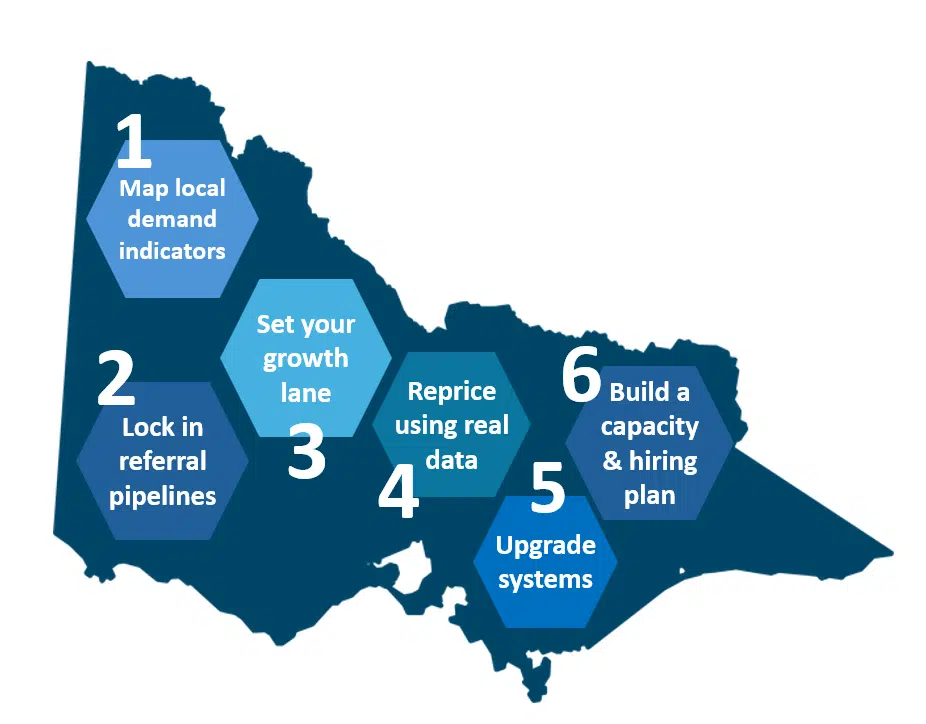
Action plan for trades businesses in regional Victoria
If you want a clear way to translate these insights into a strategy, follow this sequence.
- Map your local demand indicators. Track sales volumes, rental movement, approvals, quote volume by job type, and enquiry origin monthly.
- Choose your growth lane. Pick service lines with the strongest tailwind and margin fit, then stop marketing/quoting outside that lane unless it meets your rules.
- Reprice using real data. Update labour recovery, margin targets, and price by job type. Test first in high-growth pockets.
- Build a capacity plan before hiring. Forecast hours vs capacity and decide hire, subcontract, defer, or drop work.
- Upgrade brand and systems. Fix quoting workflow, follow-up cadence, comms templates, scheduling discipline, and quality control.
- Lock in two to three referral pipelines. Focus on partners aligned to your lane and measure referral margin impact.
Take aways for trades
The five-year house-price surge across regional Victoria isn’t just a property story. It’s a strategic opportunity for established trades and construction businesses who can read the demand signals early. Indigo’s 76.8% jump, Alpine and Mansfield’s 69%+ rise, and growth across Mildura, Shepparton and Horsham point to ongoing inflow, tight rental conditions, and a client base with higher expectations and bigger budgets.
The winners in these markets will not be the businesses who simply get busier. They will be the ones who professionalise, specialise, price confidently, plan capacity, and build referral engines that match where their towns are heading.
After two decades of helping trades businesses scale, we see this moment as a rare alignment of demand and opportunity. The market is giving regional operators permission to lift quality, lift price, and build more valuable businesses. The only question is whether you’ll treat the signal like noise — or like a roadmap.
FAQs
What’s the risk of ignoring these regional housing trends?
Trades businesses risk being trapped in low-margin, reactive work while competitors reposition for higher-spec jobs and better customers as the town evolves.
When should a regional trades business act on these insights?
Now. Housing and migration shifts lead trade demand by months or years, so early positioning gives you pricing and hiring advantages.
Do I need major capital to take advantage of a growth town?
Not usually. The biggest wins come from margin resets, service focus, systems, and smart hiring — not expensive gear or premises.
What systems matter most in a hot regional market?
Quoting discipline, job-level margin tracking, capacity forecasting, and clear client communication rhythms are the core foundations. Tradie business coaching with Tenfold sets a plan for priority systems so you’re clear on what you need to improve when.
How can a Tenfold business coach help a regional Victorian trades business ride this wave?
We build a tailored growth plan around your lane, reset pricing and margins, map capacity, strengthen cash flow, and systemise delivery so you grow profitably beyond the trends.

