


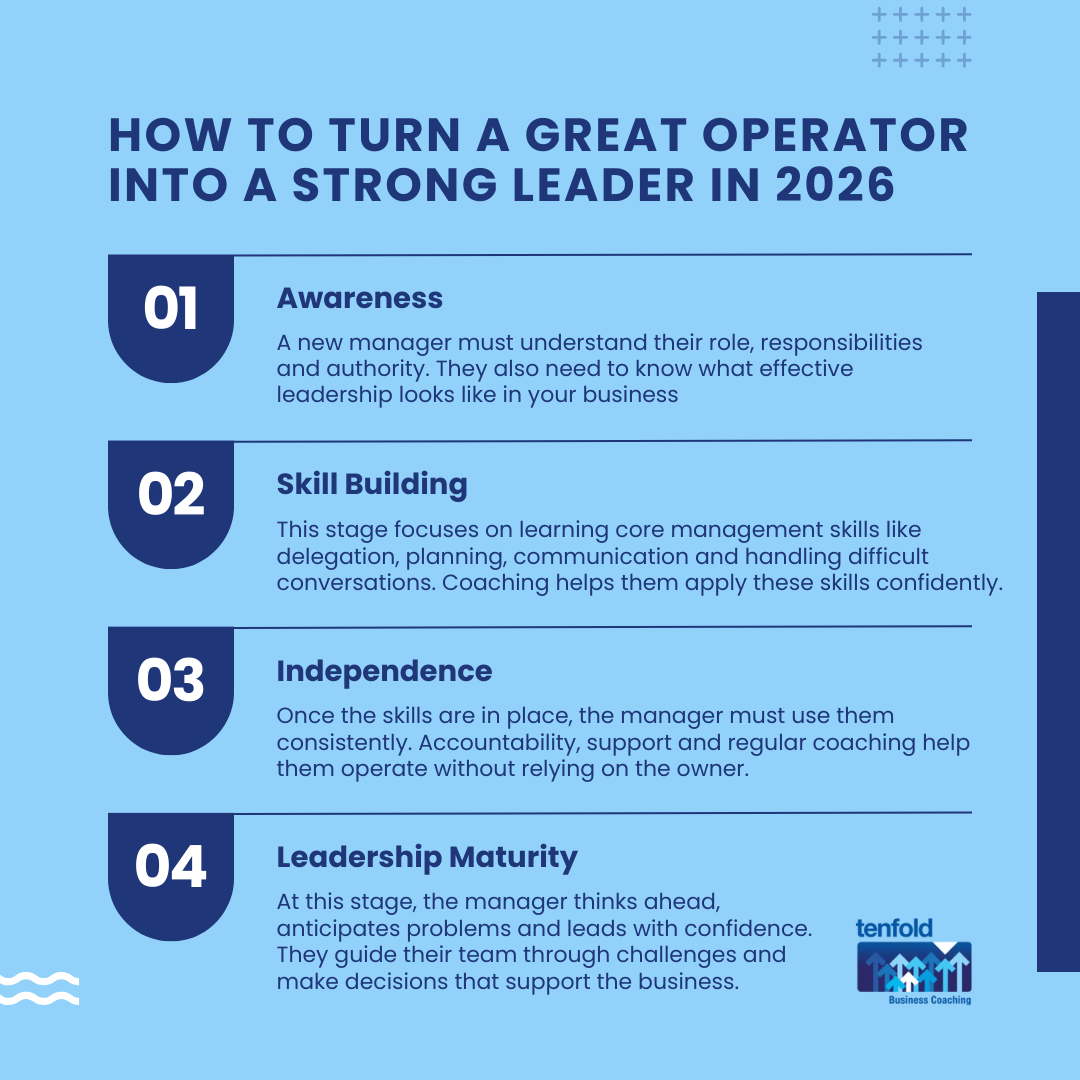
How to Turn a Great Operator Into a Strong Leader in 2026: Real Examples and Practical AI Prompts for Developing Managers
About the Author: Ashley Thomson

When an owner tells me they’ve promoted an operator to manager and it isn’t going smoothly, I’m never surprised. It’s one of the most common challenges I see in established trade, construction and manufacturing businesses. A great operator is reliable, technically strong and trusted by the team. But the moment they step into leadership, the job changes. They’re no longer measured by what they can do with their own hands. They’re measured by how well they get results through others.
That shift is where most new managers struggle. They haven’t been taught how to develop a manager mindset. They haven’t learned leadership skills for supervisors. They haven’t had coaching for new managers that shows them how to delegate, hold people accountable, run a team and make decisions that protect margin.
In 2026, the gap is even more pronounced as the work pace has increased. Clients expect faster responses. Teams expect clarity. Owners expect independence. AI tools are now part of the workflow, so managers need to know how to use them to improve planning, communication, and reporting.
This article is written for owners who want their promoted operator to manager transition to succeed. I’ll share real leadership development examples from the field, explain what a practical manager development plan looks like, and give you AI prompts for leadership development that your managers can use immediately.
Why Promoted Operators Struggle When They Become Managers
When I coach new managers, I often start by explaining that leadership is not an extension of technical skill. It’s a different job entirely. Operators are rewarded for doing. Managers are rewarded for thinking, planning and leading.
In trade and construction businesses, the promoted operator to manager pathway is usually informal. Someone is reliable, respected and good at the work, so they get tapped on the shoulder. But they’re rarely given training in delegation and accountability. They’re rarely taught how to run a meeting, manage conflict, or set expectations, or coached on shifting from being a mate on the tools to a leader who sets standards.
Without support, they default to what they know. They jump in and fix problems themselves. They avoid difficult conversations, take on too much, and become bottlenecks. The owner becomes frustrated because the manager isn’t stepping up.
This is not a capability issue. It’s a development issue. And it’s fixable.
How to Develop a Manager in a Trade or Construction Business
When owners ask me how to develop a manager, I explain that the process is structured. You don’t throw someone into the deep end and hope they swim. You build capability in stages.
Awareness
The first stage is awareness. The new manager needs to understand the role’s requirements in detail. This includes gaining clarity on their responsibilities, the authority they hold, and the expectations placed upon them. Additionally, it is essential for them to recognise what effective leadership looks like in your business, including the traits and behaviours that drive success and positively influence the team.
Skill Building
The second stage is skill building. This is a critical phase where coaching for new managers becomes essential. During this stage, they learn how to delegate tasks effectively, conduct toolbox meetings that truly drive team performance, plan workloads efficiently, manage subcontractors, and communicate clearly with clients. Additionally, they gain the skills to have difficult conversations without damaging relationships, ensuring better management outcomes.
Independence
The third stage is independence. Once individuals have acquired the necessary skills, they must consistently apply them in practice. This is a critical phase where accountability frameworks, ongoing support, and regular coaching sessions play a vital role in ensuring sustained success and confidence.
Leadership Maturity
The fourth stage is leadership maturity. At this stage, individuals begin to think proactively about the future, developing foresight to anticipate challenges before they arise. They take initiative in solving potential problems early on, demonstrating strategic thinking and adaptability. Additionally, they lead their teams with greater confidence, inspiring trust and guiding their team members effectively through complex situations and changing circumstances.
A manager development plan should follow these stages. It should be practical, commercial and aligned with the realities of your industry.
Real Leadership Development Examples from the Field
One of the strongest examples I’ve seen recently was with a commercial electrical contractor. Their leading hand had been promoted to project manager. He was technically brilliant but overwhelmed, still doing takeoffs at night, jumping on the tools during the day, and avoiding conversations with underperforming apprentices.
Through targeted coaching, we worked on delegation and accountability training. He learned how to hand over tasks properly, set expectations clearly, and follow up without micromanaging. Within three months, he reduced his workload by 15 hours per week and improved delivery times.
Another example comes from a fabrication business. Their workshop supervisor was promoted to operations manager. He struggled with planning and communication. Jobs were running late because he wasn’t forecasting capacity. Staff were frustrated because priorities changed daily.
We coached him on leadership skills for supervisors, with a focus on planning rhythms and communication routines. He implemented daily stand-ups, weekly production planning and a simple visual workflow board. Within eight weeks, the workshop was running predictably, and the owner was no longer dragged into daily issues.
These leadership development examples show that the gap is not talent. It’s training.
Using AI Prompts for Leadership Development in 2026
AI is now a practical tool for developing managers. It doesn’t replace coaching, but it accelerates learning. When used correctly, AI helps managers think more clearly, plan more effectively and communicate more confidently.
Here are practical AI prompts for leadership development that your managers can use. These are designed to support coaching, not replace it.
A manager can ask AI to draft a plan for a difficult conversation by using a prompt like:
“Help me prepare for a performance conversation with a technician who is consistently late. I want to be firm, fair and clear about expectations.”
A manager can ask AI to help with delegation by using a prompt like:
“Write a clear handover message for assigning a task to a team member. Include what needs to be done, why it matters, the deadline and how progress should be reported.”
A manager can ask AI to help with planning by using a prompt like:
“Create a weekly workflow plan for a service team with five technicians, factoring in urgent jobs, scheduled maintenance and capacity limits.”
A manager can ask AI to help with accountability by using a prompt like:
“Draft a follow up message for a team member who hasn’t completed a task on time. Keep it professional and focused on next steps.”
A manager can ask AI to help with leadership reflection by using a prompt like:
“Give me three questions I should ask myself at the end of each week to improve as a manager.”
These prompts help managers build confidence and capability faster. They also reduce the owner’s involvement by providing the manager with a tool to support their thinking.
Coaching for New Managers Creates Independence and Reduces Owner Reliance
When a promoted operator advances to a managerial role and receives structured coaching, the owner perceives the positive changes almost immediately. The manager begins to step back from the habit of bringing every problem to the owner and instead takes initiative to analyse situations and develop solutions independently.
With proper guidance, they begin making informed, confident decisions, leading their team effectively and independently. This newfound leadership allows them to focus on protecting margins and driving team performance without constant oversight.
Such a shift in leadership behaviour is fundamental to making a business scalable. When managers embrace their roles and take on their responsibilities, the owner can step back from daily operations. This enables the owner to redirect their attention towards strategic growth, building client relationships, and exploring new opportunities rather than firefighting immediate issues.
Investment in management and leadership coaching thus becomes one of the highest ROI actions an owner can take. It develops critical capabilities where they are needed most, fostering sustainable growth and long-term success.
Next Steps for Owners Who Want Their Managers to Step Up
If you have a great operator who has been promoted to manager and you want them to succeed, now is the time to invest in coaching. The longer you wait, the more entrenched the habits become and the harder the transition becomes.
At Tenfold, we specialise in developing leaders in small business. Our management and leadership coaching is built for trade, construction and manufacturing environments. It’s practical, commercial and focused on results.
If you want to understand how coaching fits into your broader goals, explore our full business coaching services.
If you’re ready to build a manager who leads with confidence and delivers with consistency, let’s talk.
Frequently Asked Questions
Why is it risky to promote an operator to manager without training?
Technical skill alone does not automatically translate into effective leadership ability. Without proper coaching and development, new managers tend to fall back on doing tasks themselves rather than guiding and inspiring their teams, which can lead to bottlenecks, inefficiencies, and people-related issues.
When is the right time to start developing a new manager?
As soon as they step into the role, you should begin providing guidance and support. Early coaching is crucial because it prevents the development of bad habits and ensures that they build strong, proper skills from the outset. This proactive approach helps accelerate their ability to perform effectively and confidently, setting a solid foundation for their future success.
What does coaching for new managers cost?
The return on investment or effort tends to vary depending on the scope and frequency of the activities involved. However, when these factors are properly managed, the benefits become evident through several key improvements. Specifically, there is a noticeable reduction in the reliance of owners on external support or intervention. Additionally, teams become more cohesive and perform more effectively, which in turn contributes to greater overall productivity. Furthermore, these positive changes often lead to improved financial margins, enhancing the profitability and sustainability of the operations.
Do I need systems in place before starting a manager development plan?
Basic systems can provide essential support, but coaching typically encompasses a broader scope, including enhancing workflows, refining communication routines, and establishing robust accountability structures.
How does Tenfold help a promoted operator become a strong leader?
We offer comprehensive, tailored coaching sessions complemented by practical tools and structured development programs designed to build confidence, foster independence, and strengthen commercial discipline, ensuring individuals and organisations are well-equipped to achieve their goals.


