

How to Protect Gross Margin Through Better Estimating Practices
About the Author: Ashley Thomson

For established trade and construction businesses, gross margin remains the vital foundation of financial stability. Builders, electricians, plumbers, concreters, HVAC specialists, solar installers, and civil contractors all depend heavily on precise estimating procedures to ensure that the projects they secure can be completed profitably. Without accurate estimates, these businesses risk significant margin losses and jeopardise their long-term viability.
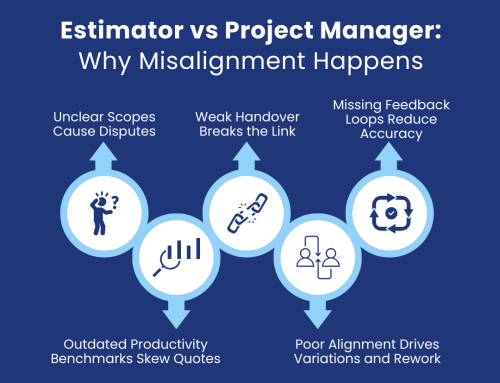
Weak estimating processes represent one of the most significant threats to maintaining healthy profit margins. They can create a misleading sense of security, leading companies to believe their jobs are more profitable than they actually are. A project might appear financially viable on paper, but if the assumptions underpinning the estimate are flawed or overly optimistic, the project manager faces the challenge of delivering the work against unrealistic expectations.
Business coaching services consistently emphasise that margin erosion often begins at the estimating stage – long before a shovel ever hits the ground. Identifying and addressing inaccuracies early can help safeguard margins and support sustainable growth for trade and construction enterprises.
How Inaccurate Labour Productivity Assumptions Drive Hidden Losses
Labour productivity is one of the most crucial variables in any cost estimate. If an estimator assumes that a crew can complete a task within eight hours when, in fact, it takes ten, the resulting hidden loss can accumulate significantly over the course of a project. These inaccuracies are often not immediately apparent until the work is underway, at which point the project manager must absorb the unexpected costs.
Business coaching tailored for tradies shows that even small errors in productivity assumptions can lead to substantial margin slippage. For instance, a plumbing contractor who underestimates labour requirements by just ten per cent across multiple jobs might see their annual profits decrease by hundreds of thousands of dollars. This highlights the importance of accurate labour predictions and careful planning to maintain healthy margins.
The Importance of Identifying Scope Gaps and Project Red Flags
Scope gaps are another common source of margin erosion. Estimators may price their bids based on incomplete drawings or vague client instructions, leaving project managers to deliver outcomes that shift and change midstream. Identifying potential issues early on is crucial to preventing surprises later in the project lifecycle.
Red flags such as unclear site access, client-driven design changes, or reliance on untested subcontractors should be carefully identified during the estimation process. These warning signs can often be missed if not explicitly checked for, leading to costly adjustments later on.
Business coaching services emphasise that every quote should be thoroughly reviewed for potential scope gaps and associated risks before submission. By doing so, companies can either adjust their pricing to incorporate these uncertainties or negotiate clearer scope definitions with the client.
This proactive approach helps protect the profit margins from avoidable erosion. Ensuring clarity and thoroughness in the initial stages of quoting is essential to maintain healthy business margins and deliver successful project outcomes.
The Role of Clear Inclusions and Exclusions in Reducing Disputes
Disputes frequently arise when clients assume certain items are included in the quoted price, while the contractor believes they are excluded. To prevent misunderstandings like this, it is essential to have clear, detailed documentation outlining what is included and excluded from the scope of work.
For example, an electrical contractor might specify that switchboards are included in the price but that cabling beyond a certain distance is not. Such distinctions need to be explicitly stated to avoid confusion or disputes during the project.
Business coaching tailored for tradies emphasises that achieving clarity on inclusions and exclusions is vital. It not only helps to reduce disputes but also strengthens relationships with clients and safeguards gross margin. Without this clear communication, contractors risk absorbing costs that were never factored into the original quote, which can negatively impact the profitability of the project.
How to Price Risk Correctly and Avoid Absorbing Client Errors
Pricing risk correctly is one of the most important disciplines for protecting gross margin in trade and construction businesses. When risks are overlooked or underestimated, contractors end up absorbing costs that should have been anticipated and priced into the job. Common examples include vague scopes, weather delays, site access issues, or client-driven changes. If these risks are not factored into the estimate, project managers are left to deliver against unrealistic budgets, and the business carries the financial burden. Business coaching services emphasise that risk pricing is not about inflating quotes but about ensuring that the business is protected from costs outside its control.
A structured approach to risk pricing involves identifying potential risks, quantifying them with realistic allowances, and documenting assumptions clearly in the estimate. This includes scope clarity, contingency allocations, and transparent inclusion and exclusion criteria. Project managers should provide feedback after each job to refine future estimates, ensuring that productivity benchmarks and risk allowances reflect real-world conditions. Business coaching for tradies often introduces frameworks to review every quote through the lenses of risk, margin, and clarity. When contractors embed this discipline, they build resilience, reduce disputes, and deliver projects profitably even in the face of unforeseen events.
How to Use Subcontractor Quote Comparisons Effectively
Subcontractor quotes are one of the most common areas where margin can slip away if not managed carefully. Many trade and construction businesses fall into the trap of simply accepting the lowest price without analysing the details behind it. This approach often leads to hidden costs, disputes, and variations that erode profitability. Effective comparison requires more than looking at the bottom line. It involves a thorough review of each subcontractor’s scope of work, inclusions, exclusions, and risk allowances. By taking the time to understand what is actually being offered, businesses can avoid costly surprises and ensure that subcontractors are aligned with the project’s requirements.
The discipline of comparing quotes properly is about protecting gross margin and ensuring predictability. A subcontractor who underprices may later submit variations that drive up costs, while one who provides a realistic quote with clear inclusions and exclusions is more likely to deliver reliably. Business coaching services emphasise that contractors should develop a structured process for quote comparison, ensuring that every estimate is tested for scope clarity and risk coverage. When businesses embed this practice, they reduce disputes, strengthen subcontractor relationships, and safeguard profitability across projects
How to Maintain Margin Discipline During Competitive Tendering
Competitive tendering often tempts businesses to reduce their profit margins in order to win work. This short-term mindset can be highly detrimental, as it ties the business to unprofitable contracts. Maintaining margin discipline involves knowing the minimum acceptable margin and steadfastly refusing to go below it, even under intense competitive pressure.
Business coaching services emphasise that prioritising winning work at the expense of margins is not a sign of growth; rather, it leads to erosion of profitability. Contractors who uphold discipline during the tendering process tend to build stronger, more predictable businesses. Such companies are better positioned to invest in future growth instead of constantly patching up issues caused by overly aggressive pricing strategies.
Practical Tools for Margin Protection
A checklist of margin-protection estimating habits should include scope clarity, productivity validation, risk allowances, subcontractor quote comparisons, and documentation of inclusions and exclusions. An example of how small estimating errors can compound downstream is seen in a civil contractor who underestimates labour productivity by 5%. Across a $10 million portfolio, this error translates into $500,000 in lost margin. A framework for reviewing every quote should involve three lenses: risk, margin, and clarity. Risk ensures that contingencies are included, margin confirms profitability, and clarity prevents disputes. Business coaching for tradies often introduces these frameworks to embed discipline into everyday estimating practices.
Conclusion: Protecting Margin Through Better Estimating
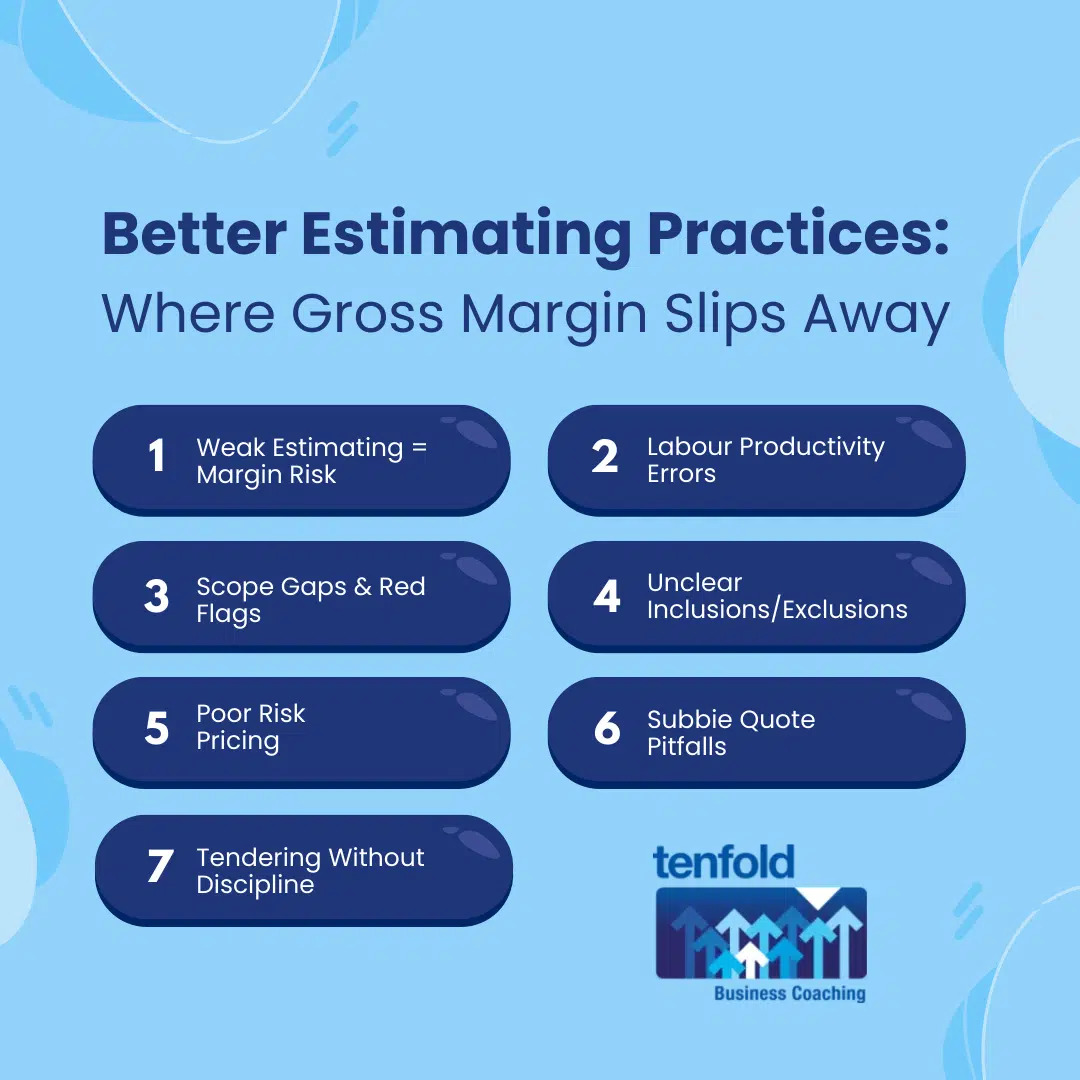
Gross margin protection begins at the estimating stage. Weak estimating practices can significantly undermine profitability, whereas strong estimating techniques help create predictability and resilience within a business. By carefully addressing labour productivity assumptions, scope gaps, inclusions and exclusions, risk pricing, subcontractor comparisons, and tendering discipline, trade and construction firms can better safeguard their margins.
Business coaching services offer valuable tools and frameworks to help businesses embed these essential practices into their daily operations. These resources support sustainable growth by ensuring that profitability is maintained rather than eroded over time.
For builders, electricians, plumbers, concreters, HVAC specialists, solar installers, and civil contractors, developing stronger estimating skills is more than just a technical ability. It is a crucial commercial skill that directly impacts the financial health and longevity of their businesses.
Frequently Asked Questions
Why is estimating accuracy so critical to margin protection?
Estimating accuracy is fundamental to establishing a profitable project. When estimates are inaccurate or overly optimistic, they can lead to budgets that are unattainable. Project managers then struggle to meet these unrealistic budgets, which can result in diminished profit margins and increased project risks.
It is therefore essential to invest time and effort into refining estimation processes. Accurate estimates provide a reliable basis for budget planning and resource allocation, ultimately contributing to the financial success of projects.
How can businesses protect margins under competitive pressure?
Margin discipline is absolutely essential for businesses operating in competitive markets. It is crucial that these businesses have a clear understanding of their minimum acceptable profit margin and are prepared to stand firm to ensure they do not go below this threshold.
What role do inclusions and exclusions play in protecting margins?
Clear inclusions and exclusions are essential in preventing disputes between contractors and clients. They serve to explicitly define what is covered and what is not, thereby reducing misunderstandings.
Ensuring these details are well specified helps prevent contractors from inadvertently absorbing costs that were never included in the project estimate. Including comprehensive and clear inclusions and exclusions in contractual documentation protects all parties involved and promotes transparency throughout the project’s duration.
How should risk be priced in estimates?
Risk should be explicitly incorporated as contingencies, scaled appropriately to the project’s complexity. This approach helps to ensure that potential issues are planned for and managed effectively.
By doing so, it prevents businesses from having to absorb the costs associated with client errors or other unforeseen circumstances that may arise during the project. Properly sizing contingencies is a key component of comprehensive risk management in Australian business practice.
How can business coaching for tradies help improve estimating practices?
Business coaching for tradies offers vital frameworks, comprehensive checklists, and constructive feedback loops that work together to reinforce estimating discipline within a trades business. These tools help tradies establish consistent and reliable practices, which are crucial for maintaining profitability and effective project management.
Coaches play an essential role in helping businesses embed sound practices that protect margins. By doing so, they help tradies develop a more robust financial footing, ensuring greater stability and success in a competitive marketplace.
![Improving cash flow forecasting for renovator builders: A practical guide [Examples]](https://tenfoldcoaching.com.au/wp-content/uploads/2025/12/Improving-cash-flow-forecasting-for-renovator-builders-A-practical-guide-Examples-500x383.png)