


Victoria’s Infrastructure and Procurement 2026: Where Public Work Is Flowing and How Contractors Get Selected
About the Author: Ashley Thomson

This article is part of Tenfold’s Victoria’s Economy 2026 series for owners in construction, trades and manufacturing. Earlier articles explored labour, credit conditions and business risk. This instalment focuses on a topic that shapes demand across the entire sector: government infrastructure spending and procurement. Public works remain one of the most stable sources of activity in Victoria, and understanding where funding flows (and how contractors are selected) helps businesses plan capacity, pricing, and investment with confidence.
As a business coach working with Victorian trades, builders, and manufacturers, I see how government support can stabilise revenue, smooth out seasonal fluctuations, and support long-term growth. However, I also see how confusing procurement processes can be for SMEs. This article breaks down the 2026 landscape in clear, practical terms so you can position your business effectively.
Public Work in Victoria, 2026
Victoria continues to invest heavily in infrastructure, though the profile of spending is shifting. Mega-projects are tapering, but maintenance, upgrades and community-scale works are increasing. This creates opportunities for SMEs, particularly those in civil trades, commercial maintenance, fabrication and specialist services. Procurement processes remain structured and documentation-heavy, but they are also becoming more transparent, with clearer criteria and more emphasis on capability, safety and financial stability.
For owners, the message is reassuring: public work is still flowing, and SMEs with strong systems, clear documentation, and reliable delivery histories are well positioned to win contracts. The key is understanding where the opportunities are and how procurement decisions are made.
Where Public Funding Is Flowing in 2026
Shift from mega-projects to mid-scale and maintenance programs
Victoria is moving away from multi‑billion‑dollar mega-projects toward a more balanced pipeline of road upgrades, rail maintenance, school refurbishments, health-facility improvements, and community infrastructure. This shift benefits SMEs by making work more accessible, less risky, and more evenly distributed across the state.
Increased investment in essential services infrastructure
Hospitals, aged care facilities, emergency services buildings and education upgrades continue to receive strong funding. These projects require a wide range of trades and manufacturing support, from electrical and HVAC to joinery, metal fabrication and civil works. Businesses with strong compliance and safety systems are particularly well-positioned.
Ongoing demand for asset maintenance and lifecycle upgrades
Government agencies are prioritising maintenance to extend the life of existing assets. This creates steady, predictable work for contractors in electrical, plumbing, HVAC, civil maintenance, painting, roofing and general building services. Unlike large construction projects, maintenance work tends to be recurring and relationship-driven.
Regional infrastructure programs supporting local economies
Regional Victoria continues to receive targeted funding for transport upgrades, community facilities and essential services. This creates opportunities for local contractors and manufacturers who can demonstrate capability, reliability and strong safety performance.
How Procurement Decisions Are Made
Capability and past performance carry significant weight
Government buyers want confidence that contractors can deliver safely, on time and to specification. Businesses with strong documentation, clear scopes, reliable scheduling and consistent quality control stand out. Past performance (especially on government or commercial projects) remains one of the strongest selection factors.
Financial stability is increasingly scrutinised
With insolvencies rising across the sector, procurement teams are paying closer attention to financial health. Clear financial reporting, stable cashflow and evidence of strong internal systems help SMEs pass this assessment. Businesses that can demonstrate stability are seen as lower risk.
Safety systems and compliance are non-negotiable
Safety documentation, training records, SWMS, QA processes and compliance frameworks are essential. Government buyers expect structured systems, not ad‑hoc processes. SMEs with well-organised safety documentation and consistent practices are more competitive.
Clear communication and documentation improve selection chances
Procurement teams value clarity. Businesses that submit complete, well-structured tenders with clear scopes, realistic timelines and transparent pricing are more likely to be shortlisted. Strong communication also reduces perceived risk, which is a significant factor in government decision-making.
Why This Environment Favours Well‑Organised SMEs
The shift toward maintenance, upgrades, and mid-scale projects has significantly transformed the landscape for small and medium-sized enterprises (SMEs). This change has created a more level playing field, allowing SMEs to compete more effectively against larger corporations. Traditionally, large companies with extensive resources, vast machinery, and substantial financial backing dominated such projects, often leaving smaller firms at a disadvantage.
However, the new environment presents numerous opportunities for SMEs. The emphasis is now on reliability, thorough documentation, and specific capabilities rather than sheer size or resource volume. Projects that require specialised skills, consistent performance, and adaptability tend to favour smaller, agile businesses that can demonstrate their expertise and commitment.
For SMEs, this means investing in the development of robust systems and streamlined processes becomes crucial. By focusing on quality assurance, efficient project management, and maintaining comprehensive records, these businesses can position themselves as strong contenders in the bidding process. Building partnerships and leveraging niche expertise also enhances their competitiveness.
Overall, the changing project landscape encourages innovation and specialisation among SMEs. Those willing to adapt and focus on their core strengths can find themselves with opportunities to grow and succeed in a market that increasingly values dedication and precise capabilities over sheer size.
Practical Actions for Contractors in 2026
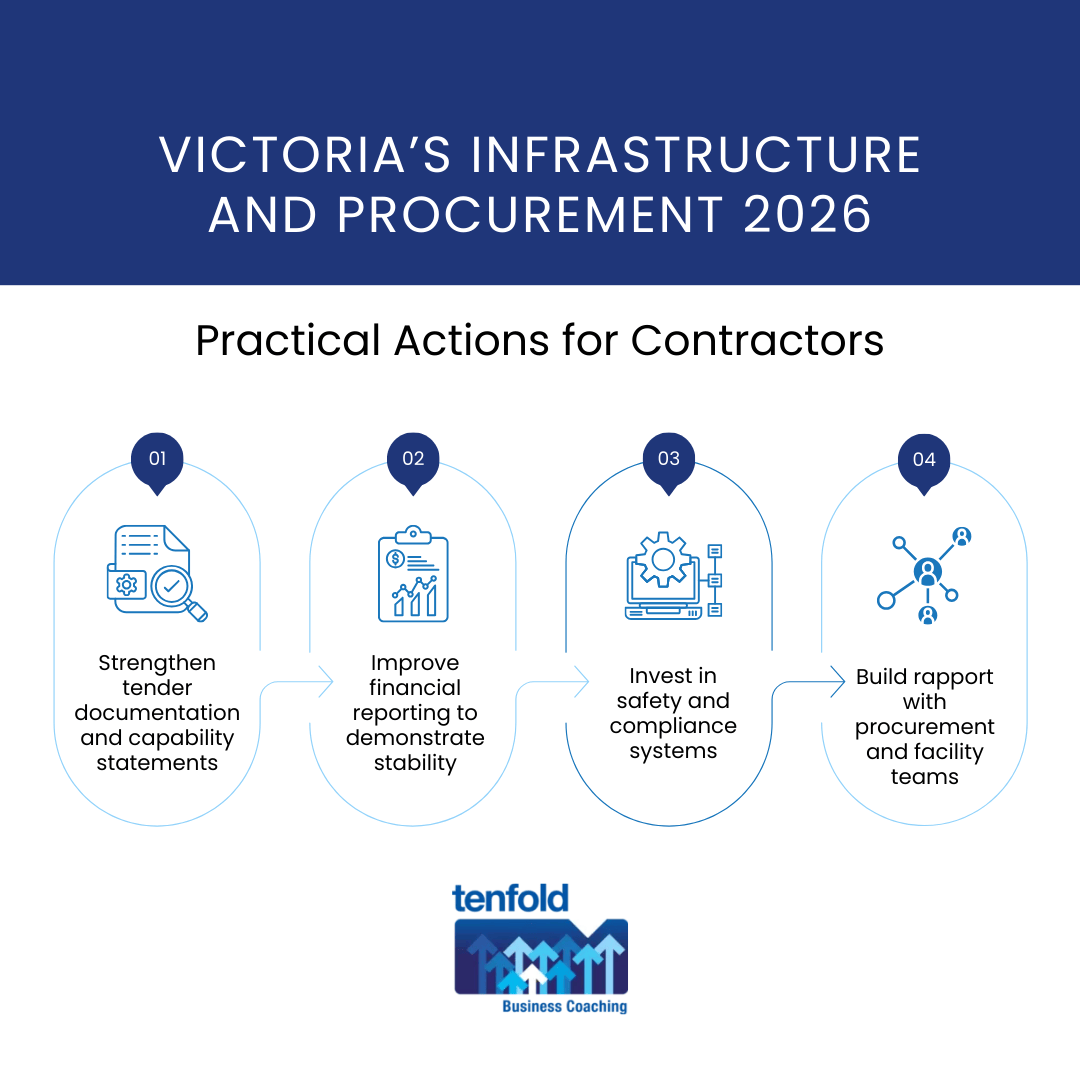
Strengthen tender documentation and capability statements
A clear, well-structured capability statement helps procurement teams quickly understand your strengths. It also positions your business as professional and reliable. Many SMEs underestimate the extent to which this influences selection.
Improve financial reporting to demonstrate stability
Government buyers want to see that you can manage cash flow, handle variations and deliver without financial stress. Up-to-date financials and clear reporting build confidence and reduce perceived risk.
Invest in safety and compliance systems
Strong safety documentation is essential for government work. Businesses with structured systems (rather than ad‑hoc processes) are more competitive and more likely to be selected for recurring contracts.
Build relationships with procurement teams and facility managers
Public work is not purely transactional. When procurement teams know your business, understand your capability and trust your delivery, you become a preferred supplier. Consistent communication and reliable performance build these relationships over time.
Tenfold Insights: What We’re Seeing Across Victoria
Across the businesses we coach, the strongest performers consistently view government work as a long-term strategic endeavour rather than a one-time opportunity. These successful entities understand that building a reputation in this space requires sustained effort and strategic planning. They invest heavily in thorough documentation, ensuring all processes and compliance measures are well-recorded and easily accessible. This not only facilitates smoother project execution but also demonstrates professionalism and readiness to potential clients.
Moreover, these top performers maintain robust financial health, allowing them to weather the often lengthy and competitive bidding processes associated with government contracts. Their financial discipline and transparency foster trust and credibility, which are critical in securing ongoing work.
In addition to these operational strategies, their consistent delivery of quality work enhances their reputation over time. This consistency builds confidence among government agencies and other stakeholders, leading to recurring assignments and a coveted position as preferred suppliers.
We are also observing a notable trend among small and medium-sized enterprises (SMEs). Those with strong internal systems (such as efficient project management, clear communication channels, and disciplined administrative procedures) are increasingly winning tenders. Interestingly, their success is not solely driven by cost competitiveness. Instead, it stems from presenting a lower risk profile, which is highly valued in today’s cautious procurement environment.
Reliability and internal robustness have become key differentiators. In a landscape where risk mitigation is a priority for government agencies, SMEs that demonstrate stable, well-organised internal systems enjoy a competitive edge, positioning themselves as trustworthy partners for long-term government projects.
Public Work Remains a Stable, Strategic Opportunity
Victoria’s infrastructure and procurement environment in 2026 offers steady, accessible opportunities for well-organised SMEs. While mega-projects are tapering, maintenance, upgrades, and community-scale works are increasing. Contractors who invest in documentation, safety, financial stability and clear communication are well-positioned to win work and build long-term relationships with government buyers.
As a business coach working with Victorian trades, builders and manufacturers for over 20 years, I’ve seen how the right systems help SMEs compete confidently in government procurement. If you want support strengthening your tendering, documentation and capability, learn more about how Tenfold’s business coaches work one-on-one with owners through our business coaching services.

