

Succession Planning for Trades and SME Businesses: How to Prepare Your #2 to Run the Day-to-Day
About the Author: Ashley Thomson

When I talk to owners of established trade, construction and manufacturing businesses, one theme comes up again and again. They want to step back from the business without everything falling apart. They want a second-in-command who can run day-to-day operations. They want a leadership bench they can rely on. And they want a succession plan that actually works in a small business environment, not a corporate textbook.
Succession planning for a small business is different. You don’t have layers of management. You don’t have HR departments grooming future leaders. You have a handful of key people, usually promoted from within, who know the work but haven’t been trained to lead. That’s why succession planning for trades business owners needs to be practical, structured and grounded in the realities of field teams, client deadlines and margin pressure.
This article is written for owners who want to develop a second in command, build a leadership pipeline for SMEs and prepare a general manager who can take the reins. I’ll share what works, what fails and what you should expect when you invest in management team development.
Why Succession Planning for Small Business Matters More Than Ever
Most owners don’t begin contemplating succession until they are completely exhausted. By that point, they yearn to step back from the business and enjoy a more balanced life. However, they find it difficult to do so because their operations still heavily depend on them. These owners often find themselves juggling multiple roles: they are the chief problem solver, the primary client relationship manager, the estimator, the HR department, and the operations manager all in one.
In trades and construction industries, this pressure is even more intense. Jobs tend to move quickly, demanding rapid responses. Clients expect immediate answers and constant updates. Staff members require clear direction and supervision. Subcontractors need careful coordination and communication. Without a strong second-in-command or a capable deputy, the owner quickly becomes a bottleneck, hindering growth and efficiency.
Succession planning for trades business owners goes beyond just preparing for retirement. It is about reducing the owner’s reliance on themselves in the present. It aims to create a business model that operates predictably and smoothly, regardless of who is at the helm. Ultimately, it’s about giving oneself the flexibility to grow the business, sell it, or even take a well-earned holiday without the entire operation falling apart or losing momentum.
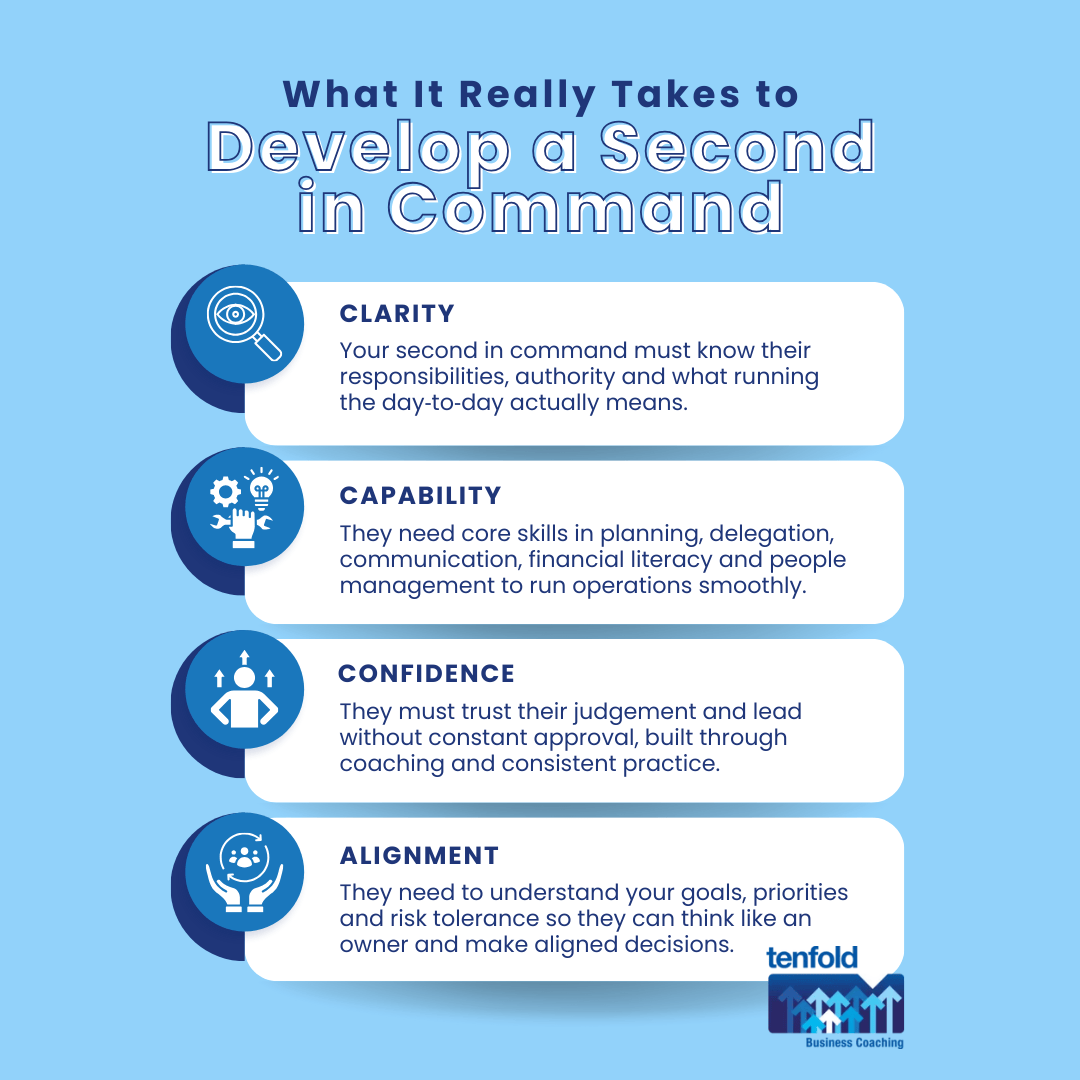
What It Really Takes to Develop a Second in Command
When owners ask me how to develop a second in command, I explain that it’s not simply a promotion. It’s a transformation process. You’re taking someone who has been rewarded primarily for their ability to execute tasks and turning them into someone who is rewarded for leadership, strategic thinking, and empowering others to succeed.
Clarity
The first step is to establish clarity. Your second-in-command must have a precise understanding of what managing the daily operations entails. They need to clearly understand the range of decisions they are authorised to make, the responsibilities they are accountable for, and the standards of performance and conduct they are expected to uphold consistently.
Capability
The second step is capability, which is crucial to ensuring effective operations. This is where the development of operations managers becomes essential to the team’s overall success. Your second-in-command needs comprehensive training in key areas, including strategic planning, delegation, clear communication, financial literacy, and people management. They must learn to run workflows efficiently, manage capacity effectively, handle client issues professionally, and implement safeguards to protect profit margins. Building these capabilities will empower them to lead confidently and contribute significantly to the organisation’s growth and stability.
Confidence
The third step is confidence. It is essential that they develop strong confidence in their judgment and decision-making. They should be able to lead with independence, without constantly seeking your approval or second-guessing themselves. Achieving this level of confidence requires consistent coaching, repeated practice, and a structured accountability system that reinforces their growth and self-reliance.
Alignment
The fourth step is alignment, which is crucial for ensuring that everyone involved is on the same page. Your second-in-command must thoroughly understand your commercial goals, including your objectives and the priorities that drive your business. They should also be aware of your risk tolerance (the level of uncertainty you’re willing to accept) to make informed decisions that align with your overall strategy. Additionally, they need clear expectations for their roles and responsibilities within the organisation. It’s important that they think like an owner, even if they’re not one by title, demonstrating a sense of responsibility, accountability, and a strategic mindset that contributes to the company’s long-term success.
This is the foundation of a strong owner succession plan.
Building a Leadership Bench in a Trade or Construction Business
Most SMEs don’t have a leadership bench. They have one or two people who show potential, but they’re stretched thin. Building a leadership bench means developing multiple people who can step up, not just one.
In a plumbing business I coached, the owner relied heavily on a single operations manager. When that manager took an extended leave, the business struggled. We used that moment to build a leadership pipeline for SMEs within the team. Leading hands were trained in scheduling. Senior techs were trained in client communication. The operations manager was coached to delegate more effectively.
Within six months, the business had three people capable of taking on greater responsibilities. The owner gained resilience, not just relief.
This is what succession planning for a small business looks like when it’s done properly.
Preparing a General Manager Who Can Run the Day-to-Day
Preparing a general manager is one of the most valuable investments an owner can make. However, it requires a structured approach to ensure success. A future GM needs to develop a comprehensive understanding of the commercial engine that drives the business. This includes knowing how jobs are priced, how profit margins are protected, how labor is managed, and how cash flow is controlled.
In addition, the prospective manager must understand the operational rhythms that maintain business stability. It’s crucial for them to learn how to lead and motivate supervisors, not just technicians, to ensure smooth day-to-day operations and long-term growth.
In a fabrication business I worked with, the owner was looking to step back from daily operations. Their production manager was technically strong but lacked the necessary commercial oversight to manage the broader business responsibilities effectively. Through targeted coaching, we focused on developing his financial literacy, planning skills, and leadership presence. Over the course of a year, he grew to the point where he was able to run the daily operations independently. This allowed the owner to shift their focus toward strategic growth initiatives and building partnerships.
This example illustrates that developing a management team intentionally and deliberately can lead to significant positive outcomes for the business.
The Role of Coaching in Succession Planning for Trades Business Owners
Coaching is the accelerator in succession planning. It shortens the learning curve. It builds capability faster. It reduces the risk of promoting someone before they’re ready.
Coaching provides structure. It provides your #2 with a safe place to learn, ask questions, and build confidence. It ensures they develop the skills needed to run the business without relying on you.
This is why owners who invest in management and leadership coaching see stronger results. Their managers step up. Their teams perform better. Their business becomes more predictable.
If you want your #2 to run the day-to-day, coaching is not optional. It’s essential.
How to Step Back from the Business Without Losing Control
Stepping back doesn’t mean stepping away entirely; rather, it signifies a shift in your role within the organisation. Instead of being at the centre of every decision, you transition into a guiding position. You set the overall direction for the business, monitor performance metrics, and support your leaders in their efforts.
A robust succession plan provides confidence that the company will continue to operate smoothly even in your absence. It gives you the freedom to focus on high-level strategies without sacrificing control over the business.
Owners who execute this transition successfully follow a simple, consistent rhythm. They delegate operational decisions to their team, while retaining control over strategic choices. They invest in coaching their second-in-command to ensure they are prepared to take on greater responsibilities. Regular performance reviews keep them informed of progress without micromanaging every detail.
This approach is how you effectively step back from the day-to-day running of the business, ensuring sustainable growth and leadership continuity..
Next Steps for Owners Ready to Build Their #2
If you want to develop a second in command and build a leadership bench, now is the time to start. Succession planning takes time. Capability takes time. Confidence takes time.
At Tenfold, we specialise in preparing managers to run the day-to-day. Our management and leadership coaching is built for trades, construction and manufacturing businesses. It’s practical, commercial and focused on results.
If you want to understand how coaching fits into your broader goals, explore our full business coaching services.
If you’re ready to build a business that runs without relying on you, let’s talk.
Frequently Asked Questions
Why is succession planning so crucial for small businesses?
Without a competent second-in-command, the owner risks becoming the main bottleneck, which can hinder the company’s growth and operational independence.
Having a clear succession plan ensures the business can continue to thrive even if the owner is unavailable or steps down. It provides stability and confidence to employees, stakeholders, and customers, knowing that leadership is prepared for the future. Proper planning also facilitates smoother transitions and helps preserve the business’s value over time.
When is the right time to start preparing a second-in-command?
Many leaders wonder about this crucial step in their succession planning. The key is to begin the process before you actually need to rely on this person. Early development of potential successors ensures a smooth transition and minimises the risk of leadership gaps.
By investing time and resources into developing a second-in-command well in advance, you create a safety net for your organisation. This proactive approach helps prevent any disruptions that might occur if your current leader suddenly steps back or is unavailable. It also provides an opportunity to identify and address weaknesses early, ensuring the individual is fully prepared when it is time to take on greater responsibilities.
What is the cost involved in developing a future general manager?
This question encompasses various factors, including training, mentorship, and experience-building opportunities. The investment required can vary significantly depending on the program or approach chosen.
However, the return on this investment is often well worth the initial expenditure. Organisations typically see a reduction in the owner’s reliance on key individuals, as a well-prepared general manager can assume greater responsibility and leadership. Additionally, these developments lead to stronger performance across the business, with improved operational efficiency and strategic execution. Over time, this contributes to the business’s overall value, making the initial investment in leadership development a strategic and financially sound decision.
Do I need to have systems in place before I start building a leadership bench?
While basic systems can be helpful, effective coaching often involves more than just foundational structures. It includes strengthening workflows, establishing clear communication rhythms, and creating accountability structures that support growth and development.
How does Tenfold help with succession planning for trades business owners?
We offer comprehensive, structured coaching programs designed to develop the skills, confidence, and commercial discipline of your future leaders. Through tailored guidance and practical insights, we help ensure a smooth transition and sustained growth for your business.


