


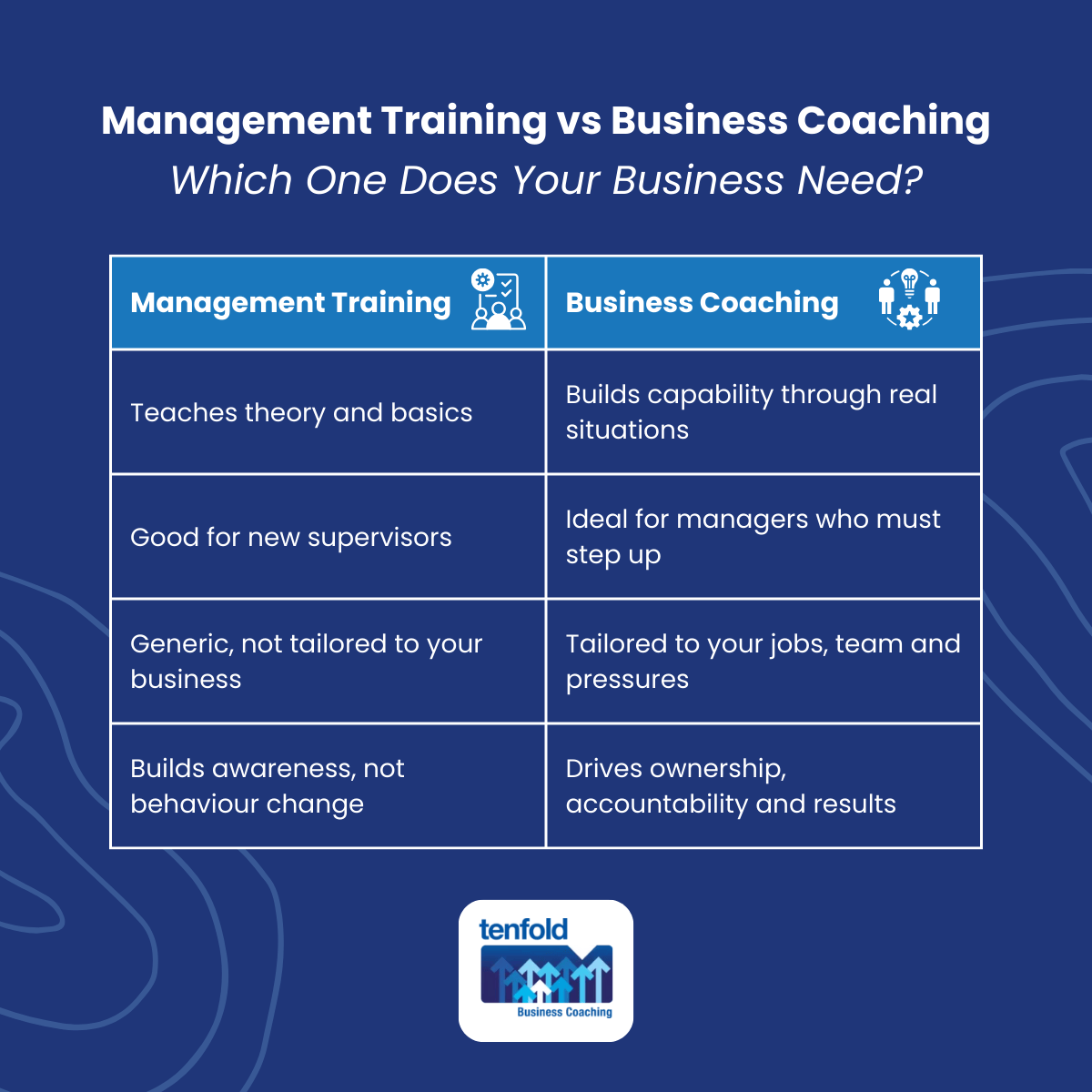
Management Training vs Business Coaching: Which One Does Your Business Need?
About the Author: Ashley Thomson

When an owner tells me they need their operations manager, service manager or project manager to step up, the next question usually follows quickly. Should I put them through management training or invest in business coaching? It is a fair question. Both options sound similar, both promise better performance, and both are common in construction, trades and manufacturing. But they deliver very different outcomes.
In this article, I break down the difference in practical, commercial terms. I work with owners who want fewer people issues, stronger accountability and more reliable execution. If that is what you want from your managers, understanding the difference between management training and business coaching will help you make the right investment.
What Management Training Actually Delivers
Management training is structured learning. It is usually delivered in a classroom or online format and follows a set curriculum. It is designed to teach management skills, such as communication, delegation, time management, and basic leadership principles. It is useful when someone is new to supervising others or has never been shown the fundamentals.
In the trades and manufacturing sectors, management training can help a promising leading hand or technician understand the basics of running a team. They learn the theory of leadership, the steps of a performance conversation and the general expectations of a manager. It is a management development program that builds foundational knowledge.
The limitation is that training is generic. It is not tailored to your business model, margins, scheduling pressures, or client expectations. It does not address the real-world complexity of managing a team of electricians spread across multiple sites, or a fabrication workshop constantly juggling urgent jobs. Training teaches the what, but not the how, in your specific environment.
Where Management Training Falls Short for Established Businesses
Owners of established businesses often come to me after trying training first. They send their manager to a course, the manager enjoys it, comes back with a workbook and then nothing changes. The same issues continue. Jobs still run over time. Staff still push back. Clients still complain about communication. The owner still feels like they are the only ones who can hold the line.
This is not because the manager is unwilling. It is because training alone does not shift behaviour. It does not build commercial judgment. It does not teach a manager how to make decisions that protect margin, maintain workflow or manage risk. It does not give them the confidence to lead people who may be older, more experienced or more resistant to change.
Training is information. Coaching is transformation.
What Business Coaching Provides That Training Cannot
Business coaching is practical, applied and specific to your business. When I coach a manager, I work with them on real situations. We look at upcoming jobs, current staff issues, client expectations and operational bottlenecks. We build capability in the context of your business, not in a classroom.
Management coaching helps a manager understand the commercial impact of their decisions. They learn how to plan work properly, communicate expectations clearly, manage performance, and run their part of the business as an owner would. They develop the confidence to lead, not just the knowledge of what leadership should look like.
This is why coaching vs training for managers is such an important distinction. Coaching builds judgement. Training builds awareness. Coaching changes behaviour. Training increases knowledge. Coaching supports implementation. Training provides theory.
For owners who want their managers to step up, business coaching is usually the missing piece.
Leadership Training vs Coaching in Real Operational Environments
In construction, trades and manufacturing, the gap between theory and practice is wide. A project manager can learn about communication in a training session, but that does not prepare them for telling a client that a job is delayed. A service manager can learn about delegation, but that does not help them manage a technician who refuses to follow the process. An operations manager can learn about planning, but that does not help them prioritise when three jobs are urgent, and two clients are unhappy.
Leadership training for managers gives them the language. Business coaching gives them the capability.
I have coached managers who were technically strong but lacked confidence. Others were confident but inconsistent. Others were overwhelmed because they were promoted for their technical skill rather than their leadership ability. Coaching meets them where they are and builds them into the leader your business needs.
When Management Training Is the Right Choice
There are times when management training is appropriate. If you have a new supervisor who has never managed people before, training can give them a foundation. If you want to introduce basic leadership concepts across a group of emerging leaders, training can be a good starting point. If you want to build general awareness of management principles, training works.
But training alone will not lift performance in an established business with real operational pressures. It will not fix recurring issues. It will not create accountability. It will not build commercial decision-making. It will not turn a good technician into a reliable manager.
Training is a starting point. Coaching is the accelerator.
When Business Coaching Is the Right Choice
If you want your manager to take ownership, improve communication, manage staff effectively and run their part of the business without constant oversight, business coaching is the right investment. It is especially effective when the manager already has experience but needs to further develop their capabilities.
Owners often tell me they want their manager to think ahead, anticipate issues, manage risk and protect margin. These are not skills learned in a classroom. They are developed through guided practice, real-world application and ongoing support. That is what management and leadership coaching delivers.
Coaching is also the right choice when the cost of poor management is high. In trades and manufacturing, poor planning, weak communication, or inconsistent leadership can cost thousands per job. Coaching pays for itself quickly because it improves execution.
How I Coach Managers at Tenfold
When I coach a manager, I work with them on the specific outcomes they want to achieve. We focus on the behaviours that matter most. We build capability in a structured, practical way. We work on real jobs, real staff and real decisions. The goal is always the same. To help your manager run their part of the business reliably, consistently and commercially.
Owners often tell me they feel a weight lifted when their manager starts stepping up. They see better planning, clearer communication, fewer surprises and stronger accountability. They see their manager grow into the role. They see the business become more stable and scalable.
That is the difference coaching makes.
If you want to understand how this works in practice, you can read more about our management and leadership coaching here.
Choosing Between Management Training and Business Coaching
The decision comes down to what you want to achieve. If you want awareness, training works. If you want behaviour change, capability and commercial improvement, coaching is the right choice.
Owners who invest in coaching for their managers see improvements in planning, communication, staff performance and job profitability. They get more reliable execution. They get fewer people issues. They get a manager who thinks like an owner.
If you want to explore how business coaching can support your managers, you can learn more here.
The Commercial Impact of Coaching vs Training for Managers
In the sectors we work with, the commercial impact of strong management is significant. A project manager who plans well can protect the margin. A service manager who communicates clearly can reduce callbacks. An operations manager who leads effectively can stabilise workflow and reduce staff turnover.
Training does not deliver these outcomes. Coaching does.
I have seen managers transform their performance through coaching. They become more confident, more consistent and more commercially aware. They make better decisions. They lead more effectively. They take ownership.
This is why business coaching is such a powerful investment for established businesses.
The Long Term Value of Management Coaching
Coaching builds capability that lasts. Managers who are coached develop habits, systems and decision-making frameworks that they carry forward. They become leaders who can grow with the business. They become the people you rely on.
Training may give them a certificate. Coaching gives them competence.
If you want your business to scale, you need managers who can run their own operations without constant oversight. Coaching builds that capability.
Final Thoughts
Owners often ask me which option will give them the best return. My answer is simple. If you want real change, choose coaching. If you want awareness, choose training. If you want your manager to step up, take ownership and lead effectively, coaching is the right investment.
If you are considering coaching for your manager, the next step is a conversation. I can help you assess your manager’s needs and determine whether coaching is the right fit. It is a practical, commercial discussion focused on outcomes.
Frequently Asked Questions
What is the risk of choosing the wrong option?
The risk is that nothing changes. Training without coaching often results in no behavioural shift, leaving the same operational issues to persist and the business to bear the cost.
How do I know if my manager is ready for coaching?
If they have the technical skill, understand the business and want to improve, they are ready. Coaching works best when the manager is already contributing but needs to lift their capability.
What does coaching cost compared to training?
Training is usually cheaper upfront, but coaching delivers a higher return because it improves performance, reduces rework and strengthens accountability across the business.
Do we need systems in place before starting coaching?
You do not need perfect systems. Coaching often helps managers implement and improve systems as part of their development.
How does Tenfold support managers through coaching?
We work directly with your manager on real situations, build capability step by step and align their development with the commercial goals of your business.


