


How to Use Actual vs Estimated Reviews to Improve Future Quoting
About the Author: Ashley Thomson

For established trade and construction businesses in Australia, the difference between estimates and actual deliveries can determine whether the business makes a profit or a loss. Actual vs. Estimated (A vs. E) reviews are a structured way to compare forecasted costs and hours in a quote against the actual figures once the job is finished. This process isn’t about assigning blame or fault. It’s about improving commercial accuracy, tightening margin control, and ensuring future quotes align with delivery realities. A business coach working with trade firms often points out that Actual vs. Estimated reviews are one of the most effective tools for boosting profitability because they reveal hidden leaks in quoting and delivery systems.
When a builder, electrician, plumber, concreter, HVAC installer, solar contractor, or civil and structural firm consistently underestimates labour hours or material costs, the impact compounds across multiple jobs. Conversely, if allowances are consistently too generous, quotes may be uncompetitive. A vs E reviews provide the evidence needed to recalibrate assumptions and improve quoting accuracy, thereby strengthening cash flow and margin reliability.
Collecting the Right Data for A vs E Reviews
The foundation of effective A vs E reviews is accurate data collection. Businesses must capture labour hours, material usage, subcontractor invoices, delays, and variations. Labour hours should be tracked against specific tasks, not just total job hours, to test productivity assumptions. Materials should be recorded in detail, including wastage and substitutions. Subcontractor costs must be logged against the scope for which they were engaged, and any delays or variations should be documented with dates, reasons, and financial impact. Without this level of detail, reviews risk being anecdotal rather than analytical.
Business coaching services often emphasise the importance of systemising data capture. Whether through job management software, site diaries, or structured spreadsheets, the key is consistency. A business coach will advise that the more disciplined the data collection, the more valuable the insights from A vs E reviews will be.
Structuring a Monthly or Post-Job Review Rhythm
A vs E reviews should be embedded into the rhythm of the business. For larger projects, a post-job review is essential. For smaller jobs or high-volume trades, a monthly review cycle may be more practical. The review should be scheduled as a formal meeting, not an informal chat, with estimators and project managers present. The agenda should include a comparison of estimated versus actual labour, materials, subcontractors, and variations, followed by a discussion of patterns and corrective actions.
Business coaching for tradies often stresses that rhythm is critical. Reviews must be regular and predictable so they become part of the business’s operating system. Sporadic reviews lead to sporadic improvements. A monthly or post-job rhythm ensures that lessons are captured while they are fresh and applied to the next round of quotes.
Identifying Patterns in Under- or Over-Allowances
The real value of A vs E reviews lies in identifying consistent patterns. If labour hours for concreting are consistently underestimated by 15 percent, it signals the need to adjust productivity assumptions. If material allowances for plumbing fittings are consistently overestimated, quotes may be padded unnecessarily. If subcontractor costs for electrical work are regularly higher than estimated, procurement strategies may need to be reviewed. Patterns reveal systemic issues rather than one-off anomalies.
A business coach will guide trade business owners to look beyond the numbers and ask why the patterns exist. Is it a lack of realistic productivity benchmarks? Is it poor communication between estimators and site teams? Is it supplier pricing volatility? Identifying the root cause is essential for turning insights into action.
Collaboration Between Estimators and Project Managers
A vs E reviews are most effective when estimators and project managers review the data together. Estimators bring the perspective of how the job was priced, while project managers bring the reality of how the job was delivered. When these perspectives are combined, businesses gain a holistic view of where assumptions diverge from reality. This collaboration also builds accountability and trust between the office and the site.
Business coaching services often highlight that without collaboration, reviews can become defensive or one-sided. The goal is not to prove who was right or wrong, but to align estimating and delivery so that future quotes are sharper and margins are protected.
Turning Insights into Improved Templates and Assumptions
The ultimate purpose of A vs E reviews is to feed insights back into estimating templates, updated rates, and productivity assumptions. If labour hours for HVAC installations are consistently underestimated, the template should be adjusted to reflect actual productivity. If material wastage in solar installations exceeds the assumed level, the allowance should be increased. If subcontractor rates for civil works are rising, the rate library should be updated. These adjustments ensure that future quotes are based on evidence rather than guesswork.
A business coach working with trade businesses will often help owners build a continuous improvement loop where estimating and delivery inform each other. This loop ensures that every job contributes to sharper quoting and stronger margins.
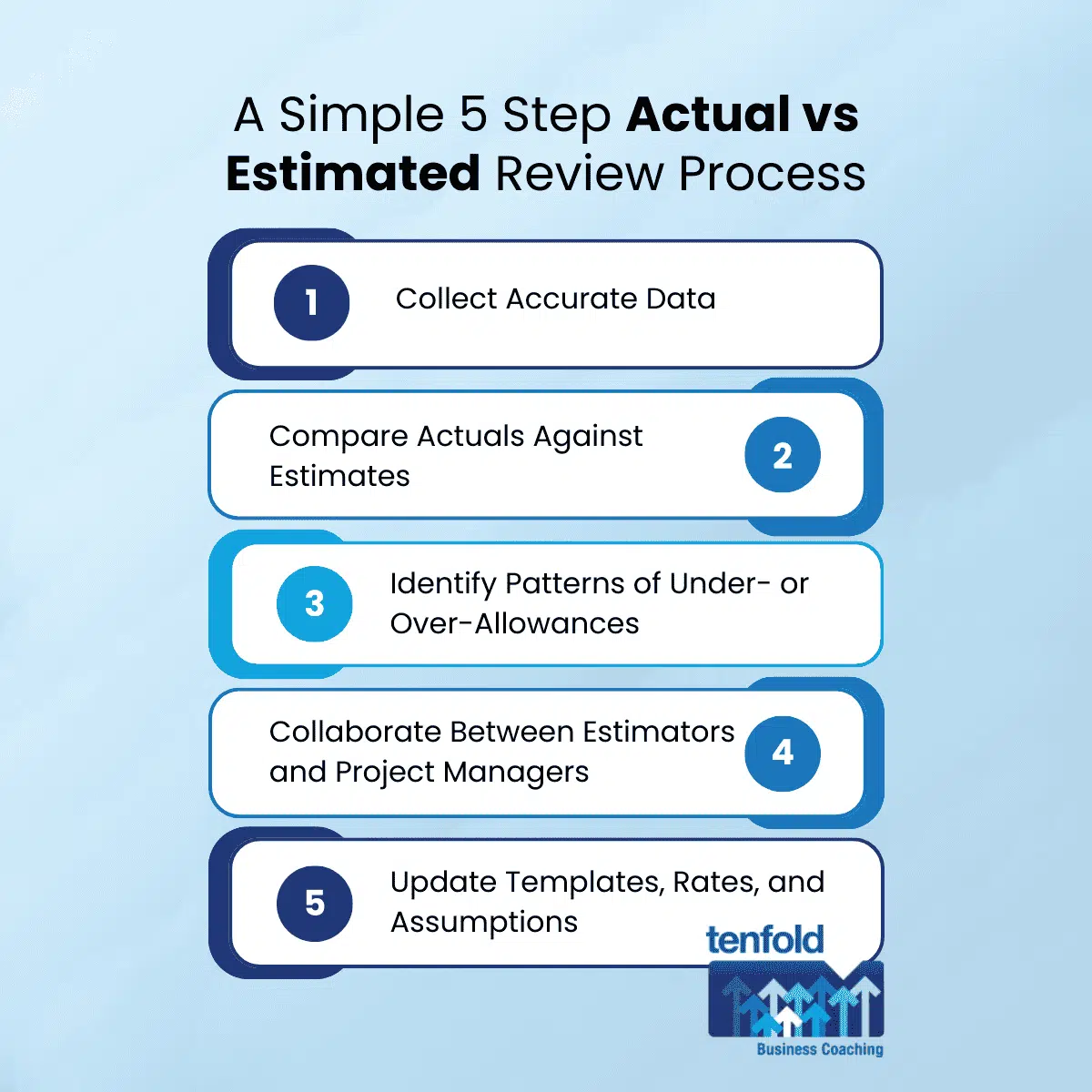
A Simple 5-Step A vs E Review Process
Collect Accurate Data
The process begins with disciplined data capture during each job. Labour hours, material usage, subcontractor costs, delays, and variations must be recorded in detail to provide a reliable foundation for analysis.
Compare Actuals Against Estimates
Once the job is complete, the actual figures are compared with the original estimates. This structured comparison highlights where assumptions were accurate and where gaps occurred.
Identify Patterns of Under- or Over-Allowances
By reviewing multiple jobs, businesses can spot consistent trends. Repeated underestimation of labour or overestimation of materials signals systemic issues that need to be corrected.
Collaborate Between Estimators and Project Managers
Estimators and project managers should review findings together. This collaboration ensures that both pricing assumptions and delivery realities are aligned, building accountability and shared improvement.
Update Templates, Rates, and Assumptions
Insights from reviews must be fed back into estimating templates, rate libraries, and productivity benchmarks. This step closes the loop, ensuring that future quotes are sharper and margins more reliable.
This five-step cycle, repeated regularly, embeds continuous improvement into the business and strengthens both quoting accuracy and margin control.
Example Insights That Lead to Margin Improvement
Consider a concreting business that consistently underestimates labour hours for slab preparation. Through A vs E reviews, the business identifies that site access issues are adding time. By adjusting productivity assumptions and including an allowance for access complexity, future quotes become more accurate and margins are protected. Or take an electrical contractor who consistently overestimates material usage for switchboards. By tightening allowances, quotes become more competitive without eroding margin. These examples show how small adjustments, identified through A vs E reviews, can have a significant commercial impact.
Building Continuous Improvement Loops Between Estimating and Delivery
The most successful trade businesses treat A vs E reviews as part of a continuous improvement loop. Estimating informs delivery, delivery informs estimating, and the cycle repeats. This loop ensures that every job contributes to sharper quoting, stronger margins, and improved productivity. Business coaching for tradies often focuses on building these loops because they create a self-reinforcing system of commercial improvement. Over time, quote accuracy improves, margins stabilise, and competitiveness strengthens.
Quote with Confidence, Deliver with Profi
Actual vs. estimated reviews are among the most powerful tools available to trade and construction businesses in Australia. By systematically comparing estimates against actuals, collecting accurate data, embedding regular review rhythms, identifying patterns, fostering collaboration, and feeding insights back into estimating templates, businesses can dramatically improve quoting accuracy and margin control. This process builds a continuous improvement loop that strengthens both estimating and delivery. For trade business owners who want to tighten margin control and build commercial resilience, engaging with Tenfold Business Coaching provides the expertise and structure to embed A vs E reviews into their operations. Contact Tenfold Business Coaching today to learn how business coaching services can help your business quote with confidence and deliver with profit.
Frequently Asked Questions
How do I start implementing A vs E reviews in my trade business?
Begin by collecting accurate data on labour, materials, subcontractors, delays, and variations during each job. Then schedule regular reviews in which estimators and project managers compare actuals with estimates.
What data is most important for A vs E reviews?
Labour hours, material usage, subcontractor costs, and records of delays or variations are critical. Without these, reviews cannot provide meaningful insights.
What if my records are incomplete or inconsistent?
Start with what you have and build discipline over time. Even partial data can reveal patterns, but the goal should be to improve record-keeping so that reviews become more accurate.
How do I use the findings from A vs E reviews?
Feed insights back into estimating templates, update rates, and adjust productivity assumptions. This ensures that future quotes reflect the realities of delivery.
Can A vs E reviews really improve margins?
Yes. By identifying consistent under- or over-allowances and adjusting quoting assumptions, businesses can protect margins, improve competitiveness, and strengthen cash flow. Over time, the cumulative impact of these improvements is significant.

