
Review of business coaching
From Troy Debono,
Debono Bros Concrete and Construction



Review of business coaching for commercial concreting and construction business
I’m Troy DeBono, director of Debono Bros Concreting and Construction (DBCC). We’re a commercial concreter for tier 2 construction firms in Melbourne.
From the time I started my concreting and construction business we were busy, but not truly in control
We were busy and capable but too much of the business was running on gut feel. The pipeline was pretty full and we were always busy juggling lots of jobs of all sizes. Being so busy meant that I was spread too thin and I didn’t feel like I had control of the all the pieces – I felt like I was always reacting.
When you don’t have the right level of visibility you can get caught out. I remember one time I was on a two-week holiday in Italy with my partner and we thought that everything would run ok while we were away. But it kind of fell over and we ran short of a week’s payroll – not because the business wasn’t good, but because we just didn’t have the visibility. That moment sticks with you. That’s when you realise: you can’t run a serious business on guesswork or gut feel.
I started coaching with Lee and Tenfold Business Coaching in October 2021.
Business coaching showed me that data = control
The biggest shift coaching gave me is vision and control through data. By that I mean practical vision (not fluff motivation speak): pipeline visibility, cash forecasting, margins, and knowing what the numbers are saying before the bank account screams at you.
My Tenfold coach pushed us toward a mindset of: if you can’t measure it, you can’t control it and if you can’t control it then the business controls you. That became a theme and we tightened everything up.
My business coach helped me build a “crystal ball” for pipeline and cashflow
One of the biggest outcomes of coaching was building backend systems that let us track projects and estimating properly so we can see what’s coming up. I call it a “crystal ball.” We can actually see where we’re going to be at on certain dates, instead of hoping it all works out.
With my Tenfold business coach, Lee, we developed a model that gives us a 90-day outlook. Before, we’d invoice and it was basically, “money comes in… hopefully there’s enough left in 60 days when payroll hits.”
Now, we can see ahead of time, and we can make decisions early whether that’s hiring to gear up, or slowing recruitment, tightening spending, pushing pricing, or adjusting workload. My business coach taught me how to stop being reactive and start being deliberate.
Being able to look ahead and know what’s coming takes stress off your shoulders, because you’re not guessing. You’re planning.
Coaching gave us the structure to professionalise estimating and create accountability
Estimating is everything in construction. If you don’t get estimating right, you don’t get profit right and you don’t get cash right.
Before coaching, our in-house estimator was managing himself but he wasn’t being tracked. My business coach pointed out that we had a crucial part of the business running on effort, not measurement. With my coach we started tracking month-on-month. Instead of simply relying on him to be busy we changed to really measuring the outcomes of his work: “What was priced? What was won? What did it convert at? What margin did it deliver?”
We also created minimum activity standards, like 13 or 15 tenders a month (or dollar value equivalents). Coaching taught me to stop treating targets like “nice-to-have goals” and start treating them like operational requirements.
If we don’t hit it, there needs to be a reason (like jobs not being available), not an excuse.
My coach helped me put a process in place; now we have a monthly estimating meeting. Everyone reports on their numbers and everyone is accountable. That structure came out of coaching, the discipline of having a targets and timeframes and not letting things drift.
The real outcome is we now know our win-rate and we know what percentage of jobs we need to price to keep the pipeline full. That’s massive because it turns workload planning into something you can actually manage.
Coaching eliminated uncertainty with a systemised approach to tracking conversion data by verticals
Another thing coaching helped us do was to categorise our projects into what we call verticals. Instead of looking at the revenue as one big blur of jobs, we started tracking conversion rates and margins across different types of work.
That gives you clarity on what to chase and what to be careful about. Coaching helped us take the emotion out of it and replace it with facts.
That’s when it really clicked for me: gut feel and opinions don’t matter as much as data. Data is very powerful.
The systems we got from our coach enable us to track job profit live, not after it’s too late
A practical shift that has made a huge difference is live project reporting. We used to only find out at the end of a project if we made money. Coaching showed me that profit isn’t something you calculate later. Profit is something you manage in real time.
Now, we report on every single project while it’s live. That means if we’re meant to come in at 15% and it’s currently tracking at 3%, we see it while it’s happening.
And once you’ve got that visibility, you can actually do something about it, like avoid scope creep, manage labour allocation, sequencing, variations, and how you handle the job.
Coaching taught us to operate seasonally and position ourselves properly
A big lesson from coaching is that you can’t run the same business model all year round. We now look at the economic cycles like they’re seasons: when to ramp up our resources and be more aggressive with pricing, and when we might take lower-margin work just to keep things moving.
We also put in place a process to track “the pool”, which is the dollar value of potential work not yet awarded. Since we started monitoring the pool, we’ve seen shrink and grow. When we saw it triple, it gave me confidence this year was going to be a big year for tendering projects and meant we didn’t get desperate for work.
Coaching helped us use market visibility as a decision-making tool, not just background noise.
A financial model from our business coach changed how we make decisions: prove it, don’t hope for it
This is a simple but huge change: coaching forced us to stop making decisions on gut feel. The financial model Lee put in place means that we now have a tool that is specific to our business – our material rates, labour, overheads, margins, productivity rate, cost of capital, equipment utilisation – it’s the DBCC financial model, not some off-the-shelf tool or a spreadsheet “borrowed” from another concreter.
Now when we’re considering a decision like buying another pump truck the approach is: show the numbers, show the cost, and make the decision properly. It’s not just “yes, that’ll probably work.” My business coach taught me how to slow down and use the data to test the decision.
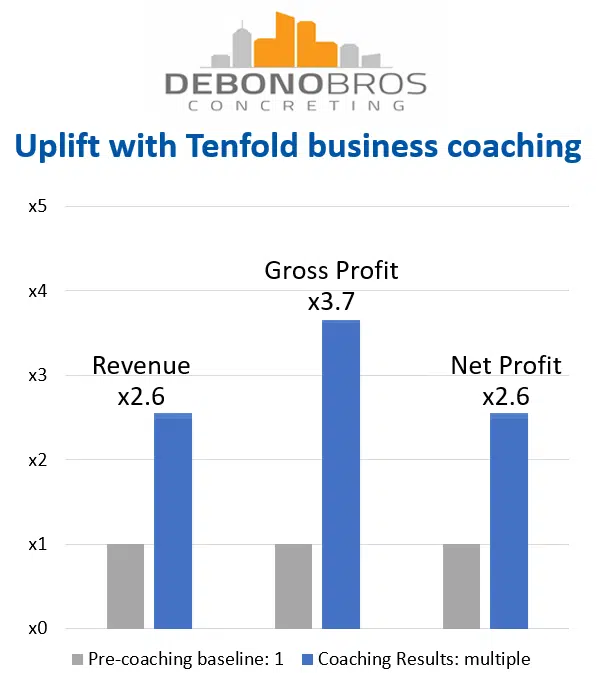
The results of business coaching are tangible and measurable
The results speak for themselves:
- Our revenue is more than double
- Gross profit is up by almost x4
- Net profit is over double times it was before coaching
- We cleared a significant tax debt
Yes, the financial results matter but coaching with Tenfold has done more than that.
As a business owner, business coaching has improved my ability as the leader of a multimillion dollar construction business. With these skills it’s helped me take the business to the next level with the control and foresight I need.
Business coaching with Tenfold takes your business to the next level: growth, confidence, control
- We went from having no real control, to having a system where we can control what’s happening and predict what needs to be priced to keep work flowing.
- I’ve got that “crystal ball” 90-day outlook for cash and pipeline, so we make decisions early instead of reacting late.
- We track jobs live, so profit performance is managed during the project, not discovered after the fact.
- We’ve built a rhythm of reporting and accountability that keeps the business tight and stops the drift that happens when you’re just busy.
If I had to sum it up: coaching with Tenfold helped us move from being a business that worked hard, to being a business that works smart. I have systems that give me visibility, and visibility gives me control to keep growing the business.
